
Introduction
Cold chain logistics is a specialized area of supply chain management that focuses on transporting and storing temperature-sensitive products under controlled conditions. Products such as pharmaceuticals, vaccines, food items, chemicals, and biological materials require proper temperature management to maintain quality and safety. Therefore, effective cold chain management is essential for many industries.
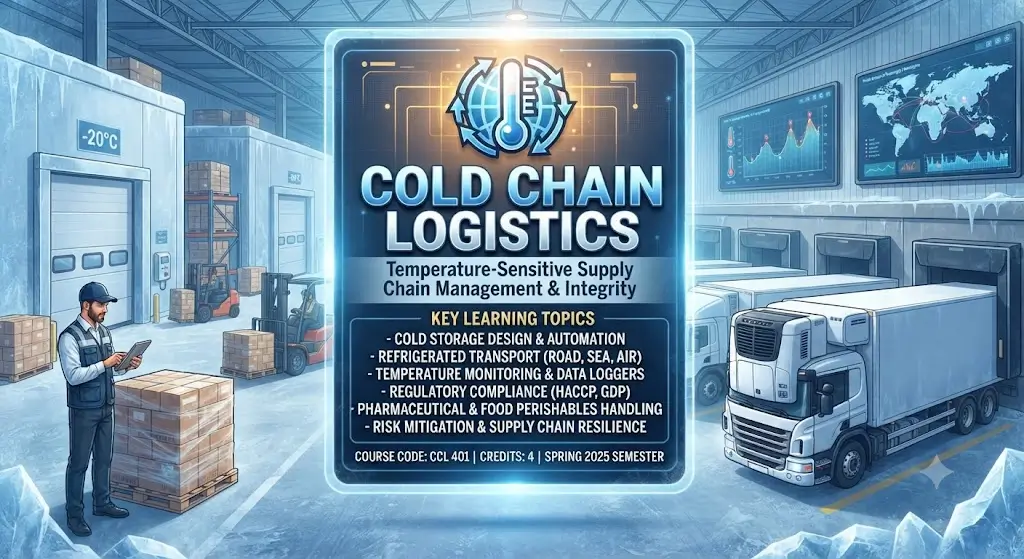
The Cold Chain Logistics Course introduces learners to the concepts, techniques, and best practices used in temperature-controlled supply chains. The course explains how organizations design, manage, and monitor cold chain operations from production facilities to final customers.
Moreover, cold chain logistics requires careful coordination between storage facilities, transportation systems, monitoring technologies, and quality management processes. Any disruption in temperature conditions can affect product quality and create operational challenges.
Throughout this course, learners explore refrigerated transportation, cold storage systems, temperature monitoring, packaging methods, inventory management, risk control, and regulatory requirements. In addition, they understand how digital technologies improve visibility and reliability in cold chain operations.
The course also develops practical skills such as planning, quality management, problem-solving, and operational coordination. These abilities help professionals manage temperature-sensitive supply chains effectively.
By completing this course, learners will gain a strong foundation in cold chain logistics and understand how efficient temperature-controlled operations support global supply chain success.
Course Overview
The Cold Chain Logistics Course provides comprehensive training on temperature-controlled transportation, cold storage management, supply chain monitoring, quality control, and logistics optimization. Furthermore, the course explains how organizations maintain product integrity throughout the supply chain.
Fundamentals of Cold Chain Logistics
The course begins with the basics of cold chain management, including temperature-sensitive products, supply chain requirements, logistics challenges, and the importance of controlled environments.
Temperature-Controlled Transportation
Learners explore refrigerated vehicles, transportation planning, temperature maintenance, shipment handling, and methods for ensuring product safety during transit.
Cold Storage Management
This section explains cold storage facilities, warehouse operations, refrigeration systems, storage conditions, inventory handling, and efficiency improvement.
Temperature Monitoring Systems
Learners understand monitoring devices, sensors, tracking technologies, data collection, and maintaining accurate temperature records.
Packaging and Product Protection
The course covers packaging solutions, insulation methods, cooling materials, product handling, and strategies for maintaining temperature stability.
Cold Chain Quality Management
Learners explore quality standards, compliance requirements, documentation, inspections, and maintaining product reliability.
Inventory Management in Cold Chains
This section explains stock management, expiry control, inventory tracking, demand planning, and reducing product losses.
Cold Chain Risk Management
Learners understand operational risks, temperature failures, contingency planning, and strategies for preventing supply chain disruptions.
Technology in Cold Chain Logistics
The course introduces IoT sensors, digital monitoring systems, automation tools, data analytics, and smart logistics solutions.
Future Trends in Cold Chain Management
Finally, learners explore artificial intelligence, predictive monitoring, sustainable refrigeration, automation, and future developments in cold chain logistics.
Overall, this course combines specialized logistics knowledge with quality management practices. Therefore, learners develop the skills required to manage efficient and reliable cold chain operations.
What You Will Learn
The Cold Chain Logistics Course equips learners with practical knowledge and skills required to manage temperature-controlled supply chains.
Understand Cold Chain Concepts
Learners will understand cold chain principles, temperature-sensitive products, logistics requirements, and supply chain challenges.
Manage Temperature-Controlled Transportation
Participants will learn refrigerated transportation methods, shipment planning, temperature control, and transit management.
Improve Cold Storage Operations
Learners will explore storage systems, refrigeration processes, inventory handling, and warehouse efficiency.
Apply Temperature Monitoring Practices
The course teaches monitoring techniques, sensor technologies, tracking systems, and temperature data management.
Understand Quality and Safety Standards
Learners will gain knowledge of quality control, compliance practices, documentation, and product protection methods.
Manage Cold Chain Risks
Participants will learn risk identification, preventive measures, contingency planning, and disruption management.
Use Technology Solutions
Learners will explore IoT devices, digital platforms, automation systems, and smart cold chain technologies.
Improve Supply Chain Performance
The course helps learners develop skills in planning, coordination, efficiency improvement, and logistics decision-making.
Skills You Will Gain
After completing the Cold Chain Logistics Course, learners will develop valuable logistics and supply chain management skills.
Cold Chain Management Skills
Develop the ability to manage temperature-controlled logistics operations effectively.
Refrigerated Transportation Skills
Learn transportation planning, temperature maintenance, shipment handling, and delivery coordination.
Cold Storage Management Skills
Understand warehouse operations, storage optimization, inventory handling, and refrigeration requirements.
Quality Control Skills
Gain knowledge of quality monitoring, compliance standards, documentation, and product safety practices.
Risk Management Skills
Learn to identify cold chain risks and implement strategies to prevent operational failures.
Technology Management Skills
Understand digital monitoring systems, IoT solutions, tracking tools, and logistics technologies.
Inventory Management Skills
Develop skills in stock control, expiry management, product tracking, and supply chain coordination.
Problem-Solving Skills
Improve analytical thinking, decision-making, and solutions for cold chain logistics challenges.
Benefits of the Course
The Cold Chain Logistics Course helps learners understand how temperature-sensitive products are stored, transported, and managed throughout the supply chain. Moreover, the course develops practical skills required to maintain product quality, improve logistics efficiency, and reduce operational risks.
Understand Temperature-Controlled Supply Chains
First, learners gain knowledge of cold chain processes and understand how temperature-sensitive products move from suppliers to customers. As a result, they can manage specialized logistics operations more effectively.
Improve Cold Storage Management Skills
Proper storage conditions are essential for product safety. Therefore, this course helps learners understand refrigeration systems, storage practices, inventory handling, and warehouse management techniques.
Enhance Transportation Management Knowledge
Cold transportation requires careful planning and monitoring. Additionally, learners develop knowledge of refrigerated vehicles, shipment handling, temperature control, and delivery coordination.
Maintain Product Quality and Safety
Temperature changes can affect product quality. Furthermore, learners understand monitoring methods, quality standards, documentation practices, and safety procedures for protecting sensitive products.
Develop Risk Management Skills
Cold chain operations involve several risks, including temperature failures and delivery disruptions. Consequently, learners develop strategies for risk identification, prevention, and operational recovery.
Learn Modern Cold Chain Technologies
Technology improves visibility and control in cold logistics. Moreover, learners explore IoT sensors, tracking systems, automation tools, and digital monitoring solutions.
Improve Inventory Management Practices
Effective inventory control reduces product loss and improves efficiency. Therefore, learners understand expiry management, stock monitoring, demand planning, and inventory optimization.
Support Sustainable Logistics Practices
Efficient cold chain operations help reduce waste and improve resource utilization. In addition, learners understand sustainable practices related to energy management and responsible logistics.
Enhance Problem-Solving Abilities
Cold chain management requires quick decision-making during operational challenges. As a result, learners improve analytical thinking and develop solutions for logistics problems.
Expand Career Opportunities
Cold chain expertise is valuable across multiple industries. Therefore, this course helps learners prepare for careers in logistics, healthcare supply chains, food distribution, and specialized transportation.
Who Should Enroll
The Cold Chain Logistics Course is suitable for individuals who want to develop skills in temperature-controlled supply chains, logistics management, and quality-focused operations.
Logistics Professionals
Logistics professionals can improve their understanding of cold transportation, storage management, monitoring systems, and supply chain coordination.
Supply Chain Managers
Supply chain managers can strengthen their knowledge of cold chain planning, risk control, inventory management, and operational improvement.
Healthcare and Pharmaceutical Professionals
Professionals working with medicines, vaccines, and medical products can understand temperature control requirements and specialized logistics processes.
Food Industry Professionals
Food industry professionals can learn how cold chain systems maintain product freshness, safety, and quality during distribution.
Warehouse Managers
Warehouse teams can develop knowledge of cold storage operations, inventory handling, refrigeration management, and quality procedures.
Transportation Professionals
Transportation specialists can improve their skills in refrigerated shipping, delivery planning, and temperature monitoring.
Students and Graduates
Students pursuing logistics, supply chain management, healthcare, food technology, or business fields can gain valuable industry knowledge.
Entrepreneurs and Business Owners
Business owners can understand how efficient cold chain management improves product quality, reduces losses, and supports customer satisfaction.
Career Opportunities
Cold chain logistics is becoming increasingly important due to the growth of healthcare, food, pharmaceuticals, and global supply chains. Therefore, professionals with cold chain management skills can explore various career opportunities.
Potential career roles include:
- Cold Chain Logistics Manager
- Supply Chain Manager
- Logistics Coordinator
- Cold Storage Manager
- Temperature Control Specialist
- Warehouse Manager
- Distribution Manager
- Pharmaceutical Logistics Specialist
- Food Supply Chain Manager
- Transportation Manager
- Quality Control Specialist
- Supply Chain Analyst
- Logistics Operations Executive
- Inventory Manager
- Cold Chain Consultant
Professionals can find opportunities in:
- Pharmaceutical companies
- Healthcare organizations
- Food and beverage industries
- Logistics service providers
- Cold storage companies
- E-commerce businesses
- FMCG organizations
- Biotechnology companies
- Agricultural supply chains
- Global distribution networks
Furthermore, this course provides a strong foundation for advanced learning in supply chain management, logistics operations, quality management, healthcare logistics, and distribution planning.
Certification
Upon successfully completing the Cold Chain Logistics Course, learners will receive a Course Completion Certificate that recognizes their knowledge of temperature-controlled logistics, cold storage management, transportation planning, quality practices, and supply chain operations.
Moreover, the certificate demonstrates your commitment to developing specialized logistics skills. It can strengthen your professional profile and showcase your ability to manage cold chain processes effectively.
Additionally, the certification validates your understanding of temperature monitoring, risk management, inventory control, logistics technology, and quality improvement methods. Consequently, it supports career growth in logistics, supply chain management, healthcare logistics, and food distribution industries.
Conclusion
Cold chain logistics plays a critical role in maintaining the quality and safety of temperature-sensitive products. Industries such as healthcare, pharmaceuticals, food, and biotechnology depend on reliable cold chain systems to deliver products effectively. Therefore, skilled professionals with cold chain management knowledge are highly valuable.
The Cold Chain Logistics Course provides comprehensive knowledge of temperature-controlled transportation, cold storage operations, monitoring technologies, inventory management, quality standards, and risk control strategies. Moreover, learners develop practical skills required to manage efficient cold chain operations.
Throughout the course, participants strengthen their understanding of logistics planning, quality management, problem-solving, and modern technology applications. In addition, they learn how effective cold chain practices improve product safety, reduce waste, and support successful supply chain performance.
Whether your goal is to build a career in logistics, specialize in healthcare or food supply chains, improve operational skills, or understand advanced distribution systems, this course provides the foundation required for success. Ultimately, it prepares learners to manage reliable cold chain networks and contribute to efficient global supply chain operations.
FAQ SECTION
1. What is the Cold Chain Logistics Course?
The Cold Chain Logistics Course teaches learners how to manage temperature-controlled transportation, storage, monitoring systems, and specialized supply chain operations.
2. Who should enroll in this course?
This course is suitable for logistics professionals, supply chain managers, healthcare professionals, food industry specialists, warehouse teams, students, and business owners.
3. Do I need prior logistics experience?
No. The course is suitable for beginners as well as professionals who want to develop knowledge of cold chain operations.
4. What topics are covered in this course?
The course covers cold storage management, refrigerated transportation, temperature monitoring, quality control, risk management, and logistics technology.
5. What skills will I gain after completing this course?
You will develop skills in cold chain management, temperature control, inventory handling, logistics planning, quality management, and supply chain coordination.
6. Why is cold chain logistics important?
Cold chain logistics helps maintain product quality, prevent losses, ensure safety, and support reliable delivery of temperature-sensitive goods.
7. What career opportunities are available after completing this course?
Graduates can pursue careers as Cold Chain Managers, Logistics Coordinators, Supply Chain Managers, Warehouse Managers, and Quality Specialists.
8. Will I receive a certificate after completing this course?
Yes. Learners who successfully complete the course will receive a Course Completion Certificate validating their cold chain logistics knowledge.
9. How does technology improve cold chain logistics?
Technology improves cold chain operations through real-time monitoring, IoT sensors, digital tracking, automation, and data-based decision-making.
10. How can this course benefit my career?
This course strengthens your logistics expertise, improves your professional profile, and prepares you for opportunities in specialized supply chain and logistics industries.



Reviews
There are no reviews yet.