
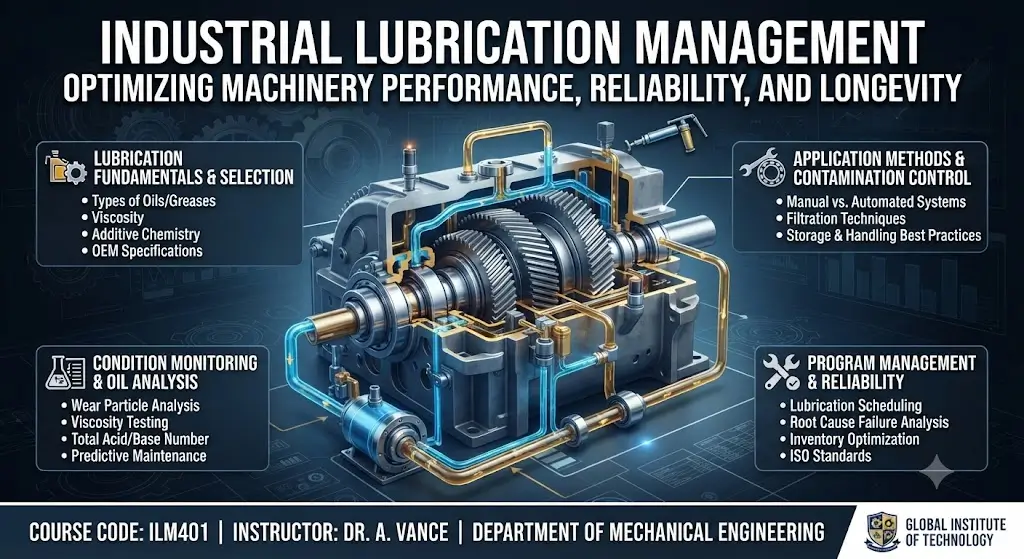
Introduction to Industrial Lubrication Management
The Industrial Lubrication Management Course is a professional training program designed to help learners understand the critical role of lubrication in maintaining industrial equipment and maximizing operational efficiency. Proper lubrication reduces friction, minimizes wear, prevents corrosion, and enhances the performance of machinery across various industries.
Industrial lubrication management involves selecting the correct lubricant, implementing proper application methods, monitoring lubricant condition, preventing contamination, and optimizing maintenance practices. Professionals in this field ensure equipment operates safely, efficiently, and with minimal unplanned downtime.
This course combines tribology, lubrication engineering, maintenance management, reliability engineering, and condition monitoring to provide practical knowledge applicable across manufacturing, mining, power generation, oil and gas, transportation, food processing, and heavy industries.
Why Industrial Lubrication Management Matters
Poor lubrication practices are a leading cause of equipment failure, increased maintenance costs, and reduced productivity. Effective lubrication management improves equipment performance, reduces energy consumption, and extends component life.
Understanding lubrication management enables organizations to improve equipment reliability, reduce operational risks, optimize maintenance schedules, and enhance overall asset performance. These skills are essential for modern maintenance and reliability programs.
The Industrial Lubrication Management Course enables learners to build expertise in lubrication systems, maintenance optimization, and industrial asset reliability.
Course Overview
The Industrial Lubrication Management Course introduces learners to the principles, techniques, and best practices of industrial lubrication.
Participants begin by studying lubrication fundamentals, friction, wear mechanisms, and lubricant properties. The course explores lubricant selection, grease applications, oil analysis, contamination control, and lubrication scheduling.
Learners also study condition monitoring, predictive maintenance, lubricant storage, safety procedures, and lubrication program development.
Practical case studies demonstrate how effective lubrication management improves equipment reliability and operational efficiency.
Topics Covered
Throughout the Industrial Lubrication Management Course, learners will study:
Lubrication Fundamentals
Understand friction, wear, and lubrication principles.
Lubricant Properties
Study the characteristics of industrial oils and greases.
Lubricant Selection
Choose the right lubricant for different equipment and operating conditions.
Lubrication Systems
Learn centralized and manual lubrication methods.
Oil Analysis
Monitor lubricant condition to assess equipment health.
Contamination Control
Prevent moisture, dirt, and particle contamination.
Predictive Maintenance
Use lubrication data to prevent equipment failures.
Lubricant Storage and Handling
Apply best practices for safe storage and dispensing.
Equipment Reliability
Improve machinery performance through effective lubrication.
Lubrication Program Management
Develop and manage structured industrial lubrication programs.
Skills You Will Gain
After completing the Industrial Lubrication Management Course, learners will develop valuable professional skills including:
- Lubrication engineering principles
- Industrial lubricant selection
- Oil analysis interpretation
- Grease application techniques
- Contamination control methods
- Predictive maintenance support
- Lubrication scheduling
- Equipment reliability improvement
- Condition monitoring
- Asset maintenance optimization
- Tribology fundamentals
- Maintenance planning
- Technical problem-solving
- Safety and compliance practices
- Lubrication program management
These competencies are valuable across manufacturing, mining, power plants, oil and gas, cement, steel, automotive, food processing, and heavy industrial sectors.
Benefits of the Course
The Industrial Lubrication Management Course provides practical knowledge for improving machinery reliability and extending equipment life.
Participants gain confidence in selecting lubricants, interpreting oil analysis reports, controlling contamination, and implementing effective lubrication strategies. The course also strengthens analytical thinking, maintenance planning, and operational decision-making.
As industries continue to prioritize reliability and cost-effective maintenance, professionals with lubrication management expertise remain in high demand.
Who Should Enroll?
This course is suitable for:
- Maintenance engineers
- Reliability engineers
- Mechanical engineers
- Plant maintenance technicians
- Industrial supervisors
- Asset management professionals
- Production engineers
- Maintenance planners
- Engineering students
- Technical professionals
Basic engineering or maintenance knowledge is recommended.
Career Opportunities
After completing the Industrial Lubrication Management Course, learners may pursue careers such as:
- Lubrication Engineer
- Maintenance Engineer
- Reliability Engineer
- Plant Maintenance Supervisor
- Asset Reliability Specialist
- Mechanical Maintenance Engineer
- Condition Monitoring Technician
- Predictive Maintenance Engineer
- Industrial Maintenance Consultant
- Production Engineer
- Equipment Reliability Analyst
- Maintenance Planner
- Technical Service Engineer
- Plant Operations Engineer
- Chief Maintenance Engineer (future path)
Certification
Upon successful completion of the Industrial Lubrication Management Course, learners receive a professional certificate recognizing their expertise in lubrication engineering, oil analysis, contamination control, equipment reliability, and maintenance optimization. This certification supports career advancement across manufacturing, maintenance, reliability engineering, and industrial operations.
Frequently Asked Questions (FAQs)
1. What is the Industrial Lubrication Management Course?
It teaches lubrication principles, oil analysis, contamination control, and maintenance strategies for industrial equipment.
2. Who should enroll in this course?
Maintenance engineers, reliability professionals, plant technicians, and engineering students can benefit.
3. Do I need prior experience?
Basic engineering or maintenance knowledge is recommended but not mandatory.
4. What topics are covered?
Lubricant selection, oil analysis, lubrication systems, contamination control, predictive maintenance, and reliability improvement.
5. Is this course practical?
Yes. It includes practical lubrication techniques, maintenance strategies, and real-world industrial case studies.
6. Will I learn oil analysis and condition monitoring?
Yes. Oil analysis, lubricant monitoring, and condition-based maintenance are key components of the course.
7. How does this help my career?
It develops specialized maintenance and reliability skills that are highly valued in industrial operations.
8. Does it include lubrication program management?
Yes. The course covers planning, implementing, and optimizing industrial lubrication programs.
9. Can this improve my job opportunities?
Yes. Lubrication management expertise is in demand across manufacturing, energy, mining, and heavy industries.
10. What industries use industrial lubrication management?
Manufacturing, mining, power generation, oil and gas, cement, steel, automotive, food processing, transportation, and heavy industrial sectors.





Reviews
There are no reviews yet.