
Introduction to Maintenance Reliability Engineering
The Maintenance Reliability Engineering Course is a professional training program designed to help learners understand how maintenance and reliability engineering contribute to the efficient operation of industrial assets and equipment. Reliable machinery is essential for maximizing productivity, ensuring safety, and reducing maintenance costs.
Maintenance reliability engineering combines engineering principles, data analysis, and asset management techniques to prevent equipment failures and improve system performance. Professionals in this field focus on identifying failure causes, implementing proactive maintenance strategies, and extending equipment life cycles.
This course combines reliability engineering, maintenance management, asset performance optimization, and industrial best practices to provide practical knowledge applicable across manufacturing, energy, oil and gas, mining, utilities, transportation, and process industries.
Why Maintenance Reliability Engineering Matters
Equipment failures can lead to costly downtime, production losses, safety risks, and increased maintenance expenses. Effective reliability engineering minimizes these risks through structured maintenance planning and continuous improvement.
Understanding maintenance reliability enables organizations to improve equipment availability, optimize maintenance resources, increase operational efficiency, and extend asset life. These skills are essential for modern industrial operations.
The Maintenance Reliability Engineering Course enables learners to build expertise in asset reliability and maintenance optimization.
Course Overview
The Maintenance Reliability Engineering Course introduces learners to the principles, tools, and methodologies used in modern maintenance management.
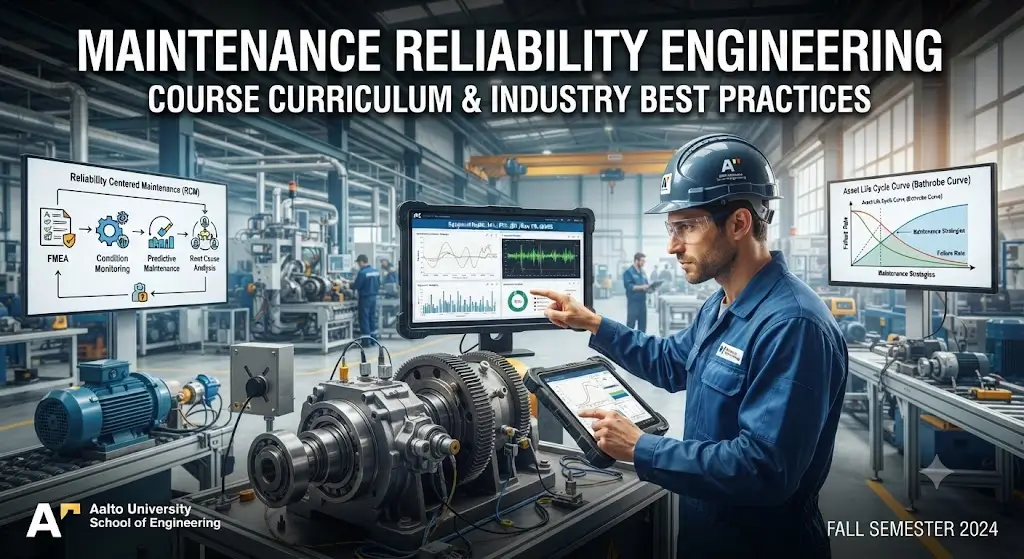
Participants begin by studying maintenance strategies and reliability engineering fundamentals. The course explores preventive, predictive, and reliability-centered maintenance approaches.
Learners also study FMEA, RCA, condition monitoring, maintenance KPIs, risk assessment, and asset lifecycle management.
Practical case studies demonstrate how organizations improve equipment reliability and reduce downtime through data-driven maintenance practices.
Topics Covered
Throughout the Maintenance Reliability Engineering Course, learners will study:
Reliability Engineering Fundamentals
Understand reliability concepts and equipment performance.
Preventive Maintenance
Develop scheduled maintenance programs.
Predictive Maintenance
Use condition monitoring to predict failures.
Reliability-Centered Maintenance (RCM)
Optimize maintenance strategies based on asset criticality.
Failure Modes and Effects Analysis (FMEA)
Identify and evaluate potential equipment failures.
Root Cause Analysis (RCA)
Determine the underlying causes of equipment failures.
Condition Monitoring
Monitor equipment health using performance data.
Maintenance Planning and Scheduling
Organize maintenance activities for maximum efficiency.
Asset Management
Improve lifecycle performance of industrial assets.
Maintenance Performance Metrics
Measure maintenance effectiveness using KPIs.
Skills You Will Gain
After completing the Maintenance Reliability Engineering Course, learners will develop valuable professional skills including:
- Reliability engineering principles
- Preventive maintenance planning
- Predictive maintenance techniques
- Reliability-centered maintenance (RCM)
- Failure modes and effects analysis (FMEA)
- Root cause analysis (RCA)
- Condition monitoring
- Maintenance scheduling
- Asset lifecycle management
- Equipment reliability improvement
- Risk assessment
- Maintenance KPI analysis
- Technical problem-solving
- Continuous improvement methodologies
- Industrial maintenance optimization
These competencies are valuable across manufacturing, power generation, oil and gas, mining, pharmaceuticals, utilities, transportation, and heavy industries.
Benefits of the Course
The Maintenance Reliability Engineering Course provides practical knowledge for improving equipment performance and reducing maintenance costs.
Participants gain confidence in reliability analysis, maintenance planning, failure investigation, and asset optimization. The course also strengthens analytical thinking, engineering decision-making, and operational efficiency.
As industries increasingly focus on maximizing equipment uptime and productivity, professionals with maintenance reliability expertise remain in strong demand.
Who Should Enroll?
This course is suitable for:
- Maintenance engineers
- Reliability engineers
- Mechanical engineers
- Industrial engineers
- Plant managers
- Maintenance supervisors
- Asset management professionals
- Engineering students
- Production managers
- Technical professionals
Basic engineering knowledge is recommended.
Career Opportunities
After completing the Maintenance Reliability Engineering Course, learners may pursue careers such as:
- Reliability Engineer
- Maintenance Engineer
- Asset Reliability Specialist
- Plant Maintenance Manager
- Maintenance Planner
- Reliability Analyst
- Asset Management Engineer
- Mechanical Maintenance Engineer
- Operations Engineer
- Industrial Engineer
- Maintenance Consultant
- Production Engineer
- Continuous Improvement Engineer
- Facilities Engineer
- Chief Reliability Officer (future path)
Certification
Upon successful completion of the Maintenance Reliability Engineering Course, learners receive a professional certificate recognizing their expertise in reliability engineering, preventive and predictive maintenance, failure analysis, asset management, and maintenance optimization. This certification supports career advancement across manufacturing, energy, industrial operations, and maintenance management.
Frequently Asked Questions (FAQs)
1. What is the Maintenance Reliability Engineering Course?
It teaches how to improve equipment reliability and optimize maintenance strategies.
2. Who should enroll in this course?
Maintenance engineers, reliability professionals, plant managers, and engineering students can benefit.
3. Do I need prior experience?
Basic engineering knowledge is recommended, but the course is suitable for beginners and professionals.
4. What topics are covered?
Reliability engineering, preventive maintenance, predictive maintenance, FMEA, RCA, RCM, and asset management.
5. Is this course practical?
Yes. It includes practical maintenance methodologies, case studies, and real-world industrial applications.
6. Will I learn FMEA and RCA?
Yes. Both Failure Modes and Effects Analysis and Root Cause Analysis are key components of the course.
7. How does this help my career?
It develops industry-relevant skills for maintenance, reliability, and asset management roles.
8. Does it include predictive maintenance techniques?
Yes. Condition monitoring and predictive maintenance strategies are covered extensively.
9. Can this improve my job opportunities?
Yes. Reliability engineering professionals are highly sought after across multiple industries.
10. What industries use maintenance reliability engineering?
Manufacturing, oil and gas, energy, mining, pharmaceuticals, utilities, transportation, and heavy industries.





Reviews
There are no reviews yet.