
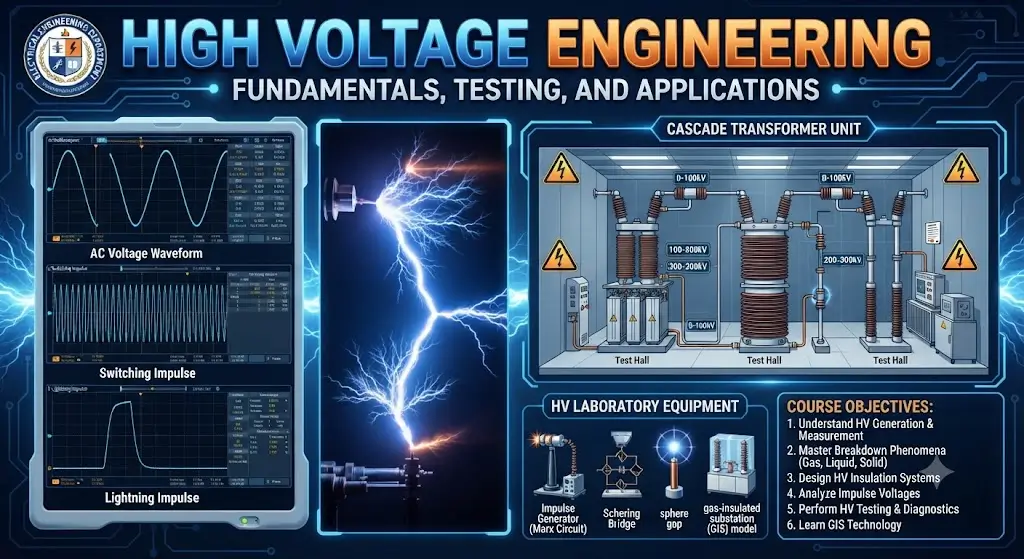
Introduction to High Voltage Engineering
The High Voltage Engineering Course is a comprehensive professional training program designed to equip learners with in-depth knowledge of high voltage power systems, insulation coordination, electrical stress management, testing techniques, and safety practices used in modern electrical power infrastructure. High voltage engineering is a specialized branch of electrical engineering that focuses on the generation, transmission, distribution, and utilization of electrical energy at high voltage levels.
In today’s rapidly expanding energy sector, high voltage systems are essential for transmitting electricity over long distances efficiently and reliably. As power demand increases globally, engineers must design systems capable of handling extremely high voltages while ensuring safety, minimizing losses, and maintaining system stability.
This course provides a structured learning path that combines theoretical foundations, practical applications, and real-world engineering case studies. It prepares learners to work in power generation companies, transmission utilities, substations, electrical manufacturing industries, and research organizations.
Importance of High Voltage Engineering
High voltage engineering plays a critical role in modern electrical infrastructure. Without high voltage transmission systems, it would be impossible to efficiently transfer electricity from power plants to cities, industries, and rural areas.
High voltage systems reduce power losses during transmission by increasing voltage and reducing current. This allows long-distance power transfer with improved efficiency. However, working with high voltage introduces challenges such as insulation breakdown, electrical discharges, corona effects, and safety hazards.
Understanding these phenomena is essential for designing safe and reliable power systems. Engineers must ensure that equipment such as transformers, transmission lines, circuit breakers, and insulators can withstand high electrical stress under varying environmental conditions.
The High Voltage Engineering Course provides learners with the knowledge to address these challenges effectively and design systems that are both efficient and safe.
Objectives of the Course
The main objectives of the High Voltage Engineering Course are:
- To understand the behavior of electrical insulation under high voltage stress
- To study the generation and measurement of high voltages
- To analyze breakdown mechanisms in gases, liquids, and solids
- To design insulation systems for power equipment
- To understand surge phenomena and protection methods
- To study high voltage testing techniques and standards
- To develop knowledge of substation insulation coordination
- To understand lightning and switching surges in power systems
- To learn safety practices in high voltage environments
- To prepare learners for careers in power and energy sectors
High Voltage Fundamentals
High voltage engineering begins with understanding what constitutes high voltage. Typically, electrical systems above 1 kV are considered high voltage, although definitions vary depending on application and industry standards.
At high voltage levels, electrical phenomena behave differently compared to low voltage systems. Air can break down and become conductive, insulation materials may fail, and electrical discharges can occur.
Key concepts include:
- Electric field intensity
- Potential gradient
- Dielectric strength
- Breakdown voltage
- Corona discharge
- Partial discharge
These concepts form the foundation for understanding how high voltage systems behave in real-world conditions.
Electrical Insulation Systems
Insulation is one of the most critical components in high voltage engineering. It prevents unwanted current flow and ensures system safety.
Insulation materials include:
- Solid insulation (paper, polymer, porcelain)
- Liquid insulation (transformer oil)
- Gaseous insulation (air, SF6 gas)
Each type of insulation has unique properties and breakdown characteristics. Engineers must select appropriate insulation based on voltage level, environmental conditions, thermal stress, and mechanical requirements.
Insulation coordination ensures that different parts of the system are protected against voltage surges and electrical stress.
Generation of High Voltages
High voltages are generated using specialized equipment such as:
- Transformer-based systems
- Marx generators
- Cockcroft-Walton circuits
- Resonant transformers
These systems are used in laboratories, testing facilities, and industrial applications. Engineers must understand how to generate controlled high voltages for testing insulation and equipment.
Measurement of High Voltages
Accurate measurement of high voltage is essential for system design and testing.
Common methods include:
- Potential dividers
- Electrostatic voltmeters
- Sphere gap method
- Capacitive voltage transformers
Each method has advantages and limitations depending on accuracy, cost, and application.
High Voltage Testing Techniques
Testing is essential to ensure reliability and safety of electrical systems. Common tests include:
- Dielectric strength tests
- Insulation resistance tests
- Partial discharge tests
- Breakdown voltage tests
- Impulse voltage tests
These tests help identify weak insulation and prevent failures in service.
Transmission and Substation Applications
High voltage engineering is widely used in:
- Power transmission lines
- Electrical substations
- Power transformers
- Circuit breakers
- Insulation systems
Engineers must ensure that all components are designed to withstand high voltage stresses over long operational lifetimes.
Safety in High Voltage Engineering
Safety is the most critical aspect of high voltage systems. Due to the extreme energy levels involved, even small mistakes can result in severe accidents.
Safety practices include:
- Proper grounding and earthing
- Insulation coordination
- Safe distance regulations
- Protective equipment usage
- Lockout-tagout systems
Engineers must strictly follow safety standards and operational procedures.
Modern Developments in High Voltage Engineering
Recent advancements include:
- GIS (Gas Insulated Substations)
- HVDC transmission systems
- Smart monitoring systems
- Nanomaterial-based insulation
- AI-based fault detection
These innovations are improving efficiency, reliability, and safety in power systems.
Career Scope
After completing this course, learners can pursue roles such as:
- High Voltage Engineer
- Power System Engineer
- Substation Engineer
- Transmission Engineer
- Electrical Design Engineer
- Testing Engineer
- Research Engineer
- Utility Engineer
- Maintenance Engineer
- Technical Consultant
The demand for high voltage engineers is increasing due to global expansion of power infrastructure and renewable energy integration.
Conclusion
The High Voltage Engineering Course provides a deep understanding of advanced electrical power systems and prepares learners for real-world engineering challenges. It combines theoretical knowledge with practical applications to build strong technical expertise in high voltage systems.
This course is essential for anyone aiming to build a career in electrical power systems, transmission networks, and industrial electrical engineering.
FAQ Section
1. What is High Voltage Engineering?
High voltage engineering is the study of electrical systems operating at high voltages, focusing on insulation, transmission, and safety.
2. Who should take this course?
Electrical engineers, power system engineers, technicians, and engineering students.
3. What topics are covered?
Insulation systems, breakdown mechanisms, surge protection, HV testing, and substations.
4. Is this course practical?
Yes, it includes real-world power system applications and testing concepts.
5. What is the importance of high voltage engineering?
It ensures safe and efficient transmission of electricity over long distances.
6. Will I learn testing methods?
Yes, high voltage testing and insulation testing are included.
7. What industries use this knowledge?
Power generation, transmission utilities, substations, and electrical manufacturing industries.
8. Is this useful for career growth?
Yes, HV engineers are highly demanded in the power sector.




Reviews
There are no reviews yet.