
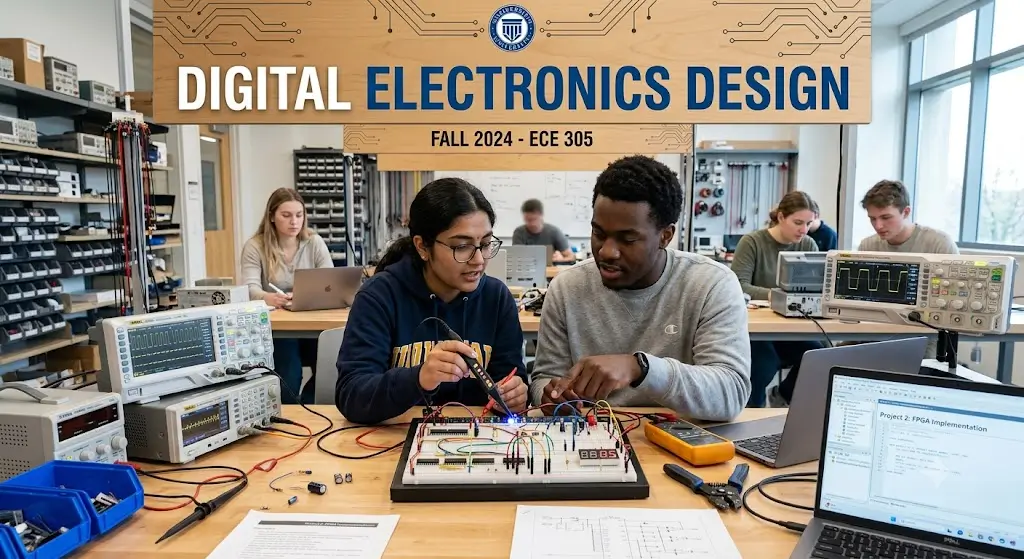
Digital Electronics Design Course: Build Strong Logic Circuit Skills
The Digital Electronics Design Course is a comprehensive, beginner-friendly, and career-focused training program designed to help learners understand how digital systems are designed using logic gates, Boolean algebra, and circuit design techniques. Digital electronics is the foundation of modern computing systems, microprocessors, and digital communication devices.
First, this course introduces learners to number systems and Boolean algebra and explains how digital circuits process binary data. Understanding these fundamentals is essential for anyone pursuing electronics engineering, embedded systems, VLSI design, or computer engineering.
Additionally, the course presents technical concepts in a structured and simple format, making it suitable for beginners as well as professionals seeking to strengthen their digital design knowledge. Whether you are an engineering student, diploma holder, technician, or industry professional, this course provides practical skills that support career growth.
Why Learn Digital Electronics Design?
Digital systems are everywhere in modern technology. Moreover, industries require professionals who can design and analyze digital circuits efficiently.
Learning digital electronics helps you:
- Understand logic circuit design
- Learn Boolean algebra simplification
- Improve problem-solving skills
- Develop circuit analysis ability
- Build foundation for VLSI and microprocessors
- Increase technical confidence
As a result, learners become well-prepared for careers in electronics and digital system industries.
What You Will Learn
Introduction to Digital Systems
First, learners will understand number systems and binary logic.
Logic Gates and Boolean Algebra
Next, learners will study AND, OR, NOT, NAND, NOR XOR gates.
Combinational Circuits
Additionally, learners will explore adders, multiplexers, and encoders.
Sequential Circuits
Moreover, learners will learn flip-flops, counters, and registers.
Karnaugh Maps (K-Maps)
Therefore, learners will study logic simplification techniques.
Memory and Storage Basics
Digital systems store data. Furthermore, learners will explore memory concepts.
Applications of Digital Electronics
Finally, learners will understand use in computers, processors, and embedded systems.
Skills You Will Gain
After completing this course, learners will develop:
- Digital logic design skills
- Boolean algebra understanding
- Circuit analysis ability
- Problem-solving skills
- Sequential circuit design knowledge
- Combinational circuit design skills
- Analytical thinking
- Technical confidence
- Engineering readiness
Who Should Enroll?
This course is suitable for:
- Electronics engineering students
- Electrical engineering students
- Diploma students
- Embedded system beginners
- VLSI aspirants
- Technicians
- Computer engineering students
- Working professionals
- Anyone interested in digital systems
No prior experience is required.
Career Opportunities
Completing this course can support careers such as:
- Electronics Engineer
- Digital Design Engineer
- VLSI Engineer (Beginner level)
- Embedded Systems Engineer
- Hardware Engineer
- Circuit Design Engineer
- Test Engineer
- R&D Engineer
- Technical Support Engineer
- Semiconductor Industry Trainee
Industries Hiring
Professionals with digital electronics skills are valuable in:
- Semiconductor industry
- VLSI design companies
- Embedded systems industry
- IT hardware companies
- Consumer electronics
- Automotive electronics
- Robotics industry
- Telecommunications
- Defense electronics
- Research organizations
Certification Benefits
Upon successful completion, learners receive a certificate validating their digital electronics knowledge.
Benefits include:
- Improved employability
- Strong electronics foundation
- Professional credibility
- Career advancement opportunities
- Industry-ready digital design skills
9. FAQ SECTION
1. What is a Digital Electronics Design Course?
It teaches logic gates, Boolean algebra, and digital circuit design fundamentals.
2. Who should enroll in this course?
Electronics students, engineers, and beginners in digital systems.
3. Do I need prior experience?
No, it is beginner friendly.
4. What skills will I learn?
Logic design, Boolean algebra, and digital circuits.
5. How long is the course?
Typically, 4–8 weeks.
6. Will I get a certificate?
Yes, after completion.
7. Why is digital electronics important?
It is the foundation of computers and modern electronic systems.
8. Which industries hire digital electronics professionals?
Semiconductor, VLSI, embedded systems, and electronics industries.
9. Can this course help my career?
Yes, it supports electronics and hardware careers.
10. Is it suitable for beginners?
Yes, fully designed for beginners.



Reviews
There are no reviews yet.