
Introduction
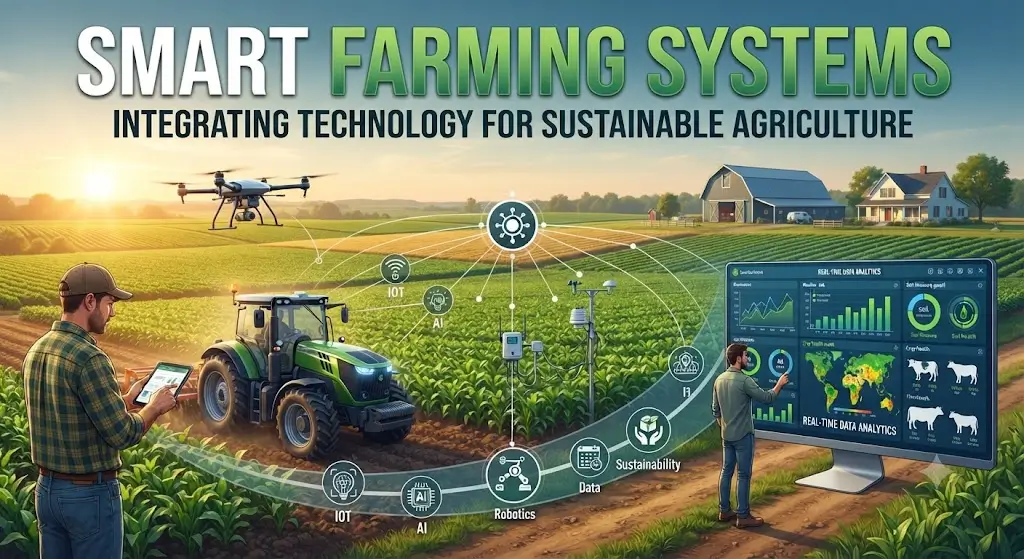
The Smart Farming Systems Course is a comprehensive training program designed to help learners understand how advanced technologies are transforming modern agriculture. As global food demand continues to increase, farmers and agricultural organizations are adopting innovative farming practices that improve productivity while conserving natural resources. Therefore, smart farming has become one of the most important developments in the agricultural sector.
Traditional farming methods alone are no longer sufficient to meet the challenges of climate change, resource scarcity, and increasing production costs. Consequently, technologies such as precision agriculture, Internet of Things (IoT), artificial intelligence, remote sensing, drones, GPS mapping, and automated irrigation systems are becoming essential components of modern farming. These innovations enable farmers to make informed decisions based on real-time data and improve overall farm efficiency.
This course introduces learners to the principles of smart farming systems and demonstrates how digital technologies can optimize crop production, livestock management, irrigation, soil monitoring, and farm operations. Moreover, participants explore practical applications of agricultural technology while gaining an understanding of sustainable farming practices that promote environmental conservation and long-term agricultural success.
Whether you are an aspiring agricultural professional, farmer, agribusiness manager, researcher, agricultural consultant, or student pursuing a career in agriculture, this course provides valuable knowledge and practical skills that support professional growth in the rapidly evolving agricultural industry.
Course Overview
Agriculture is experiencing a technological revolution that is changing the way food is produced across the world. Therefore, understanding smart farming systems has become increasingly valuable for professionals involved in agricultural production, agribusiness management, and sustainable development.
This course provides a comprehensive overview of modern farming technologies, precision agriculture techniques, digital monitoring systems, and farm automation solutions. Additionally, learners examine how data analytics, IoT devices, satellite imagery, sensors, and artificial intelligence contribute to improved farming decisions.
Participants also explore how smart technologies support efficient irrigation management, crop health monitoring, pest control, fertilizer optimization, and weather forecasting. Furthermore, the course emphasizes sustainable farming methods that improve productivity while reducing environmental impact.
By combining theoretical knowledge with practical agricultural applications, the course enables learners to understand how technology can transform traditional farming into intelligent and data-driven agricultural systems.
What You Will Learn
The Smart Farming Systems Course covers a broad range of agricultural technologies and modern farming concepts. First, learners study the fundamentals of smart agriculture and understand how digital transformation is reshaping the farming industry.
Next, participants explore precision agriculture techniques, including GPS-guided machinery, variable-rate technology, and field mapping systems. These tools help farmers apply resources more efficiently while maximizing crop yields.
Furthermore, the course explains the role of Internet of Things (IoT) devices in agriculture. Learners understand how sensors monitor soil moisture, temperature, humidity, crop growth, and livestock health in real time. Consequently, farmers can make faster and more accurate management decisions.
The course also introduces remote sensing technologies, drone applications, satellite imagery, and geographic information systems (GIS). These technologies assist in crop monitoring, disease detection, irrigation planning, and land assessment.
In addition, participants learn about automated irrigation systems, greenhouse automation, climate-smart agriculture, and precision nutrient management. These technologies help reduce water consumption while improving overall agricultural productivity.
Learners also examine agricultural data analytics, decision support systems, machine learning applications, and predictive farming models. These tools enable farmers to identify patterns, forecast production, and minimize operational risks.
Moreover, the course discusses sustainable farming systems, renewable energy integration, carbon-efficient farming practices, and environmentally responsible agricultural management.
Finally, participants explore emerging trends in agricultural innovation, digital farm management platforms, robotics, autonomous farm equipment, blockchain applications in agriculture, and future developments that continue to transform the global agricultural sector.
Skills You Will Gain
Upon successful completion of the course, learners will develop valuable skills, including:
- Smart farming system implementation
- Precision agriculture techniques
- Digital farm management
- Agricultural data analysis
- IoT applications in agriculture
- Drone-based crop monitoring
- GPS farming technology
- Smart irrigation management
- Soil health monitoring
- Climate-smart farming practices
- Farm automation techniques
- Sustainable agriculture planning
- Agricultural technology integration
- Crop monitoring and assessment
- Decision-making using farm data
Moreover, these skills are highly valued across modern farming enterprises, agribusiness companies, agricultural technology firms, research institutions, government agriculture departments, and sustainable farming organizations.
Benefits of the Course
The Smart Farming Systems Course offers numerous benefits for individuals interested in modern agriculture and agricultural technology. First, it provides a strong understanding of digital farming systems and precision agriculture techniques used across the industry.
Additionally, learners develop practical knowledge of smart irrigation, automated farm equipment, crop monitoring technologies, and agricultural data management. These competencies enable professionals to improve farming efficiency and increase productivity.
Furthermore, the course helps participants understand sustainable farming methods that reduce operational costs while conserving natural resources. Because environmental sustainability has become a global priority, organizations increasingly seek professionals who can implement eco-friendly agricultural solutions.
The course also enhances analytical thinking, technological proficiency, and decision-making abilities through the study of real-world farming technologies. As a result, learners become better prepared to contribute to technology-driven agricultural development.
In addition, participants gain insights into current industry trends, digital transformation strategies, and future agricultural innovations. Consequently, they remain competitive in an industry that continues to adopt advanced technologies.
Whether learners plan to work in commercial farming, agribusiness, agricultural consulting, government agencies, research organizations, or AgriTech startups, this course provides knowledge that supports long-term professional success.
Who Should Enroll?
This course is ideal for:
- Farmers adopting modern farming technologies
- Agriculture students
- Agribusiness professionals
- Agricultural consultants
- Farm managers
- Agricultural engineers
- AgriTech professionals
- Agricultural researchers
- Government agriculture officers
- Sustainable farming practitioners
- Agricultural entrepreneurs
- Individuals interested in digital agriculture
No prior experience in smart farming technologies is required. Therefore, beginners can confidently enroll and build a strong foundation in modern agricultural systems.
Career Opportunities
After completing the course, learners may pursue opportunities such as:
- Smart Farming Specialist
- Precision Agriculture Consultant
- Farm Technology Manager
- Agricultural Data Analyst
- Agribusiness Operations Manager
- Agricultural IoT Specialist
- Farm Automation Coordinator
- Sustainable Agriculture Consultant
- Digital Agriculture Advisor
- Agricultural Technology Officer
- Precision Farming Technician
- AgriTech Project Coordinator
- Farm Innovation Specialist
- Agricultural Systems Analyst
- Smart Irrigation Consultant
Additionally, learners can apply their expertise in commercial farms, agribusiness companies, agricultural technology firms, government agriculture departments, research organizations, environmental agencies, food production companies, and international agricultural development programs.
Certification
Upon successful completion of the Smart Farming Systems Course, participants receive a certification recognizing their knowledge of precision agriculture, digital farming technologies, smart irrigation systems, IoT applications, farm automation, sustainable agriculture, and agricultural data management.
This certification demonstrates proficiency in modern farming practices and technology-driven agricultural solutions. Moreover, it enhances professional credibility and supports career advancement across agriculture, agribusiness, AgriTech, environmental sustainability, and farm management sectors.
Why Choose This Course?
The Smart Farming Systems Course is designed to provide learners with a comprehensive understanding of modern agricultural technologies and their practical applications. As the agriculture industry continues to adopt digital solutions, professionals with expertise in smart farming are becoming increasingly valuable. Therefore, this course equips learners with the knowledge and confidence needed to succeed in technology-driven agricultural environments.
Unlike traditional agriculture courses that primarily focus on conventional farming methods, this program introduces learners to advanced concepts such as precision agriculture, farm automation, Internet of Things (IoT), remote sensing, artificial intelligence, drone technology, GPS-guided farming, and agricultural data analytics. Consequently, participants develop a well-rounded understanding of how technology enhances productivity and sustainability.
Moreover, the course emphasizes real-world applications rather than theory alone. Learners explore how modern farms utilize digital tools to monitor crop health, optimize irrigation schedules, improve soil management, reduce operational costs, and increase agricultural efficiency. As a result, participants gain practical insights that can be applied across various farming operations and agribusiness settings.
Another significant advantage of this course is its strong focus on sustainable agriculture. Since environmental conservation and resource management have become global priorities, agricultural professionals must understand how to balance productivity with sustainability. Therefore, learners study climate-smart farming techniques, renewable energy integration, precision resource management, and environmentally responsible farming practices that contribute to long-term agricultural success.
Furthermore, the curriculum has been developed to accommodate learners from diverse educational and professional backgrounds. Whether you are a beginner exploring agricultural technology for the first time or an experienced farming professional seeking to upgrade your skills, the course provides structured learning that is easy to follow while remaining relevant to current industry practices.
Additionally, the course introduces learners to emerging innovations that continue to transform agriculture. Topics such as robotics, autonomous farming equipment, blockchain technology, predictive analytics, digital farm management systems, and machine learning applications prepare participants for future developments within the agricultural sector.
The certification awarded upon successful completion further strengthens professional credibility. Employers increasingly recognize certified professionals who possess expertise in precision agriculture and smart farming technologies. Consequently, completing this course can improve employment prospects and support career advancement across commercial farming, agribusiness, AgriTech companies, government agencies, and research organizations.
Whether your goal is to modernize your farming practices, pursue a career in agricultural technology, enhance operational efficiency, or contribute to sustainable food production, this course provides the technical knowledge, practical understanding, and industry-focused skills necessary for long-term success.
Enroll Today
The future of agriculture is increasingly driven by innovation, automation, and data-driven decision-making. Therefore, developing expertise in smart farming systems is becoming essential for professionals who want to remain competitive in the evolving agricultural industry.
The Smart Farming Systems Course provides a comprehensive learning experience that combines agricultural science with advanced technologies to create practical, efficient, and sustainable farming solutions. Throughout the course, learners gain valuable knowledge of precision agriculture, digital farm management, IoT applications, drone technology, crop monitoring, climate-smart practices, and farm automation systems.
In addition, participants develop practical skills that improve productivity, optimize resource utilization, reduce production costs, and support environmentally responsible farming. These competencies are highly valued by agricultural businesses, technology companies, government organizations, research institutions, and international development agencies.
Whether you aspire to become a smart farming specialist, agricultural consultant, farm manager, precision agriculture expert, AgriTech professional, or sustainable agriculture advisor, this course provides a strong foundation for achieving your professional goals.
Enroll today and build your expertise in Smart Farming Systems to become part of the next generation of agricultural professionals driving innovation, sustainability, and global food security.
FAQ Section
1. What is the Smart Farming Systems Course?
The Smart Farming Systems Course is an online training program that teaches learners how to use advanced agricultural technologies such as precision farming, IoT, drones, GPS, automation, and data analytics to improve farm productivity and sustainability.
2. Is this course suitable for beginners?
Yes. The course is designed for beginners as well as experienced agricultural professionals. No prior knowledge of smart farming technologies is required to enroll.
3. What topics are covered in this course?
The course covers precision agriculture, digital farming systems, IoT in agriculture, smart irrigation, farm automation, drone technology, crop monitoring, soil health management, agricultural data analytics, sustainable farming, and emerging AgriTech innovations.
4. Will I receive a certificate after completing the course?
Yes. Upon successful completion, learners receive a certification recognizing their knowledge of smart farming systems, precision agriculture, and modern agricultural technologies.
5. Who should enroll in this course?
This course is ideal for farmers, agriculture students, agribusiness professionals, farm managers, agricultural consultants, AgriTech professionals, researchers, government agriculture officers, and anyone interested in modern farming technologies.
6. Do I need prior farming experience?
No. The course starts with fundamental concepts and gradually introduces advanced smart farming technologies, making it suitable for learners from all backgrounds.
7. Is the course fully online?
Yes. The course is delivered entirely online, allowing learners to study at their own pace and from any location with internet access.
8. What skills will I gain from this course?
You will develop skills in precision agriculture, digital farm management, IoT applications, crop monitoring, farm automation, agricultural data analysis, smart irrigation, sustainable farming practices, and technology-driven decision-making.
9. Can this course help advance my career?
Yes. The knowledge and certification gained through this course can improve career opportunities in commercial farming, agribusiness, AgriTech companies, agricultural consulting, research institutions, and government agriculture departments.
10. Why is smart farming important?
Smart farming improves agricultural productivity, reduces resource wastage, enhances crop quality, supports sustainable farming, minimizes environmental impact, and helps farmers make informed decisions using real-time data and advanced technologies.




Reviews
There are no reviews yet.