
Introduction
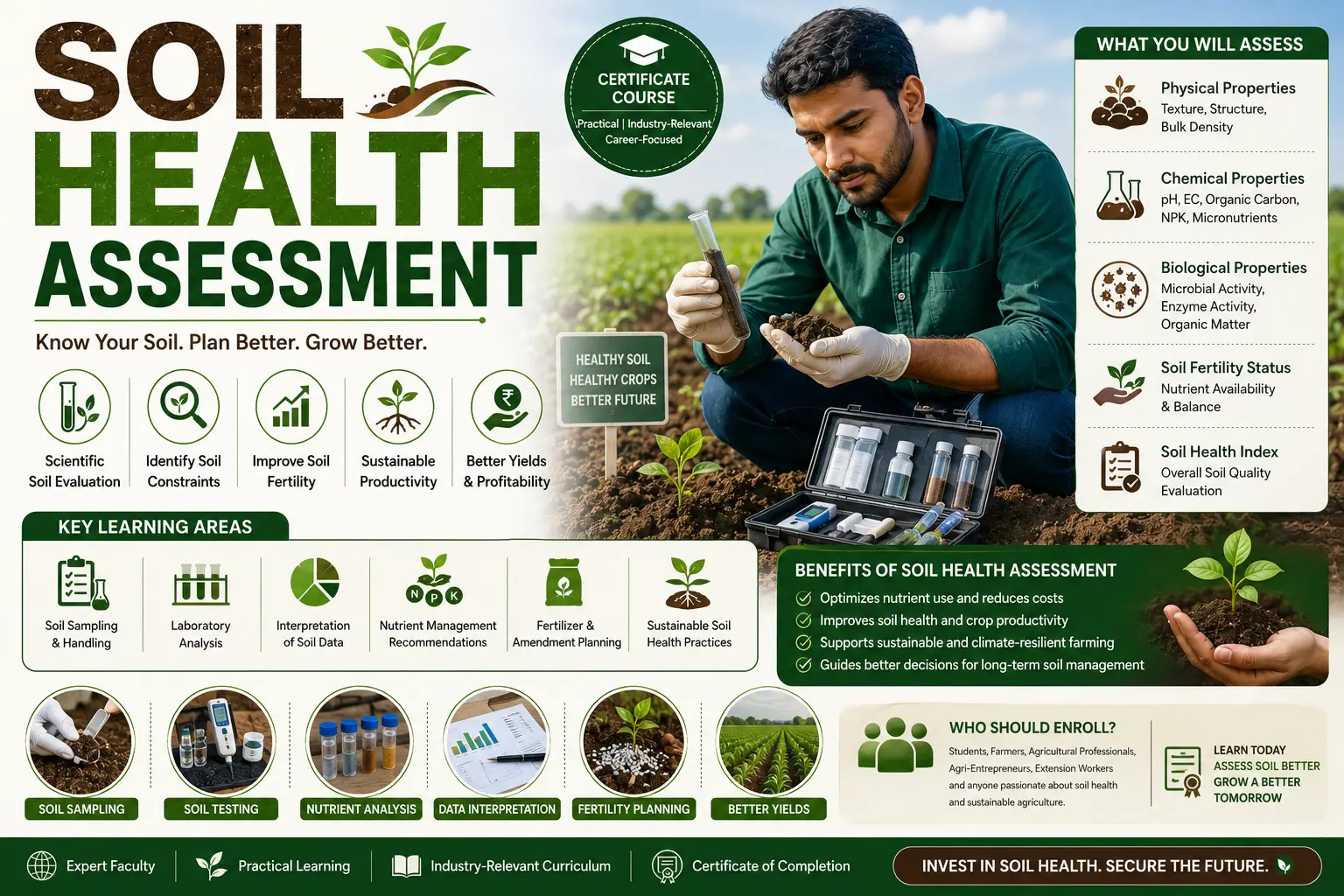
Healthy soil is the foundation of successful agriculture because it supports plant growth, stores water, supplies nutrients, and maintains a balanced ecosystem. The Soil Health Assessment Course introduces learners to the scientific principles and practical techniques required to evaluate soil quality and improve agricultural productivity. As modern farming continues to focus on sustainability and efficient resource management, understanding soil health has become increasingly important for farmers and agricultural professionals.
Soil health assessment involves evaluating the physical, chemical, and biological properties of soil to determine its ability to support healthy crop production. Therefore, proper soil assessment helps farmers make informed decisions about fertilizer application, irrigation planning, crop selection, and land management practices.
Moreover, this course explains how soil testing, nutrient analysis, organic matter evaluation, pH measurement, and biological indicators contribute to sustainable agriculture. Learners also become familiar with soil sampling techniques, laboratory analysis, erosion prevention, and precision agriculture technologies used in modern farming.
In addition, participants develop practical skills in soil monitoring, data interpretation, fertility management, and sustainable land-use planning. These competencies prepare learners for careers in agriculture, soil science, agribusiness, environmental management, research institutions, and government agricultural organizations.
By completing this course, learners establish a strong foundation in soil health assessment while contributing to sustainable farming, environmental conservation, and improved agricultural productivity.
Course Overview
The Soil Health Assessment Course provides comprehensive training in soil evaluation, fertility analysis, nutrient management, and sustainable soil conservation practices. Furthermore, the course explains how healthy soil supports crop productivity, environmental protection, and long-term agricultural sustainability.
Fundamentals of Soil Health
The course begins by introducing the principles of soil health and its importance in agriculture. Learners understand soil formation, soil composition, soil functions, and the relationship between healthy soil and crop productivity. Consequently, they develop a strong foundation in soil science.
Soil Physical Properties
Healthy soil has balanced physical characteristics. Therefore, learners study soil texture, soil structure, porosity, compaction, bulk density, water infiltration, and drainage. These factors influence root development and crop growth.
Soil Chemical Properties
The course explains soil pH, nutrient availability, salinity, cation exchange capacity, organic carbon, and fertility indicators. Moreover, participants understand how chemical properties influence plant nutrition and agricultural productivity.
Soil Biological Health
Living organisms play an important role in soil quality. Accordingly, learners explore soil microorganisms, earthworms, microbial activity, biodiversity, decomposition, nutrient cycling, and biological indicators of soil health.
Soil Testing and Sampling
The course introduces soil sampling procedures, laboratory analysis, field testing methods, interpretation of soil test reports, and quality assessment techniques. Consequently, learners gain practical experience in evaluating soil conditions accurately.
Nutrient Management
Participants study macro and micronutrients, fertilizer recommendations, organic amendments, compost application, integrated nutrient management, and soil fertility improvement strategies. Furthermore, they learn how balanced nutrition improves crop performance.
Soil Conservation Practices
The course explains erosion control, conservation tillage, cover cropping, crop rotation, residue management, and sustainable land management techniques. Therefore, learners become familiar with practices that preserve soil quality.
Precision Soil Assessment
Learners study GIS mapping, remote sensing, soil sensors, digital soil mapping, precision agriculture, and modern technologies that improve soil monitoring and decision-making.
Emerging Trends in Soil Management
Finally, participants examine regenerative agriculture, carbon sequestration, climate-smart farming, artificial intelligence, and digital agriculture innovations that continue to transform soil health assessment.
Overall, this course combines scientific knowledge with practical agricultural applications, enabling learners to understand every aspect of soil health assessment while preparing them for careers in agriculture, environmental management, research, and agribusiness.
What You Will Learn
The Soil Health Assessment Course equips learners with practical knowledge and technical skills required to evaluate soil quality and improve sustainable agricultural production.
Fundamentals of Soil Science
First, learners understand soil formation, soil composition, soil properties, and the importance of soil health in sustainable farming.
Soil Testing Techniques
Participants learn soil sampling methods, laboratory analysis, field testing procedures, and soil report interpretation. Furthermore, they understand how accurate testing supports better farming decisions.
Soil Fertility Management
The course explains nutrient management, fertilizer planning, organic amendments, compost application, and integrated nutrient management practices. Consequently, learners gain practical fertility management skills.
Soil Physical and Chemical Assessment
Learners explore soil texture, soil structure, pH analysis, nutrient availability, salinity, organic matter evaluation, and water-holding capacity. Moreover, they understand how these properties influence crop productivity.
Soil Biological Assessment
The course introduces microbial activity, biodiversity, earthworms, biological indicators, and soil ecosystem health. Therefore, learners become familiar with biological methods used in soil evaluation.
Soil Conservation Practices
Participants study erosion control, cover cropping, crop rotation, conservation tillage, and sustainable land management. In addition, they understand how conservation practices improve long-term soil health.
Precision Agriculture Applications
The course also emphasizes digital soil mapping, GIS technology, remote sensing, soil sensors, artificial intelligence, and precision agriculture tools used in modern soil assessment.
Skills You Will Gain
After completing the Soil Health Assessment Course, learners will develop valuable agricultural, technical, and environmental management skills required for effective soil evaluation and sustainable farming.
Soil Assessment Skills
Develop the ability to evaluate soil quality using scientific testing methods and field observations.
Soil Testing Skills
Learn practical techniques for soil sampling, laboratory testing, report interpretation, and fertility evaluation.
Nutrient Management Skills
Gain expertise in fertilizer planning, nutrient analysis, compost application, and integrated nutrient management.
Soil Conservation Skills
Understand erosion control, conservation tillage, crop rotation, residue management, and sustainable land-use practices.
Precision Agriculture Skills
Develop practical knowledge of GIS mapping, soil sensors, remote sensing, digital soil analysis, and precision farming technologies.
Analytical Skills
Interpret soil test reports, fertility data, nutrient levels, and environmental indicators to support informed agricultural decisions.
Problem-Solving Skills
Analyze soil-related challenges and implement practical solutions that improve soil quality and crop productivity.
Communication Skills
Strengthen professional communication skills required to work with farmers, agricultural organizations, researchers, soil laboratories, and government agencies.
Sustainable Farming Skills
Build expertise in environmentally responsible farming practices that protect soil health while improving agricultural productivity.
Professional Competence
Build the confidence to contribute effectively to agricultural organizations, soil testing laboratories, environmental projects, research institutions, and sustainable farming initiatives.





Reviews
There are no reviews yet.