
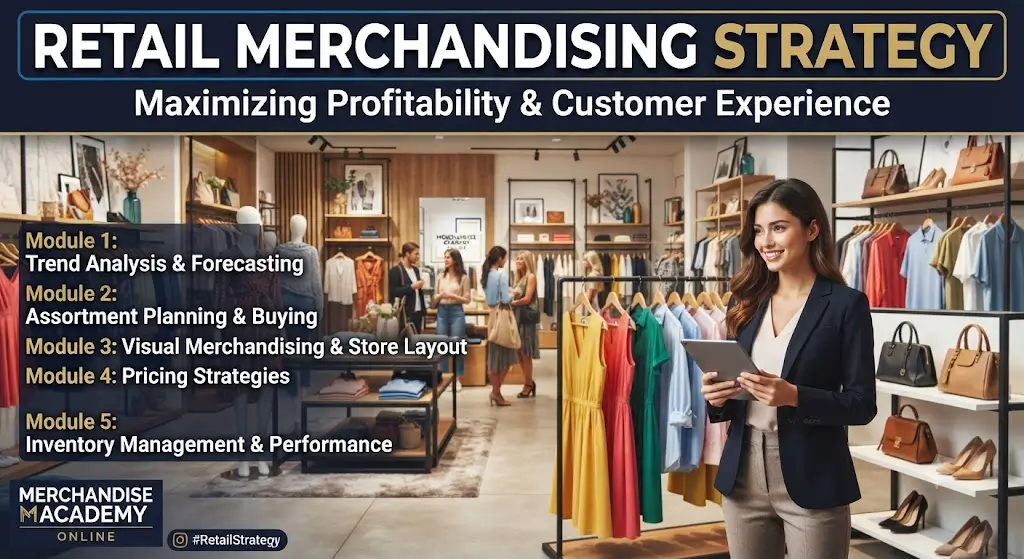
Introduction to Retail Merchandising Strategy
The Retail Merchandising Strategy Course is a comprehensive professional training program designed to prepare learners to plan, manage, and optimize merchandising activities within modern retail businesses. Merchandising strategy combines product planning, visual presentation, pricing, customer insights, and sales analysis to ensure products are displayed and promoted effectively.
Retail merchandisers play a critical role in influencing customer purchasing decisions by creating attractive product assortments, improving store layouts, managing promotional campaigns, and ensuring merchandise availability. Effective merchandising strategies help retailers improve customer experiences while increasing sales and profitability.
This course combines retail management, merchandising, consumer behavior, category planning, inventory coordination, retail marketing, business analytics, and retail technology to provide practical knowledge applicable across supermarkets, department stores, specialty retailers, fashion brands, lifestyle stores, franchise businesses, and e-commerce organizations.
Why Retail Merchandising Strategy Matters
In today’s competitive retail environment, customers expect engaging shopping experiences, attractive product displays, and personalized product offerings. Effective merchandising strategies enable retailers to optimize product presentation, improve inventory turnover, increase customer engagement, and maximize revenue.
Strategic merchandising also strengthens brand positioning, supports promotional activities, improves operational efficiency, and enhances customer satisfaction. Data-driven merchandising decisions help businesses respond to changing market trends and consumer preferences.
The Retail Merchandising Strategy Course enables learners to understand how merchandising contributes to successful retail operations and sustainable business growth.
Course Overview
The Retail Merchandising Strategy Course introduces learners to the principles, tools, and best practices used to create effective merchandising strategies.
Participants begin by studying merchandising fundamentals, consumer buying behavior, and retail trends. The course explores assortment planning, visual merchandising, pricing strategies, category management, inventory coordination, supplier collaboration, promotional planning, and retail analytics.
Learners also study retail technology, CRM systems, financial reporting, leadership, communication, innovation, and strategic retail planning.
Practical case studies demonstrate how successful retailers use merchandising strategies to improve sales performance, customer satisfaction, and brand value.
Topics Covered
Throughout the Retail Merchandising Strategy Course, learners will study:
Retail Merchandising Fundamentals
Understand merchandising principles, product planning, assortment strategies, and retail business objectives.
Consumer Buying Behavior
Learn how customer preferences, shopping habits, and market trends influence merchandising decisions.
Merchandise Planning
Study assortment planning, product lifecycle management, seasonal merchandising, and inventory alignment.
Visual Merchandising
Explore store layout design, product displays, signage, window displays, and customer engagement techniques.
Pricing and Promotional Strategies
Learn pricing models, promotional campaigns, discount strategies, and sales optimization methods.
Category and Inventory Coordination
Study category management, stock planning, replenishment coordination, and merchandise availability.
Supplier and Vendor Management
Understand supplier collaboration, purchasing coordination, vendor negotiations, and product sourcing.
Retail Analytics and Technology
Explore POS systems, merchandising software, retail dashboards, CRM platforms, and business intelligence tools.
Financial Performance Management
Learn sales reporting, profitability analysis, KPI monitoring, budgeting, and merchandising performance evaluation.
Leadership and Strategic Retail Management
Strengthen leadership, communication, teamwork, decision-making, innovation, and strategic planning skills.
Skills You Will Gain
After completing the Retail Merchandising Strategy Course, learners will develop valuable professional skills including:
- Merchandise planning
- Visual merchandising
- Product assortment management
- Category management
- Consumer behavior analysis
- Pricing strategy development
- Promotional planning
- Inventory coordination
- Retail analytics
- CRM and retail technology utilization
- Financial analysis
- Leadership and teamwork
- Communication skills
- Problem-solving
- Strategic retail management
These competencies are valuable across supermarkets, department stores, fashion retailers, specialty retailers, franchise businesses, wholesale companies, consumer goods organizations, and e-commerce platforms.
Benefits of the Course
The Retail Merchandising Strategy Course provides practical knowledge for creating customer-focused merchandising strategies that improve retail performance and profitability.
Participants gain confidence in planning merchandise assortments, designing visual displays, coordinating inventory, analyzing retail performance, managing promotional campaigns, and using merchandising technologies. The course also strengthens leadership, communication, creativity, and analytical thinking.
As retailers continue to compete through customer experience and product presentation, merchandising professionals remain highly valued across the retail industry.
Who Should Enroll?
This course is suitable for:
- Merchandisers
- Retail managers
- Store managers
- Category executives
- Retail buyers
- Sales supervisors
- Retail entrepreneurs
- Marketing professionals
- Retail management students
- Individuals interested in merchandising careers
No previous experience is required.
Career Opportunities
After completing the Retail Merchandising Strategy Course, learners may pursue careers such as:
- Retail Merchandiser
- Visual Merchandising Executive
- Category Manager
- Merchandise Planner
- Retail Buyer
- Store Manager
- Retail Operations Executive
- Product Planning Executive
- Merchandising Analyst
- Retail Marketing Executive
- Sales Promotion Manager
- Inventory Planning Executive
- Retail Business Consultant
- Retail Strategy Manager
- Brand Merchandising Executive
Certification
Upon successful completion of the Retail Merchandising Strategy Course, learners receive a professional certificate recognizing their expertise in merchandise planning, visual merchandising, category management, pricing strategies, promotional planning, inventory coordination, and retail analytics. This certification supports career advancement across retail chains, fashion brands, supermarkets, franchise businesses, wholesale organizations, and e-commerce companies.
Frequently Asked Questions (FAQs)
1. What is the Retail Merchandising Strategy Course?
The course teaches how to develop merchandising strategies that improve product presentation, customer engagement, sales performance, and retail profitability.
2. Who should enroll in this course?
Merchandisers, retail managers, buyers, category executives, store managers, entrepreneurs, and students interested in retail merchandising can benefit.
3. Do I need prior experience?
No. The course is suitable for beginners as well as experienced retail professionals.
4. What topics are covered?
Topics include merchandise planning, visual merchandising, assortment management, pricing, category management, inventory coordination, retail analytics, and promotional strategies.
5. Will I receive a certificate after completion?
Yes. Participants receive a professional certificate after successfully completing the course.
6. What skills will I develop?
You will develop skills in merchandising, visual display planning, category management, pricing strategies, inventory coordination, leadership, communication, and retail analytics.
7. Is this course suitable for retail careers?
Yes. It is highly relevant for careers in retail chains, fashion brands, supermarkets, department stores, franchise businesses, and e-commerce organizations.
8. Can this course improve my career opportunities?
Yes. It prepares learners for professional roles in merchandising, retail management, category management, buying, and retail strategy.
9. Does the course include retail technology?
Yes. The course covers merchandising software, POS systems, CRM platforms, retail dashboards, inventory tools, and business intelligence applications.
10. Why is retail merchandising strategy important?
Retail merchandising strategy helps businesses optimize product presentation, improve customer engagement, increase sales, strengthen brand identity, and enhance overall retail performance.





Reviews
There are no reviews yet.