
Introduction
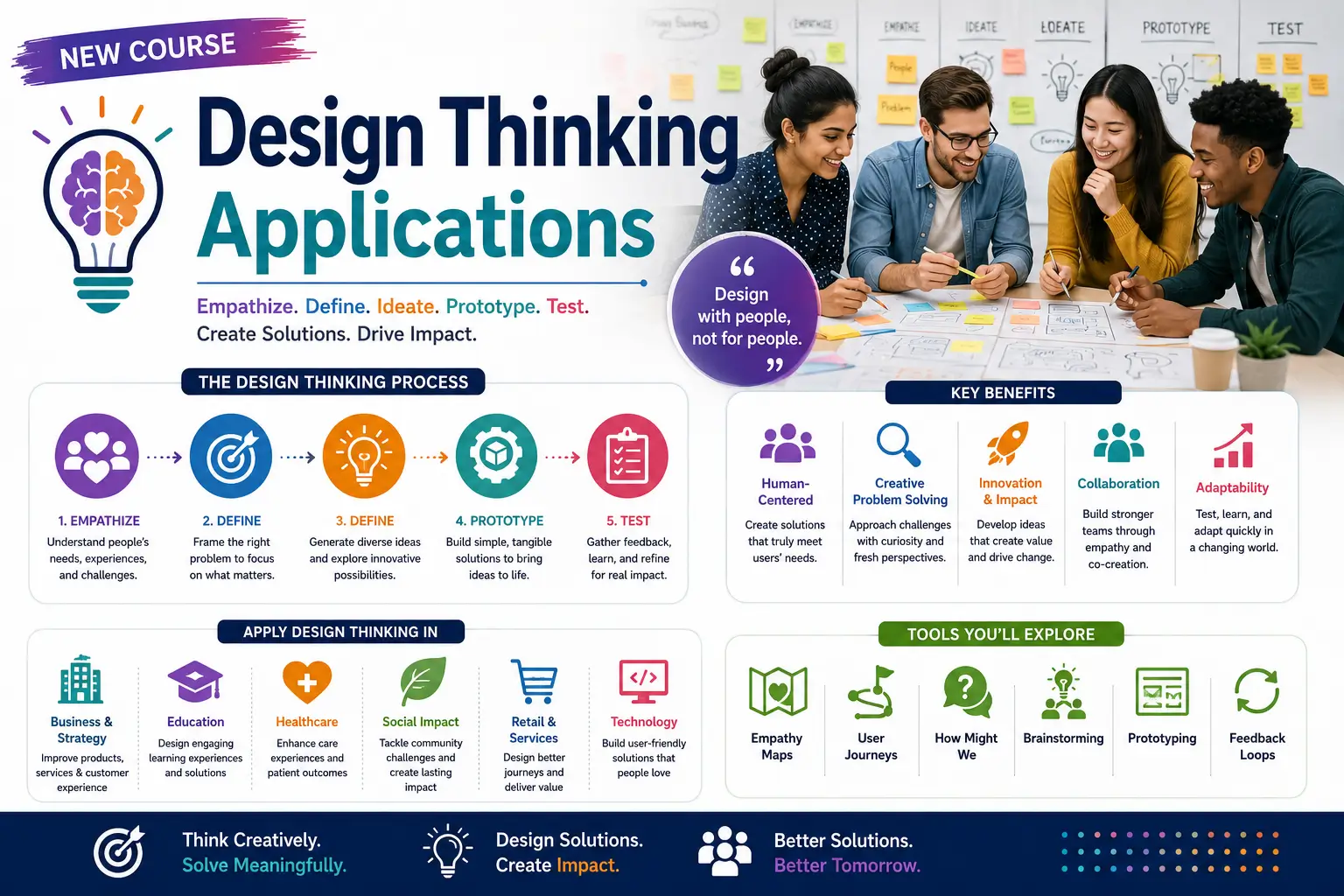
The Design Thinking Applications Course is a comprehensive training program designed to equip learners with the knowledge and practical skills required to apply design thinking methodologies to business, technology, education, healthcare, and organizational challenges. Design thinking is a structured yet flexible innovation process that focuses on understanding users, identifying problems, generating creative ideas, building prototypes, testing solutions, and continuously improving outcomes.
In today’s competitive environment, organizations must innovate quickly while meeting changing customer expectations. Design thinking provides a proven framework for creating products, services, processes, and experiences that are user-focused and business-driven. By combining empathy, creativity, collaboration, and experimentation, professionals can develop innovative solutions that improve customer satisfaction and organizational performance.
Whether you are a student, entrepreneur, product manager, business analyst, designer, marketer, educator, project manager, consultant, or innovation professional, this course provides practical knowledge to apply design thinking successfully in a wide range of professional environments.
Why Design Thinking is Important
Design thinking enables organizations to solve problems creatively while keeping user needs at the center of decision-making.
Key benefits include:
- Encourages innovation
- Improves creative problem-solving
- Enhances customer experience
- Supports user-centered product development
- Strengthens collaboration
- Reduces development risks
- Improves decision-making
- Increases business competitiveness
- Promotes continuous improvement
- Supports organizational growth
For example, organizations use design thinking to develop innovative products, redesign customer experiences, improve digital services, optimize business processes, and solve complex organizational challenges.
Course Overview
This course provides a structured understanding of design thinking principles and practical innovation techniques.
Learners will explore:
- Introduction to design thinking
- Human-centered design principles
- User research methods
- Empathy mapping
- Problem definition
- Ideation techniques
- Brainstorming strategies
- Creativity and innovation
- Prototyping
- User testing and feedback
- Iterative improvement
- Customer experience design
- Collaborative teamwork
- Innovation management
- Best practices for applying design thinking
What You Will Learn
By the end of this course, learners will be able to:
- Understand design thinking principles
- Conduct user research effectively
- Define business and customer problems clearly
- Generate innovative ideas
- Build simple prototypes
- Evaluate solutions through user feedback
- Improve products and services continuously
- Apply human-centered design approaches
- Strengthen teamwork and collaboration
- Solve complex business challenges creatively
Key Components of Design Thinking Applications
1. User-Centered Research
Learn techniques for understanding customer needs, observing user behavior, conducting interviews, and gathering meaningful insights.
2. Creative Problem-Solving
Understand how structured brainstorming, ideation, and innovation techniques help generate multiple solutions for complex problems.
3. Prototyping and Testing
Explore methods for creating low-cost prototypes, collecting user feedback, validating ideas, and refining solutions through continuous improvement.
4. Collaboration and Innovation
Learn how multidisciplinary teams work together using design thinking principles to encourage creativity, communication, and innovation.
5. Business Applications
Understand how design thinking improves customer experience, product development, service innovation, business transformation, marketing strategies, and organizational effectiveness.
Skills You Will Gain
After completing this course, learners will develop valuable professional skills, including:
- Design thinking
- Human-centered design
- Creative problem-solving
- User research
- Empathy mapping
- Ideation
- Brainstorming
- Prototyping
- Customer experience design
- Innovation management
- Team collaboration
- Critical thinking
- Decision-making
- Communication
- Continuous improvement
Benefits of This Course
Completing this course offers several professional advantages, including:
- Strong understanding of design thinking methodologies
- Better creative problem-solving abilities
- Improved innovation skills
- Practical understanding of user-centered design
- Better teamwork and collaboration capabilities
- Enhanced customer experience design knowledge
- Increased employability across multiple industries
- Competitive advantage in product management, business strategy, marketing, consulting, UX, and innovation careers
- Strong foundation for advanced innovation, product development, UX design, and business transformation studies
Who Should Enroll?
This course is suitable for:
- Students
- Entrepreneurs
- Product Managers
- Business Analysts
- Designers
- Marketing Professionals
- Project Managers
- Innovation Teams
- Consultants
- Anyone interested in creative problem-solving and innovation
No previous design thinking experience is required, making this course suitable for beginners as well as experienced professionals.
Career Opportunities
After completing this course, learners can strengthen their capabilities for roles such as:
- Design Thinking Facilitator
- Innovation Consultant
- Product Manager
- Business Analyst
- UX Researcher
- Customer Experience Specialist
- Innovation Manager
- Project Manager
- Service Designer
- Business Consultant
- Strategy Executive
Certification
Upon successful completion of the Design Thinking Applications Course, learners receive a professional certificate recognizing their knowledge of design thinking, human-centered design, user research, ideation, prototyping, innovation management, customer experience, creative problem-solving, collaboration, and continuous improvement. This certification enhances career opportunities across technology companies, consulting firms, startups, educational institutions, healthcare organizations, manufacturing companies, financial institutions, government agencies, multinational corporations, and innovation-focused organizations.
Conclusion
The Design Thinking Applications Course provides learners with practical knowledge and professional skills to solve real-world challenges through innovation and human-centered design. By mastering empathy, user research, ideation, prototyping, testing, collaboration, customer experience design, and continuous improvement, learners will be well prepared to create meaningful solutions that benefit both organizations and their customers.
Whether your goal is to innovate products, improve customer experiences, lead organizational transformation, strengthen creative problem-solving skills, or build a successful career in business or design, this course provides a strong foundation for long-term professional success.
FAQ
1. What is the Design Thinking Applications Course?
It is a course that teaches how to apply design thinking principles to solve business and customer problems through human-centered design, creativity, collaboration, prototyping, and innovation.
2. Who should enroll in this course?
Students, entrepreneurs, product managers, business analysts, designers, marketers, project managers, consultants, innovation professionals, and anyone interested in creative problem-solving.
3. Do I need prior design or innovation experience?
No. The course is beginner-friendly and suitable for learners with no previous experience in design thinking or innovation.
4. What topics are covered in this course?
The course covers user research, empathy mapping, problem definition, ideation, brainstorming, prototyping, user testing, innovation management, customer experience, collaboration, and continuous improvement.
5. Will I learn how to solve business problems using design thinking?
Yes. The course teaches practical methods for identifying customer needs, generating ideas, testing solutions, and improving products, services, and business processes through a structured design thinking approach.
6. Does this course include prototyping and user testing?
Yes. You will learn how to create simple prototypes, gather user feedback, validate ideas, and refine solutions before implementation.
7. Will I receive a certificate after completing the course?
Yes. A professional course completion certificate is awarded upon successful completion.
8. Why is design thinking important?
Design thinking helps organizations understand customer needs, encourage innovation, improve collaboration, reduce development risks, create better products and services, and solve complex problems effectively.
9. How does design thinking benefit organizations?
It improves innovation, customer satisfaction, teamwork, decision-making, product development, service design, operational efficiency, and long-term business competitiveness.
10. What career opportunities are available after this course?
This course strengthens your skills for roles such as Design Thinking Facilitator, Innovation Consultant, Product Manager, Business Analyst, UX Researcher, Customer Experience Specialist, Innovation Manager, Project Manager, Service Designer, Business Consultant, and Strategy Executive.




Reviews
There are no reviews yet.