
Introduction
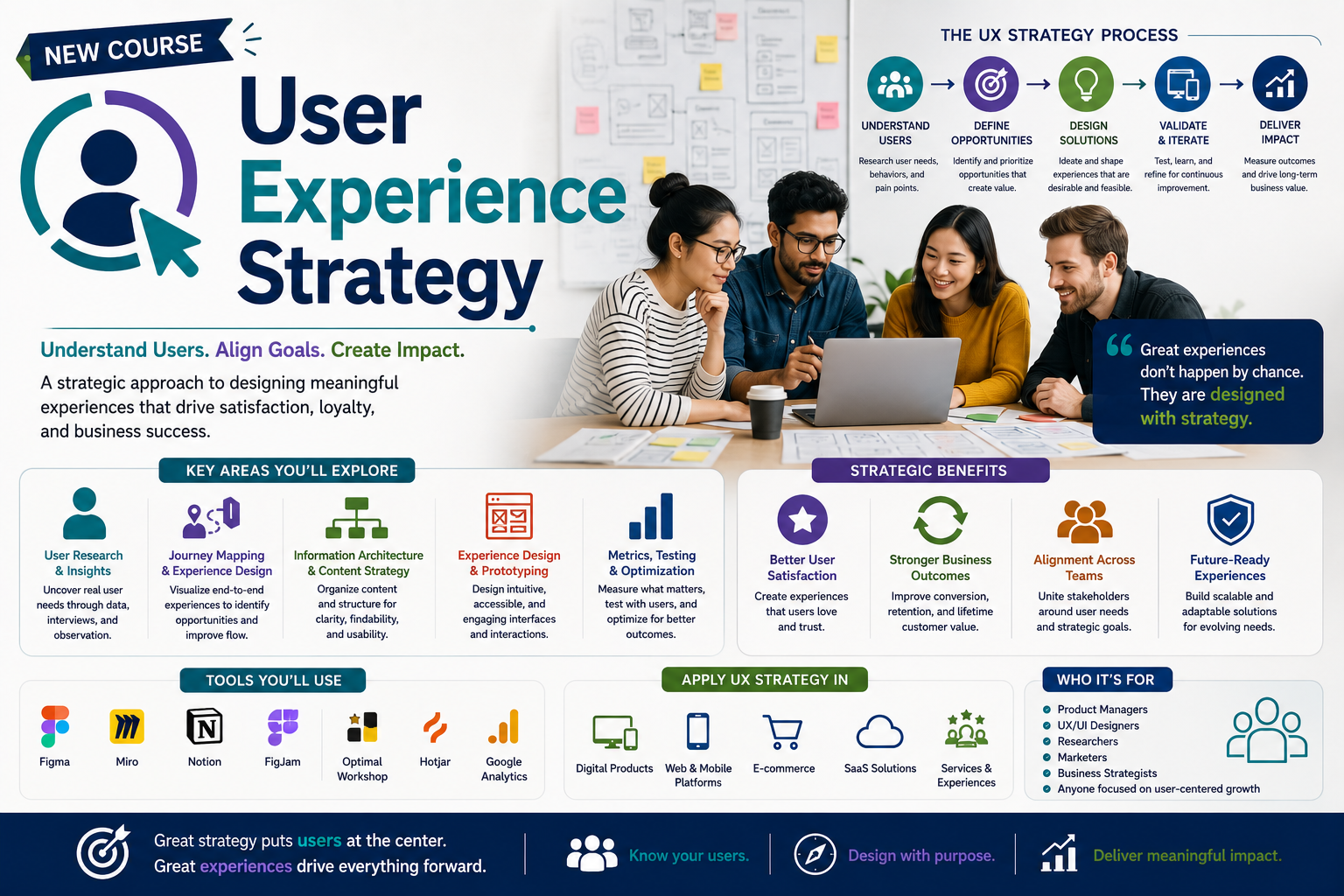
The User Experience Strategy Course is a comprehensive training program designed to equip learners with the knowledge and practical skills required to develop effective user experience strategies for digital products and services. In today’s digital economy, organizations compete not only through innovative technology but also by delivering seamless, intuitive, and satisfying user experiences.
User Experience (UX) strategy is a structured approach that aligns customer needs, business objectives, and design decisions. By understanding user behavior and applying strategic UX principles, organizations can create products that improve customer satisfaction, strengthen brand loyalty, increase conversions, and support long-term business success.
This course combines UX research, design thinking, usability, customer journey mapping, information architecture, interaction design, and strategic planning to help learners understand the complete UX process.
Whether you are a student, UX designer, product manager, business analyst, software developer, entrepreneur, digital marketer, project manager, consultant, or business professional, this course provides practical knowledge for designing exceptional user experiences.
Why User Experience Strategy is Important
A strong UX strategy helps organizations build products that meet user expectations while supporting business growth.
Key benefits include:
- Improves customer satisfaction
- Enhances product usability
- Supports user-centered design
- Increases customer engagement
- Reduces product development risks
- Improves business decision-making
- Enhances digital accessibility
- Strengthens customer loyalty
- Encourages innovation
- Supports long-term business success
For example, organizations use UX strategy to create intuitive websites, mobile applications, software platforms, e-commerce solutions, and digital services that deliver meaningful user experiences.
Course Overview
This course provides a structured understanding of UX strategy and customer-centered digital design.
Learners will explore:
- Introduction to UX strategy
- User-centered design principles
- UX research methods
- User personas
- Customer journey mapping
- Information architecture
- Interaction design
- Usability principles
- Wireframing concepts
- Design thinking
- UX testing and evaluation
- Digital accessibility
- Product strategy
- UX metrics and improvement
- Best practices for user experience strategy
What You Will Learn
By the end of this course, learners will be able to:
- Understand UX strategy principles
- Conduct user research
- Create user personas
- Develop customer journey maps
- Improve digital product usability
- Apply user-centered design methods
- Evaluate user experiences
- Support digital product development
- Strengthen collaboration between design and business teams
- Improve customer satisfaction through strategic UX planning
Key Components of User Experience Strategy
1. User Research
Learn techniques for understanding customer needs through interviews, observations, surveys, usability studies, and behavioral analysis.
2. User-Centered Design
Understand how empathy, accessibility, usability, and human-centered design principles guide digital product development.
3. Customer Journey Mapping
Explore methods for analyzing customer interactions, identifying pain points, improving user flows, and creating seamless digital experiences.
4. UX Planning and Evaluation
Learn how UX strategies support product planning, usability testing, iterative improvements, and long-term product success.
5. Business and Innovation Integration
Understand how UX strategy aligns business objectives, customer expectations, innovation, and product management to create competitive digital solutions.
Skills You Will Gain
After completing this course, learners will develop valuable professional skills, including:
- UX strategy
- User research
- Customer journey mapping
- User personas
- Information architecture
- Interaction design
- Design thinking
- Usability evaluation
- Customer experience design
- Digital accessibility
- Product strategy
- Problem-solving
- Collaboration
- Communication
- Critical thinking
Benefits of This Course
Completing this course offers several professional advantages, including:
- Strong understanding of UX strategy
- Better user-centered design skills
- Improved customer experience planning
- Practical understanding of UX research methods
- Better collaboration between business and design teams
- Enhanced digital product strategy capabilities
- Increased employability across technology and digital industries
- Competitive advantage in UX design, product management, digital marketing, consulting, and software development careers
- Strong foundation for advanced UX, UI, product design, and digital transformation studies
Who Should Enroll?
This course is suitable for:
- Students
- UX Designers
- Product Managers
- Business Analysts
- Software Developers
- Digital Marketers
- Project Managers
- Entrepreneurs
- Consultants
- Anyone interested in user-centered digital product development
No previous UX experience is required, making this course suitable for beginners as well as experienced professionals.
Career Opportunities
After completing this course, learners can strengthen their capabilities for roles such as:
- UX Strategist
- UX Designer
- Product Manager
- Customer Experience Specialist
- UX Researcher
- Digital Product Manager
- Business Analyst
- Service Designer
- Product Owner
- Digital Transformation Consultant
- Interaction Designer
Certification
Upon successful completion of the User Experience Strategy Course, learners receive a professional certificate recognizing their knowledge of UX strategy, user research, customer journey mapping, usability, interaction design, information architecture, design thinking, digital accessibility, product strategy, and customer experience optimization. This certification enhances career opportunities across technology companies, software organizations, digital agencies, startups, consulting firms, financial institutions, healthcare organizations, e-commerce businesses, educational technology companies, and multinational corporations.
Conclusion
The User Experience Strategy Course provides learners with practical knowledge and professional skills to design user-centered digital products that align customer needs with business objectives. By mastering UX research, customer journey mapping, usability, design thinking, product strategy, information architecture, interaction design, and continuous improvement, learners will be well prepared to create meaningful digital experiences that drive customer satisfaction and business success.
Whether your goal is to become a UX strategist, improve digital product experiences, strengthen customer engagement, support innovation, or build a successful career in digital design and product management, this course provides a strong foundation for long-term professional growth.
FAQ
1. What is the User Experience Strategy Course?
It is a course that teaches how to develop user-centered strategies for designing digital products and services that improve usability, customer satisfaction, and business outcomes.
2. Who should enroll in this course?
Students, UX designers, product managers, business analysts, software developers, digital marketers, entrepreneurs, consultants, project managers, and anyone interested in UX strategy.
3. Do I need prior UX or design experience?
No. The course is beginner-friendly and suitable for learners with no previous experience in UX design or strategy.
4. What topics are covered in this course?
The course covers UX strategy, user research, user personas, customer journey mapping, usability, interaction design, information architecture, design thinking, accessibility, UX testing, and product strategy.
5. Will I learn how to improve digital products using UX strategy?
Yes. The course teaches practical methods for understanding users, identifying pain points, improving digital experiences, testing solutions, and aligning UX decisions with business goals.
6. Does this course include user research and customer journey mapping?
Yes. You will learn how to conduct user research, create user personas, map customer journeys, evaluate usability, and improve user experiences through data-driven insights.
7. Will I receive a certificate after completing the course?
Yes. A professional course completion certificate is awarded upon successful completion.
8. Why is UX strategy important?
UX strategy helps organizations understand customer needs, improve usability, enhance satisfaction, increase engagement, reduce development risks, and create successful digital products.
9. How does UX strategy benefit organizations?
It improves customer experience, strengthens brand loyalty, supports innovation, increases product adoption, improves digital accessibility, enhances business performance, and contributes to long-term growth.
10. What career opportunities are available after this course?
This course strengthens your skills for roles such as UX Strategist, UX Designer, UX Researcher, Product Manager, Customer Experience Specialist, Business Analyst, Service Designer, Product Owner, Interaction Designer, Digital Product Manager, and Digital Transformation Consultant.





Reviews
There are no reviews yet.