
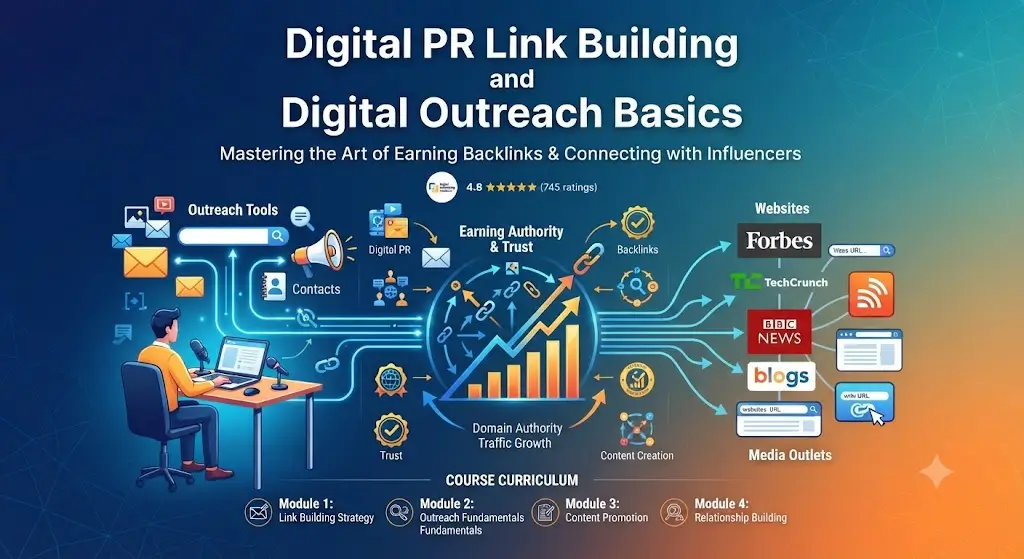
Digital PR Link Building & Digital Outreach Basics
Introduction
The Digital PR Link Building & Digital Outreach Basics course introduces the fundamentals of earning quality backlinks through digital public relations and strategic outreach. Search visibility depends on many factors, and authoritative links can support a website’s credibility when they are relevant and naturally earned.
Digital PR combines public relations with online marketing. It helps brands attract attention from journalists, publishers, bloggers, creators, and industry websites.
This course explains how digital PR and outreach can support SEO and brand visibility. Learners will explore prospect research, outreach planning, media angles, content promotion, relationship building, backlink opportunities, and campaign measurement.
Moreover, practical examples help participants understand how these strategies work in real marketing situations.
Understanding Digital PR
Digital PR uses online channels to build awareness, credibility, and media attention.
Learners will explore how digital PR can support:
- Brand awareness
- Online visibility
- Media coverage
- Reputation
- Referral traffic
- Search visibility
- Industry authority
A successful digital PR campaign focuses on providing something valuable to the audience.
Therefore, strong campaigns begin with a useful story, insight, resource, or perspective.
Understanding Link Building
Link building involves earning links from external websites to your website.
However, quantity should not be the main goal.
Relevant and credible links can provide stronger value than large numbers of unrelated links. For this reason, learners will focus on quality, relevance, natural placement, and genuine editorial value.
The course also explains how digital PR can create opportunities for naturally earned backlinks.
Why Digital PR Supports SEO
Digital PR and SEO can work together.
A successful PR campaign may generate media coverage, referral visits, brand mentions, and backlinks. These outcomes can support broader online visibility.
Furthermore, PR activity can help a brand become more recognizable within its industry.
Participants will learn how to connect PR objectives with SEO goals without making link acquisition the only campaign objective.
Understanding Digital Outreach
Digital outreach involves communicating with people who may be interested in a brand, story, resource, or piece of content.
Potential contacts include:
- Journalists
- Bloggers
- Editors
- Publishers
- Industry websites
- Content creators
- Researchers
- Podcast hosts
Effective outreach should be relevant and personalized.
Consequently, understanding the recipient becomes an important part of successful communication.
Identifying Outreach Opportunities
Not every website or publisher is a suitable outreach target.
Learners will explore how to identify opportunities based on:
- Topic relevance
- Audience fit
- Industry connection
- Content quality
- Website credibility
- Editorial focus
- Potential value
A smaller list of relevant prospects can often be more useful than a large generic database.
Therefore, research should come before outreach.
Building an Outreach Prospect List
A structured prospect list helps organize campaign activity.
Participants will learn how to record information such as:
- Website name
- Contact person
- Publication topic
- Contact details
- Relevant content
- Outreach angle
- Campaign status
- Follow-up date
This process makes outreach easier to manage.
In addition, organized records help prevent repeated or irrelevant communication.
Researching Publishers and Journalists
Research is one of the most important parts of outreach.
Before contacting someone, learners should understand:
- What they publish
- Which topics they cover
- Who their audience is
- What type of stories they prefer
- What content they recently published
This information helps create a more relevant pitch.
As a result, outreach can feel more like professional communication than mass promotion.
Finding Relevant Journalists
Journalists often work within specific areas.
They may focus on:
- Business
- Technology
- Marketing
- Finance
- Education
- Retail
- Healthcare
- Entrepreneurship
- Lifestyle
Participants will learn how to identify journalists whose interests match the campaign topic.
Therefore, relevance should guide media targeting.
Developing a PR Angle
A PR angle explains why a story is interesting right now.
Useful angles may involve:
- New research
- Industry trends
- Data
- Customer insights
- Expert commentary
- New developments
- Market changes
- Original findings
A strong angle gives publishers a reason to pay attention.
Furthermore, it can make outreach more focused.
Creating Newsworthy Content
Digital PR often depends on useful or interesting content.
Learners will explore content formats such as:
- Original research
- Surveys
- Industry reports
- Data studies
- Expert commentary
- Guides
- Visual resources
- Trend analysis
The content should offer genuine value.
Consequently, publishers have a stronger reason to reference or share it.
Using Original Data
Original data can create strong PR opportunities.
Businesses may use:
- Customer surveys
- Internal research
- Industry statistics
- Trend analysis
- Market comparisons
- Public datasets
However, data should be accurate and presented clearly.
Therefore, research quality is essential when using data for digital PR.
Creating Expert Commentary
Expert commentary can help brands contribute to relevant stories.
Participants will learn how to develop useful commentary around:
- Industry trends
- Market changes
- Customer behavior
- Business developments
- Emerging technologies
The objective is to provide insight rather than promotional language.
As a result, commentary can feel more valuable to journalists and publishers.
Writing Outreach Emails
Outreach emails should be concise and relevant.
A basic pitch can include:
- Personal introduction
- Relevant reason for contact
- Story or resource
- Key value
- Supporting information
- Simple next step
Long explanations can reduce clarity.
Instead, the message should quickly communicate why the opportunity matters.
Personalizing Outreach
Personalization can improve the quality of outreach.
Learners will explore personalization using:
- Recent articles
- Specific topics
- Publication focus
- Audience interests
- Previous work
However, personalization should be genuine.
For example, mentioning a relevant recent article is more useful than adding a recipient’s name to a generic template.
Creating Outreach Templates
Templates can save time when used carefully.
Participants will learn how to create templates for:
- Media pitches
- Resource outreach
- Expert commentary
- Content promotion
- Partnership requests
- Follow-ups
Each template should still allow room for personalization.
Therefore, efficiency should not come at the cost of relevance.
Follow-Up Strategy
Follow-ups can help keep a conversation active.
A professional follow-up should:
- Remain brief
- Add context when useful
- Avoid pressure
- Respect the recipient’s time
- Provide an easy next step
One or more thoughtful follow-ups may be appropriate depending on the situation.
However, excessive messages can damage relationships.
Building Publisher Relationships
Digital PR works best when relationships develop over time.
Learners will explore ways to build relationships through:
- Helpful responses
- Relevant expert insights
- Useful resources
- Consistent communication
- Respectful outreach
The goal is not only to earn one backlink.
Instead, businesses can build long-term media and publisher relationships.
Understanding Backlink Relevance
A backlink is more valuable when it makes sense within the surrounding content.
Learners will explore relevance based on:
- Topic
- Audience
- Industry
- Content context
- Website purpose
For example, a marketing resource is more naturally linked from a relevant marketing publication than from an unrelated website.
Therefore, contextual relevance should remain a key consideration.
Understanding Link Quality
Not all backlinks provide the same value.
Participants will learn to consider:
- Relevance
- Editorial context
- Website quality
- Audience fit
- Content usefulness
- Natural placement
A quality-focused approach supports sustainable SEO practices.
Moreover, it reduces dependence on low-value link acquisition methods.
Digital PR Content Promotion
Creating content is only the first step.
Learners will explore promotion through:
- Media outreach
- Industry communities
- Social platforms
- Email communication
- Partnerships
- Expert networks
Promotion should match the audience.
Consequently, relevant distribution can increase the chances of content discovery.
Guest Content and Contributor Opportunities
Some publishers accept contributions from external experts.
Participants will explore how to evaluate these opportunities based on:
- Editorial standards
- Topic relevance
- Audience quality
- Content requirements
- Brand fit
The priority should be useful content.
Therefore, contributor opportunities should not be treated only as a way to place links.
Digital PR and Content Marketing
Digital PR can amplify strong content.
A detailed report, study, or guide may become the foundation for outreach.
At the same time, PR insights can influence future content topics.
This creates a useful connection between content marketing and digital PR.
Brand Mentions and Unlinked References
A brand may be mentioned online without receiving a link.
Learners will understand how relevant mentions can create potential outreach opportunities.
A respectful request may sometimes encourage a publisher to add a useful reference.
However, the request should provide value to the reader.
As a result, outreach remains focused on improving the resource rather than demanding a link.
Competitor Backlink Research
Competitor research can reveal useful outreach ideas.
Participants will explore how to identify:
- Competitor mentions
- Industry publications
- Relevant resource pages
- Content opportunities
- Media coverage
- Common referral sources
The objective is to discover market opportunities.
Therefore, competitor research should inform strategy rather than encourage copying.
Building a Digital PR Campaign
A basic campaign can follow several stages:
- Define the objective
- Identify the audience
- Develop the story
- Create supporting content
- Research prospects
- Prepare outreach
- Launch the campaign
- Follow up
- Track results
- Evaluate performance
This structure provides a practical starting point.
Furthermore, it makes campaign progress easier to manage.
Setting Campaign Objectives
A clear objective helps determine campaign direction.
Possible objectives include:
- Increase brand awareness
- Earn relevant backlinks
- Generate referral traffic
- Gain media coverage
- Build authority
- Promote original research
- Support a product launch
The objective should be realistic and measurable.
Consequently, campaign performance becomes easier to evaluate.
Creating a Campaign Timeline
Digital PR campaigns require coordination.
Learners will explore timelines covering:
- Research
- Content creation
- Prospecting
- Outreach
- Follow-ups
- Reporting
A clear timeline helps prevent rushed execution.
In addition, it allows teams to coordinate content and outreach activities.
Measuring Outreach Performance
Outreach performance can be evaluated using several indicators.
Useful metrics include:
- Emails sent
- Response rate
- Positive responses
- Media placements
- Backlinks earned
- Referral visits
- Brand mentions
- Content engagement
These metrics should be reviewed together.
For example, a smaller campaign may produce fewer links but generate highly valuable media coverage.
Measuring Digital PR Results
Digital PR should support broader business goals.
Learners will explore measurements such as:
- Brand visibility
- Referral traffic
- Organic search performance
- Media mentions
- Backlinks
- Engagement
- Audience growth
The right metrics depend on the campaign objective.
Therefore, reporting should connect activity with meaningful outcomes.
Understanding Outreach Ethics
Ethical outreach is essential for long-term reputation.
Participants will learn to avoid:
- Misleading pitches
- Fake claims
- Irrelevant mass emails
- Manipulative link requests
- Deceptive content
- Excessive follow-ups
Professional communication builds stronger relationships.
Moreover, ethical practices reduce reputational risk.
Common Outreach Mistakes
Several mistakes can reduce outreach effectiveness.
Common examples include:
- Sending generic emails
- Targeting irrelevant websites
- Writing overly long pitches
- Ignoring publication guidelines
- Failing to research recipients
- Following up too aggressively
- Focusing only on backlinks
A better approach emphasizes relevance and value.
Therefore, outreach quality should take priority over outreach volume.
Common Link Building Mistakes
Learners will also explore common link-building problems.
These include:
- Chasing irrelevant links
- Prioritizing quantity over quality
- Using manipulative tactics
- Creating content only for links
- Ignoring audience value
- Measuring success only by link count
Sustainable link building should support users first.
As a result, SEO and PR efforts can become more credible.
Practical Outreach Exercises
The course includes practical exercises designed to build foundational skills.
Participants will practice:
- Identifying PR opportunities
- Researching journalists
- Finding relevant publishers
- Building prospect lists
- Developing PR angles
- Creating outreach messages
- Personalizing email pitches
- Creating follow-up messages
- Evaluating backlink opportunities
- Reviewing competitor coverage
- Identifying unlinked mentions
- Planning digital PR campaigns
- Setting campaign objectives
- Creating outreach timelines
- Measuring campaign performance
These activities help learners move from theory to practical application.
What You Will Learn
By completing the Digital PR Link Building & Digital Outreach Basics course, learners will be able to:
- Understand digital PR
- Understand basic link building
- Explain the relationship between PR and SEO
- Identify relevant outreach opportunities
- Research publishers and journalists
- Build outreach prospect lists
- Develop PR angles
- Create newsworthy content ideas
- Use original data for PR
- Develop expert commentary
- Write basic outreach emails
- Personalize outreach messages
- Create outreach templates
- Plan professional follow-ups
- Build publisher relationships
- Evaluate backlink relevance
- Assess link quality
- Promote content through outreach
- Evaluate contributor opportunities
- Identify unlinked brand mentions
- Conduct basic competitor backlink research
- Build digital PR campaigns
- Set campaign objectives
- Create campaign timelines
- Measure outreach performance
- Measure digital PR results
- Follow ethical outreach practices
- Avoid common link-building mistakes
Skills You Will Gain
Participants will develop practical skills in:
- Digital PR
- Link building
- Digital outreach
- Media research
- Publisher research
- Prospect identification
- PR angle development
- Outreach copywriting
- Email personalization
- Follow-up planning
- Relationship building
- Content promotion
- Backlink evaluation
- Competitor research
- Campaign planning
- PR measurement
- SEO support
- Media communication
Benefits of This Course
Build Digital PR Foundations
Learners gain a clear understanding of how digital PR can support brand visibility and SEO.
Improve Outreach Skills
Participants learn how to research prospects and create more relevant outreach messages.
Discover Link Opportunities
The course explains how to identify natural and relevant backlink opportunities.
Develop Better PR Angles
Learners understand how to turn data, trends, insights, and expertise into stronger story ideas.
Strengthen Media Relationships
Professional communication can help businesses build useful long-term relationships with publishers and journalists.
Support SEO Goals
Digital PR can contribute to backlinks, brand mentions, referral traffic, and broader online visibility.
Improve Campaign Planning
Participants learn how to structure campaigns from research through reporting.
Measure Campaign Results
The course introduces practical metrics for evaluating outreach and digital PR performance.
Who Should Enroll?
The Digital PR Link Building & Digital Outreach Basics course is suitable for:
- SEO Professionals
- Digital Marketers
- Content Marketers
- PR Professionals
- Marketing Managers
- Social Media Professionals
- Communications Professionals
- Entrepreneurs
- Business Owners
- Startup Founders
- Freelancers
- Agency Professionals
- Marketing Students
It is especially useful for beginners and professionals who want to develop foundational skills in digital PR and outreach.
Career Opportunities
The skills covered in this course can support roles such as:
- Digital PR Executive
- PR Specialist
- SEO Executive
- Link Building Specialist
- Outreach Specialist
- Digital Marketing Executive
- Content Marketing Executive
- SEO Content Specialist
- Marketing Coordinator
- Communications Executive
- Digital Marketing Specialist
These skills can be applied across agencies, startups, media businesses, e-commerce companies, technology firms, and other organizations.
Practical Applications
Digital PR and outreach can support many marketing activities.
A startup can use original research to attract media attention. Similarly, an established company can promote industry insights through targeted publisher outreach.
An SEO team can combine relevant PR activity with content marketing. Meanwhile, a PR team can use digital channels to expand traditional media relationships.
Furthermore, businesses can use expert commentary to participate in industry conversations.
Therefore, digital PR can become a useful part of a broader online marketing strategy.
Certification
Upon successful completion of the Digital PR Link Building & Digital Outreach Basics course, learners receive a professional course completion certificate.
The certificate recognizes foundational knowledge of digital PR, link building, outreach research, media communication, PR content, backlink evaluation, campaign planning, and performance measurement.
Additionally, the certificate can strengthen a professional portfolio. It may demonstrate relevant skills for SEO, digital marketing, PR, content marketing, and communications roles.
Conclusion
The Digital PR Link Building & Digital Outreach Basics course provides a practical foundation for building online visibility through digital PR and strategic outreach.
Successful outreach starts with research. It then connects a relevant story or resource with the right publisher, journalist, or industry website.
Quality link building should focus on relevance and genuine value. Similarly, digital PR should aim to build credibility rather than simply collect backlinks.
Throughout the course, learners explore prospect research, PR angles, outreach emails, publisher relationships, content promotion, backlink opportunities, campaign planning, and measurement.
Moreover, practical exercises help participants apply these concepts to realistic marketing situations.
Whether the goal is to support SEO, improve brand visibility, earn media coverage, or build professional outreach skills, this course provides a structured starting point for Digital PR Link Building & Digital Outreach Basics.
Frequently Asked Questions
1. What is the Digital PR Link Building & Digital Outreach Basics course?
It is a foundational course that explains digital PR, link building, media outreach, publisher research, outreach communication, and campaign measurement.
2. Who should take this course?
SEO professionals, digital marketers, PR teams, content marketers, entrepreneurs, business owners, and beginners can benefit from the course.
3. Does the course cover link building?
Yes. Learners explore backlink relevance, link quality, outreach opportunities, and natural link acquisition.
4. What is digital outreach?
Digital outreach is the process of contacting relevant publishers, journalists, bloggers, creators, and industry websites with useful stories, resources, or insights.
5. Will I learn how to find journalists?
Yes. The course explains how to research journalists based on their topics, publications, audiences, and recent work.
6. Does the course teach outreach email writing?
Yes. Participants learn the basic structure of concise, relevant, and personalized outreach emails.
7. Does the course cover PR content?
Yes. Learners explore research, data, expert commentary, reports, guides, and other content formats that can support digital PR.
8. Will I learn how to measure outreach campaigns?
Yes. The course covers response rates, media placements, backlinks, referral traffic, mentions, engagement, and other useful metrics.
9. Is the course suitable for beginners?
Yes. It introduces the fundamental concepts and gradually connects them with practical outreach activities.
10. Can digital PR support SEO?
Yes. Digital PR can contribute to relevant backlinks, brand mentions, referral traffic, and broader online visibility.
11. Does the course cover ethical outreach?
Yes. Learners explore professional communication and common practices that should be avoided during outreach and link building.
12. Will I receive a certificate?
Yes. Learners receive a professional course completion certificate after successfully completing the Digital PR Link Building & Digital Outreach Basics course.



Reviews
There are no reviews yet.