
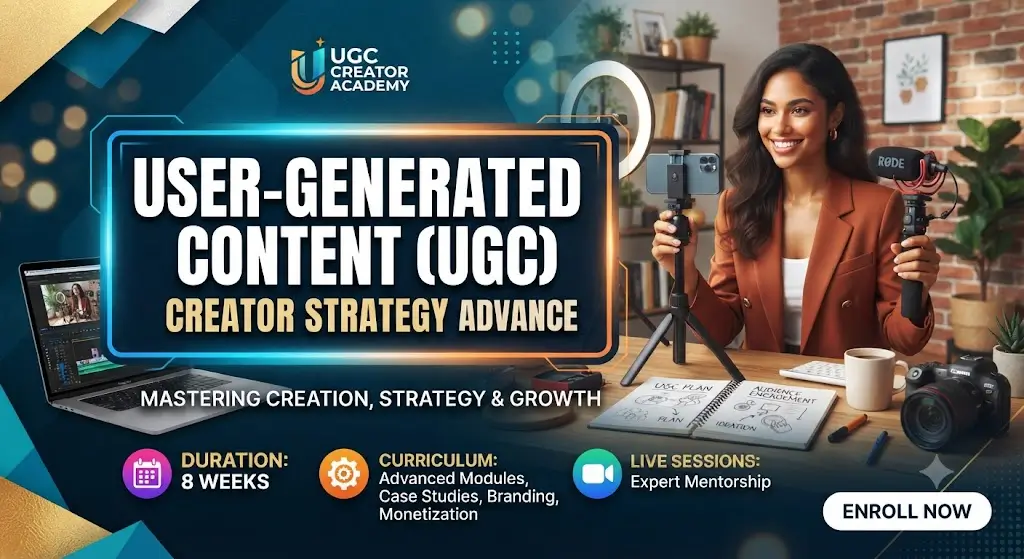
User-Generated Content (UGC) Creator Strategy Advance Course
Introduction
The User-Generated Content (UGC) Creator Strategy Advance Course is designed for marketing professionals who want to build stronger and more effective creator-led content strategies. User-generated content has become an important part of digital marketing because audiences often respond well to authentic, relatable, and experience-based content.
Modern brands can use UGC to strengthen awareness, engagement, trust, product discovery, and conversions. However, successful UGC campaigns require more than simply finding creators and requesting content. A strong strategy needs clear objectives, audience research, creator selection, creative direction, content management, performance tracking, and continuous optimization.
This advanced course takes learners beyond basic UGC concepts. Participants will explore practical methods for managing creators, developing campaign strategies, improving content quality, analyzing performance, and scaling successful UGC programs.
Furthermore, the course focuses on strategic decision-making. Learners will understand how creator content can support social media, e-commerce, paid advertising, product launches, customer engagement, and broader marketing goals.
Understanding Advanced UGC Strategy
Advanced UGC strategy connects creator-generated content with measurable business objectives. Instead of treating UGC as an isolated content activity, marketers can integrate it into the wider customer journey.
A strategic UGC program may support:
- Brand awareness
- Audience engagement
- Product discovery
- Lead generation
- Social proof
- Customer education
- E-commerce sales
- Product launches
- Paid advertising
- Customer retention
First, marketers should identify the primary objective. Next, they can select the audience, creator type, content format, and distribution channel.
As a result, UGC activities become more focused and easier to evaluate.
Developing a UGC Strategy
An effective UGC strategy starts with a clear framework. Marketers need to understand what content should be created, who should create it, where it will be distributed, and how success will be measured.
A practical strategy can include:
- Business objective
- Target audience
- Campaign message
- Creator profile
- Content format
- Distribution channel
- Content requirements
- Usage rights
- Performance metrics
- Optimization plan
Moreover, each element should support the overall marketing objective. This alignment can reduce unnecessary content production and improve campaign efficiency.
Advanced Audience Research
Audience research becomes especially important when campaigns target specific customer groups. Marketers should understand customer interests, behaviors, needs, preferences, and purchasing motivations.
Useful research areas include:
- Demographic characteristics
- Customer interests
- Purchase behavior
- Content preferences
- Platform activity
- Product usage
- Customer challenges
- Buying motivations
- Engagement patterns
For example, a fitness brand may need creators who understand a specific customer segment. Similarly, a technology brand may require creators who can explain complex products in simple language.
Therefore, audience research should influence creator selection and content planning.
Advanced Creator Selection
Choosing the right creator is one of the most important parts of a UGC program. Follower count alone does not determine whether a creator will produce valuable content.
Instead, marketers should evaluate:
- Content quality
- Storytelling ability
- Audience relevance
- Communication style
- Creative consistency
- Reliability
- Professionalism
- Platform suitability
- Product fit
- Engagement quality
A creator with a smaller audience may still produce excellent campaign assets. Meanwhile, a larger creator may not always match the brand’s communication style.
Consequently, creator selection should be based on campaign requirements rather than popularity alone.
Creator Portfolio Analysis
Portfolio analysis helps marketers understand a creator’s capabilities before starting a collaboration. Previous content can reveal visual style, storytelling skills, editing quality, product presentation, and communication ability.
Look for evidence of:
- Strong hooks
- Clear storytelling
- Natural delivery
- Product demonstrations
- Effective pacing
- Visual consistency
- Audience engagement
In addition, marketers should check whether creators can follow campaign instructions while maintaining their personal style.
As a result, portfolio analysis can support better creator decisions.
Creator Segmentation
Not every creator should receive the same campaign approach. Creator segmentation allows marketing teams to organize creators according to specific characteristics.
Possible segments include:
- Niche creators
- Lifestyle creators
- Product-focused creators
- Expert creators
- Review creators
- Tutorial creators
- Micro-creators
- Community-focused creators
Each segment can serve a different purpose. For instance, expert creators may be useful for educational content, while lifestyle creators may work well for product storytelling.
Thus, creator segmentation can improve campaign planning.
Building Creator Personas
A creator persona describes the type of creator best suited to a campaign. It can include communication style, content format, audience profile, platform preference, and subject expertise.
A creator persona may answer questions such as:
- Who does the creator reach?
- What type of content do they produce?
- How do they communicate?
- What products fit their content?
- Which platform performs best?
- What audience problems can they address?
Furthermore, clear creator personas can make recruitment more efficient.
Developing Advanced UGC Briefs
A strong brief provides direction without making content feel artificial. Advanced UGC briefs should explain campaign goals while giving creators enough creative freedom.
A detailed brief may include:
- Campaign objective
- Target audience
- Product information
- Core message
- Key benefits
- Required talking points
- Creative direction
- Content format
- Deliverables
- Technical requirements
- CTA
- Deadline
- Usage rights
However, marketers should avoid writing every line of the creator’s script. Allowing natural communication can preserve authenticity.
Therefore, a good brief balances brand requirements with creator creativity.
Creative Direction for UGC
Creative direction helps creators understand the desired visual and storytelling approach. It can cover hooks, themes, product presentation, pacing, tone, and CTA structure.
For example, a campaign may request a problem-solution format. Another campaign might focus on personal experience or product demonstration.
Moreover, creative direction can provide consistency across multiple creators. At the same time, each creator can maintain an individual voice.
Developing Strong UGC Hooks
The opening seconds of short-form content can influence viewer attention. Strong hooks should create curiosity or immediately communicate value.
Common hook approaches include:
- Asking a question
- Presenting a problem
- Sharing an experience
- Highlighting a benefit
- Demonstrating a result
- Addressing a common mistake
For instance, a creator might begin with a customer problem before introducing the product as a solution.
Consequently, effective hooks can help UGC capture attention more quickly.
Storytelling in UGC
Storytelling can make creator content easier to follow. Instead of simply listing product features, creators can explain how the product fits into a real situation.
A simple story structure may include:
Problem → Experience → Solution → Result → CTA
First, introduce a relatable problem. Then, explain the experience and show how the product helped.
Finally, communicate the result and provide an appropriate CTA. This structure can make product-focused content more engaging.
Maintaining Authenticity at Scale
Scaling UGC can create a challenge. Brands need consistent messaging, but excessive control can make creator content feel repetitive.
Therefore, marketers should establish non-negotiable brand requirements while leaving flexible creative areas.
For example, product claims and legal statements may require consistency. However, the creator’s tone, storytelling style, and presentation can remain flexible.
As a result, brands can maintain recognizable communication without losing authenticity.
Managing Creator Communication
Professional communication supports successful creator partnerships. Marketing teams should clearly communicate expectations from the beginning.
Important areas include:
- Project scope
- Deliverables
- Deadlines
- Feedback
- Revisions
- Approval process
- Payment terms
- Usage rights
In addition, communication should remain organized throughout the campaign.
Consequently, creators can work more efficiently, while marketing teams can reduce delays.
Managing UGC Campaign Workflows
A structured workflow helps teams manage multiple creators and content assets. A typical process can include:
Research → Recruitment → Briefing → Production → Review → Revision → Approval → Distribution → Measurement
Each stage should have clear responsibilities. Moreover, campaign managers should maintain records of deadlines, submissions, approvals, and content rights.
This structure becomes especially useful when several creators work on the same campaign.
Content Review and Quality Control
Content review ensures that creator submissions meet campaign requirements. However, quality control should not remove the creator’s natural communication style.
Review teams can check:
- Brand accuracy
- Product information
- Required messaging
- Visual quality
- Audio quality
- CTA
- Technical specifications
- Compliance requirements
Afterward, feedback should be specific and constructive.
Therefore, creators can make necessary improvements without losing the original creative direction.
UGC for Product Launches
UGC can play an important role during product launches. Creators can introduce new products, explain benefits, demonstrate usage, and share first impressions.
A launch strategy may use several content stages:
- Awareness
- Introduction
- Demonstration
- Social proof
- Consideration
- Conversion
Initially, creators can generate curiosity. Later, product demonstrations and testimonials can help customers understand the offering.
As a result, UGC can support different stages of a launch campaign.
UGC for E-Commerce
E-commerce brands can use UGC across multiple customer touchpoints. Creator content can provide additional product context before customers make purchasing decisions.
UGC can be used on:
- Product pages
- Landing pages
- Social media
- Paid advertisements
- Email campaigns
- Online stores
For example, a product demonstration can explain how an item works. Similarly, a testimonial can address common customer concerns.
Furthermore, creator content can complement traditional product photography and descriptions.
UGC for Paid Advertising
Creator content can become a valuable advertising asset when appropriate usage rights are secured. Brands can test different creators, hooks, formats, and messages within paid campaigns.
Useful advertising variations may include:
- Problem-solution videos
- Product demonstrations
- Testimonials
- Reviews
- Comparison content
- Educational videos
However, paid usage should be agreed upon before campaign production. Clear documentation can help prevent future misunderstandings.
UGC for Social Media
Social platforms provide multiple opportunities for distributing creator content. Brands can publish UGC through organic posts, stories, short-form videos, and other suitable formats.
Each platform has different audience behaviors. Therefore, marketers should adapt content to the platform rather than simply reposting identical material everywhere.
Moreover, platform-specific performance data can reveal which formats deserve greater investment.
Creator Collaboration Models
Brands can use different collaboration structures depending on campaign objectives. Common models include:
- One-time projects
- Long-term creator partnerships
- Product-based collaborations
- Campaign packages
- Content licensing arrangements
- Performance-based collaborations
The right model depends on content requirements, budget, creator capabilities, and campaign duration.
Consequently, collaboration structures should be selected strategically.
Building Long-Term Creator Partnerships
Long-term partnerships can create stronger consistency and deeper creator relationships. Creators who understand the brand can often produce content with less onboarding.
A long-term program may include:
- Recurring content
- Product launches
- Seasonal campaigns
- Educational content
- Customer stories
- Advertising assets
Furthermore, ongoing partnerships can make creator planning more predictable.
UGC Content Repurposing
A single creator asset may support multiple marketing activities. Repurposing can increase the value of existing content when usage rights allow it.
For example, one video may be adapted for:
- Organic social media
- Paid advertising
- Product pages
- Email marketing
- Landing pages
However, the content should be adjusted for each channel where necessary.
Thus, strategic repurposing can improve content efficiency.
Content Usage Rights
Usage rights are an essential part of advanced UGC management. Brands and creators should agree on how content can be used before production begins.
Important considerations include:
- Platforms
- Campaign duration
- Paid advertising
- Organic use
- Website use
- Geographic markets
- Editing permissions
- Exclusivity
Clear agreements can reduce confusion. Additionally, organized records help marketing teams track which assets are available for specific uses.
Managing UGC Content Libraries
A growing creator program can produce hundreds of content assets. Without proper organization, valuable content can become difficult to locate.
Teams can organize assets by:
- Creator
- Campaign
- Product
- Content format
- Platform
- Date
- Usage rights
- Performance
- Approval status
As a result, content libraries become easier to manage and reuse.
Measuring UGC Performance
Advanced UGC management requires consistent performance measurement. Marketers should connect content metrics with campaign objectives.
Useful metrics include:
- Reach
- Views
- Watch time
- Engagement
- Shares
- Saves
- Click-through rate
- Leads
- Conversions
- Revenue
- Return on ad spend
For awareness campaigns, reach and views may be important. Meanwhile, conversion campaigns may prioritize sales and revenue.
Therefore, performance should always be interpreted within the campaign context.
Analyzing Creator Performance
Creator performance should be evaluated using relevant data. A creator who generates strong engagement may not always produce the highest conversions.
Teams can compare creators based on:
- Engagement rate
- Content quality
- Clicks
- Leads
- Conversions
- Revenue
- Cost per result
- Content efficiency
Furthermore, qualitative feedback should also be considered.
Consequently, creator evaluation can become more balanced and data-driven.
Creative Performance Analysis
Marketers can also compare content characteristics. Hooks, formats, storytelling structures, CTAs, and video lengths may influence results.
For example, short demonstrations may generate stronger engagement than long explanations. Similarly, testimonial-style content may perform better during conversion campaigns.
Therefore, creative analysis can reveal patterns that guide future briefs.
A/B Testing UGC
A/B testing helps marketers compare different creative approaches. Teams can test one major variable at a time to understand its impact.
Possible variables include:
- Hook
- Creator
- Video format
- CTA
- Product benefit
- Storytelling style
- Offer
- Video length
After the test, results can guide future production.
As a result, UGC campaigns can become increasingly data-driven.
Optimizing UGC Campaigns
Optimization involves using performance insights to improve future campaigns. Marketers should identify what worked, what underperformed, and why.
A practical optimization process includes:
- Review campaign results
- Identify strong performers
- Analyze creative patterns
- Compare creator performance
- Review audience response
- Update the strategy
- Improve future briefs
Moreover, optimization should be continuous rather than limited to the end of a campaign.
Scaling UGC Programs
Scaling requires more than increasing the number of creators. Marketing teams need systems for recruitment, briefing, review, approval, content management, and measurement.
A scalable UGC program may include:
- Creator databases
- Standardized briefs
- Workflow templates
- Content libraries
- Performance dashboards
- Usage-rights records
- Creator evaluation frameworks
Therefore, operational structure becomes increasingly important as campaign volume grows.
Common Advanced UGC Challenges
UGC programs can face several challenges, especially at scale. Common issues include:
- Inconsistent content quality
- Poor creator selection
- Unclear briefs
- Delayed submissions
- Excessive revisions
- Weak performance
- Limited usage rights
- Poor content organization
- Inconsistent brand messaging
Fortunately, many of these problems can be reduced through structured processes.
Furthermore, clear communication and performance tracking can help teams identify issues earlier.
Best Practices for Advanced UGC Strategy
Define Clear Objectives
Every campaign should have a measurable purpose. This foundation helps guide creator selection and content planning.
Select Creators Strategically
Look beyond follower counts. Consider relevance, quality, reliability, audience alignment, and creative capability.
Use Strong Briefs
Provide clear requirements without controlling every creative decision. Consequently, creators can produce authentic content.
Encourage Authentic Storytelling
Let creators communicate naturally. At the same time, ensure that essential brand information remains accurate.
Track Performance
Use campaign data to understand which creators and creative formats deliver stronger results.
Test Creative Approaches
Compare hooks, creators, formats, CTAs, and messages. Then, apply successful findings to future campaigns.
Manage Usage Rights
Document content rights before publishing or repurposing assets. This step can reduce future complications.
Build Long-Term Partnerships
Strong creator relationships can improve consistency and reduce repeated onboarding work.
Organize Content Assets
Maintain structured records for creators, campaigns, content, rights, and performance.
Optimize Continuously
Use both quantitative results and qualitative feedback to improve future campaigns.
What You Will Learn
By completing the User-Generated Content (UGC) Creator Strategy Advance Course, learners will be able to:
- Develop advanced UGC strategies
- Define UGC campaign objectives
- Conduct audience research
- Develop creator personas
- Segment creators
- Evaluate creator portfolios
- Select creators strategically
- Create advanced UGC briefs
- Provide creative direction
- Develop stronger content hooks
- Apply storytelling techniques
- Maintain authenticity at scale
- Manage creator communication
- Build creator workflows
- Review creator content
- Manage content quality
- Plan product launch campaigns
- Apply UGC to e-commerce
- Use UGC for paid advertising
- Plan social media UGC
- Develop creator collaboration models
- Build long-term creator partnerships
- Repurpose UGC assets
- Manage content usage rights
- Organize UGC libraries
- Measure campaign performance
- Analyze creator performance
- Analyze creative performance
- Conduct A/B testing
- Optimize UGC campaigns
- Scale creator programs
- Avoid common UGC challenges
- Apply advanced UGC best practices
Skills You Will Gain
Learners will develop advanced skills in:
- UGC strategy development
- Creator research
- Creator segmentation
- Creator evaluation
- Campaign planning
- Creative briefing
- Creative direction
- Storytelling
- Content quality management
- Creator relationship management
- Campaign workflow management
- Social media UGC
- E-commerce content
- Paid advertising content
- Performance analysis
- A/B testing
- Campaign optimization
- Content repurposing
- Usage-rights management
- Content library management
- Creator program scaling
Benefits of This Course
Advanced Creator Strategy
Learners gain practical knowledge for developing structured creator programs. Consequently, they can make more informed creator and campaign decisions.
Better Content Quality
The course explains how to improve briefs, creative direction, review processes, and storytelling. As a result, creator content can become more consistent and effective.
Stronger Campaign Performance
Participants learn how to analyze creators, formats, hooks, and campaign metrics. Therefore, they can identify opportunities for improvement.
Improved Creator Relationships
Clear communication and structured workflows can support better collaboration. Furthermore, long-term partnerships can make creator programs more efficient.
Better Content Utilization
Learners explore content libraries, repurposing, and usage rights. Thus, businesses can increase the value of suitable creator assets.
Data-Driven Optimization
Performance analysis and A/B testing help marketers make evidence-based decisions. In turn, future campaigns can benefit from previous insights.
Scalable UGC Programs
The course introduces systems that support creator recruitment, content production, review, and measurement. Consequently, teams can build more scalable UGC operations.
Who Should Enroll?
The User-Generated Content (UGC) Creator Strategy Advance Course is suitable for:
- Digital Marketing Professionals
- Social Media Managers
- Content Strategists
- Brand Managers
- UGC Marketing Specialists
- Influencer Marketing Professionals
- Creator Partnership Managers
- E-Commerce Professionals
- Growth Marketers
- Performance Marketers
- Marketing Managers
- Advertising Professionals
- Entrepreneurs
- Marketing Consultants
Professionals who already understand basic digital marketing or UGC concepts can use this course to strengthen their strategic capabilities.
Career Opportunities
Advanced UGC knowledge can support roles such as:
- UGC Marketing Manager
- Creator Marketing Manager
- Influencer Marketing Manager
- Social Media Manager
- Content Strategist
- Brand Marketing Manager
- Creator Partnerships Manager
- Digital Marketing Manager
- E-Commerce Marketing Manager
- Performance Marketing Specialist
- Content Marketing Manager
- Marketing Consultant
These skills can be applied across e-commerce, retail, technology, beauty, fashion, hospitality, education, fitness, and consumer brands.
Practical Applications
The concepts in this course can be applied to real-world marketing campaigns. An e-commerce company, for example, can use multiple creators to produce product demonstrations, testimonials, reviews, and lifestyle content.
A consumer brand may build a long-term creator program for product launches and seasonal campaigns. Meanwhile, a performance marketing team can test creator videos as paid advertising assets.
Similarly, a social media team can use UGC to improve content variety and audience engagement. Therefore, advanced UGC skills can support several marketing functions.
Certification
Upon successful completion of the User-Generated Content (UGC) Creator Strategy Advance Course, learners receive a professional course completion certificate.
The certificate recognizes advanced knowledge of UGC strategy, creator selection, campaign planning, creative direction, creator management, content optimization, performance analysis, testing, usage rights, and UGC program development.
Additionally, the certificate can strengthen a professional profile. It may also demonstrate relevant skills for digital marketing, creator marketing, content strategy, social media, e-commerce, and brand management roles.
Conclusion
The User-Generated Content (UGC) Creator Strategy Advance Course provides an advanced framework for managing creator-led content programs.
Effective UGC requires more than attractive content. It depends on strategic creator selection, clear objectives, strong creative direction, authentic storytelling, organized workflows, responsible content management, and continuous optimization.
Throughout the course, learners explore advanced creator research, campaign planning, content development, performance measurement, A/B testing, content repurposing, and program scaling.
Furthermore, the course connects creator content with broader marketing objectives. This approach helps learners understand how UGC can support awareness, engagement, product discovery, e-commerce, advertising, and conversions.
Whether the goal is to manage creator partnerships, improve campaign performance, build scalable UGC programs, or strengthen a digital marketing career, this course provides practical knowledge for developing and managing advanced UGC creator strategies.
Frequently Asked Questions
1. What is the User-Generated Content (UGC) Creator Strategy Advance Course?
It is an advanced course focused on creator selection, UGC campaign planning, creative direction, content management, performance analysis, testing, and optimization.
2. Who should take this course?
The course is suitable for digital marketers, social media managers, content strategists, brand professionals, e-commerce teams, creator marketing specialists, and entrepreneurs.
3. Does the course cover advanced creator selection?
Yes. Learners explore creator evaluation based on content quality, audience relevance, reliability, communication style, engagement, and campaign objectives.
4. Will I learn how to create advanced UGC briefs?
Yes. The course explains how to develop detailed briefs that provide clear campaign direction while preserving creator authenticity.
5. Does the course cover UGC performance analysis?
Yes. Learners explore reach, views, engagement, clicks, conversions, revenue, creator performance, and creative performance.
6. Does the course teach A/B testing?
Yes. Participants learn how to test creators, hooks, formats, CTAs, storytelling approaches, and other creative variables.
7. Can UGC be used for paid advertising?
Yes. The course explains how creator content can support paid advertising when suitable usage rights are established.
8. Does the course cover content usage rights?
Yes. Learners explore important considerations for organic use, paid advertising, websites, platforms, duration, editing, and geographic usage.
9. Will I learn how to scale UGC programs?
Yes. The course covers creator databases, standardized workflows, content libraries, performance tracking, and other systems that can support program scaling.
10. Will I receive a certificate?
Yes. Learners receive a professional course completion certificate after successfully completing the User-Generated Content (UGC) Creator Strategy Advance Course.



Reviews
There are no reviews yet.