
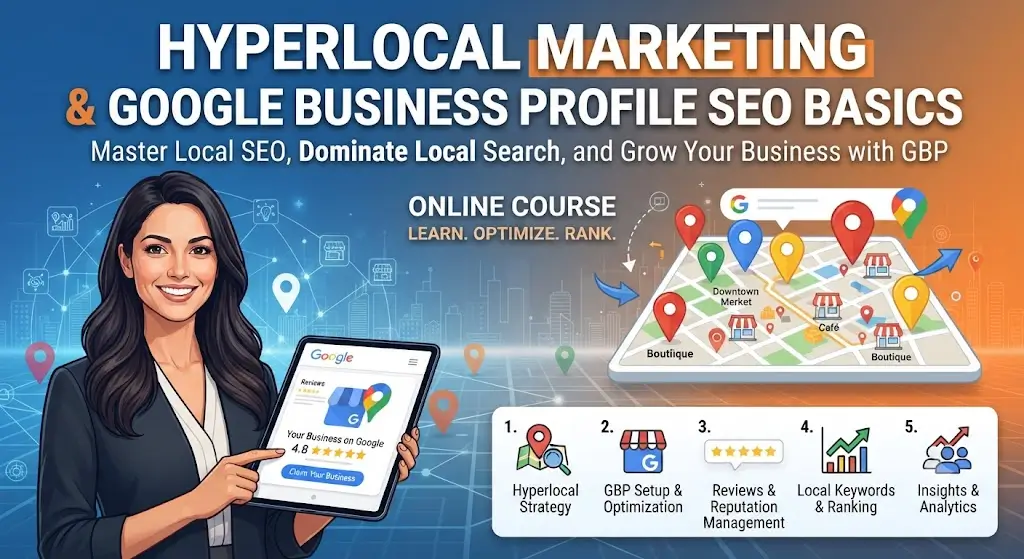
Hyperlocal Marketing & Google Business Profile SEO Basics
Introduction
The Hyperlocal Marketing & Google Business Profile SEO Basics course is designed to help learners understand the fundamentals of local digital marketing and Google Business Profile optimization. Today, customers often search online for businesses, products, and services located close to them.
Because of this behavior, local visibility has become important for businesses that serve specific communities, neighborhoods, cities, or service areas. A well-optimized Google Business Profile can help potential customers discover useful information about a business when searching locally.
This course introduces practical methods for improving local visibility. Learners will explore business profile optimization, local keywords, customer reviews, photos, posts, business information, and location-based content.
Moreover, the course explains how hyperlocal marketing can connect online activity with nearby customer needs.
Understanding Hyperlocal Marketing
Hyperlocal marketing focuses on reaching customers within a very specific geographic area. Instead of targeting an entire country or broad market, businesses can concentrate on neighborhoods, communities, districts, towns, or nearby service areas.
For example, a restaurant may target customers within a few kilometers. Similarly, a local plumber can focus on households within selected neighborhoods.
Hyperlocal marketing can include:
- Local search optimization
- Google Business Profile
- Location-based content
- Local keywords
- Customer reviews
- Community marketing
- Local social media
- Local promotions
- Nearby customer targeting
- Location-specific landing pages
Therefore, the strategy is particularly useful for businesses that depend on local customers.
Why Local Search Matters
Search engines help customers discover nearby businesses when they need products or services. Queries such as “restaurant near me,” “dentist nearby,” or “best salon in [location]” show strong local intent.
Businesses that provide accurate and relevant information can improve their chances of appearing in these searches.
Local search can influence:
- Business discovery
- Website visits
- Phone calls
- Direction requests
- Store visits
- Customer inquiries
- Online bookings
- Purchases
As a result, local SEO can support both online and offline business activity.
Introduction to Google Business Profile
Google Business Profile is a free business listing that allows organizations to manage important information displayed across Google Search and Maps.
A profile can provide customers with details such as:
- Business name
- Address
- Phone number
- Website
- Business hours
- Category
- Photos
- Reviews
- Services
- Products
- Business updates
Keeping this information accurate is essential.
Furthermore, an updated profile can make it easier for customers to understand what a business offers.
Setting Up a Google Business Profile
A strong profile begins with accurate setup. Learners will understand the basic information required for creating and managing a business profile.
Important details include:
- Correct business name
- Accurate address
- Contact information
- Business category
- Opening hours
- Website
- Service areas
Consistency matters throughout the setup process.
For example, business details should match information shown on the company’s website and other relevant platforms.
Consequently, accurate information can improve customer confidence.
Choosing the Right Business Category
Business categories help Google understand what a company offers. Selecting the most relevant primary category is therefore important.
A business may also have additional categories when appropriate.
For instance, a restaurant may select a category that accurately represents its primary service. A home-service company can choose a category that reflects its main service type.
The selected category should describe the business accurately rather than simply targeting a popular keyword.
Optimizing Business Information
Complete business information can improve the usefulness of a profile. Learners will explore how to review and update important profile details.
Key areas include:
- Business name
- Address
- Phone number
- Website
- Hours
- Service area
- Business description
- Categories
Additionally, businesses should update information whenever changes occur.
Therefore, profile maintenance should be treated as an ongoing activity.
Writing a Local Business Description
The business description provides an opportunity to explain what the company offers. A useful description should be clear, relevant, and customer-focused.
It can mention:
- Main services
- Products
- Service areas
- Customer benefits
- Business strengths
- Relevant local context
However, keyword stuffing should be avoided.
Instead, businesses should use natural language that explains their value clearly.
As a result, the description can remain useful to both customers and search engines.
Understanding Local Keywords
Local keywords combine search intent with geographic relevance. Learners will practice identifying keywords that customers may use when looking for nearby businesses.
Examples include:
- Service + city
- Product + neighborhood
- Business type + location
- Service + “near me”
- Product + local area
For example, a customer may search for “coffee shop in Jaipur” or “AC repair near me.”
Therefore, understanding local search language can help businesses create more relevant content.
Conducting Basic Local Keyword Research
Keyword research helps businesses understand how potential customers search. Learners will explore simple ways to identify local search terms.
Useful research sources include:
- Google Search suggestions
- Related searches
- Customer questions
- Competitor listings
- Website search data
- Local service terms
First, identify the core service or product. Next, add relevant location terms and customer intent.
Afterward, review which phrases naturally match the business.
Optimizing for “Near Me” Searches
“Near me” searches often indicate strong local intent. Customers using these searches are usually looking for a nearby solution.
Businesses can support this intent by maintaining:
- Accurate location information
- Correct business categories
- Updated hours
- Relevant services
- Customer reviews
- Local content
However, businesses cannot simply force a profile to rank for every “near me” query.
Instead, relevance, distance, and overall profile quality influence local visibility.
Building Local Relevance
Local relevance helps search engines and customers understand where a business operates and what it offers.
Businesses can strengthen relevance through:
- Accurate profile information
- Local keywords
- Service descriptions
- Location pages
- Local content
- Reviews
- Community references
For example, a service business can create useful content around the specific areas it serves.
Consequently, local relevance can become stronger over time.
Managing Business Photos
Photos can make a business profile more informative and attractive. Learners will explore how different types of images can support local discovery.
Useful images may include:
- Storefront photos
- Interior photos
- Product photos
- Team photos
- Service photos
- Work examples
- Location images
Images should accurately represent the business.
Furthermore, fresh and relevant visual content can help customers understand what to expect.
Using Google Business Profile Posts
Business updates can help communicate timely information. Posts may highlight promotions, announcements, products, services, events, or useful updates.
Possible post topics include:
- New products
- Special offers
- Seasonal services
- Events
- Business announcements
- Customer information
Content should provide genuine value.
As a result, regular updates can help keep the business profile active and informative.
Managing Customer Reviews
Reviews can influence customer trust and local decision-making. Positive experiences may encourage potential customers to choose one business over another.
Businesses should create a simple process for requesting feedback from genuine customers.
Review management includes:
- Encouraging authentic reviews
- Monitoring new reviews
- Responding professionally
- Addressing customer concerns
- Thanking customers
Importantly, businesses should never create fake reviews.
Instead, genuine customer feedback should form the foundation of the review strategy.
Responding to Reviews
Professional responses can demonstrate that a business values customer feedback.
For positive reviews, businesses can express appreciation. Meanwhile, negative reviews require calm and constructive communication.
A useful response can:
- Acknowledge the customer’s experience.
- Thank them for their feedback.
- Address the concern professionally.
- Offer an appropriate next step.
Therefore, review responses can support customer relationships and brand reputation.
Maintaining NAP Consistency
NAP refers to Name, Address, and Phone number. Consistency across business listings can help reduce confusion.
Businesses should check whether their details are consistent across:
- Website
- Google Business Profile
- Local directories
- Social profiles
- Industry listings
Even small differences can create uncertainty for customers.
Consequently, regular information checks are useful for local marketing.
Creating Local Content
Local content connects business expertise with geographic relevance. Learners will explore basic content ideas that can support hyperlocal marketing.
Examples include:
- Neighborhood guides
- Local service tips
- Community information
- Local customer questions
- Area-specific service pages
- Local events
- Seasonal information
For example, a home-service business could create maintenance tips for homeowners in specific service areas.
Thus, local content can provide value while strengthening geographic relevance.
Creating Location-Specific Landing Pages
Businesses serving multiple areas may use location-specific landing pages. Each page should provide genuinely useful information about the relevant service area.
A strong local page can include:
- Service information
- Local area details
- Customer benefits
- Relevant FAQs
- Contact information
- Service availability
However, businesses should avoid creating many nearly identical pages with only location names changed.
Instead, each page should provide unique value.
Local Competitor Research
Competitor research can help businesses understand the local market. Learners will explore basic methods for reviewing competing business profiles.
Useful areas to compare include:
- Categories
- Reviews
- Photos
- Services
- Descriptions
- Content activity
- Customer engagement
The goal is not to copy competitors.
Rather, the information can help identify opportunities for improvement.
Understanding Local Ranking Factors
Local visibility depends on several factors. Learners will gain a basic understanding of three important concepts:
- Relevance
- Distance
- Prominence
Relevance relates to how well a business matches a search. Distance considers the relationship between the searcher and business location. Prominence relates to how well-known or established a business appears to be.
Therefore, local SEO requires a balanced approach rather than reliance on one tactic.
Tracking Customer Actions
A business profile can generate valuable customer actions. These actions can help marketers understand how customers interact with the listing.
Important activities may include:
- Website visits
- Phone calls
- Direction requests
- Profile interactions
- Search visibility
- Customer messages
Tracking these actions can provide useful performance insights.
As a result, businesses can identify which areas require improvement.
Basic Local SEO Measurement
Measurement helps determine whether local marketing efforts are producing results.
Learners will explore basic indicators such as:
- Search visibility
- Profile interactions
- Website traffic
- Calls
- Direction requests
- Review growth
- Customer inquiries
Metrics should be evaluated over time rather than from a single day.
Furthermore, businesses should compare performance against their own previous results.
Improving Local Customer Engagement
Local marketing should not stop when customers find a business. Engagement can help turn discovery into action.
Businesses can encourage engagement through:
- Useful profile information
- Helpful content
- Fast responses
- Genuine reviews
- Relevant offers
- Clear CTAs
- Accurate contact details
Therefore, the profile should make it easy for customers to take the next step.
Common Hyperlocal Marketing Mistakes
Beginners may make several common mistakes when managing local marketing.
These include:
- Incorrect business information
- Wrong business category
- Keyword stuffing
- Inconsistent NAP details
- Ignoring reviews
- Using poor-quality photos
- Creating duplicate location pages
- Neglecting profile updates
- Using misleading information
- Focusing only on rankings
Fortunately, these issues can often be addressed through regular profile management.
Best Practices for Google Business Profile SEO
Keep Information Accurate
Review business details regularly and update them whenever changes occur.
Select Relevant Categories
Choose categories that accurately describe the business and its primary offerings.
Use Natural Local Keywords
Include relevant location terms where they genuinely help customers.
Add Useful Photos
Use clear images that accurately represent the business, products, services, and location.
Encourage Genuine Reviews
Ask real customers to share honest feedback about their experiences.
Respond Professionally
Answer reviews and customer questions in a helpful and respectful manner.
Publish Useful Updates
Share relevant announcements, offers, products, services, and local information.
Maintain Consistency
Keep important business information consistent across online platforms.
Create Valuable Local Content
Publish content that answers questions and provides useful information for local customers.
Monitor Performance
Review profile activity and customer actions to identify improvement opportunities.
Practical Exercises
The course encourages practical application of the concepts covered.
Learners can practice:
- Creating a hyperlocal marketing plan
- Identifying target service areas
- Researching local keywords
- Reviewing Google Business Profiles
- Selecting business categories
- Writing business descriptions
- Checking NAP consistency
- Planning profile photos
- Creating local post ideas
- Developing review response templates
- Identifying local content topics
- Reviewing competitor profiles
- Planning location-specific content
- Tracking local customer actions
- Identifying profile improvement opportunities
These activities help learners connect local SEO concepts with practical business needs.
What You Will Learn
By completing the Hyperlocal Marketing & Google Business Profile SEO Basics course, learners will be able to:
- Understand hyperlocal marketing
- Explain local search intent
- Understand Google Business Profile
- Set up basic profile information
- Select relevant business categories
- Optimize business information
- Write local business descriptions
- Identify local keywords
- Conduct basic local keyword research
- Understand “near me” searches
- Improve local relevance
- Manage business photos
- Create profile post ideas
- Manage customer reviews
- Respond to reviews professionally
- Understand NAP consistency
- Create local content
- Plan location-specific pages
- Conduct basic competitor research
- Understand local ranking factors
- Track customer actions
- Measure basic local SEO performance
- Improve local customer engagement
- Avoid common local marketing mistakes
Skills You Will Gain
Participants will develop skills in:
- Hyperlocal marketing
- Local SEO
- Google Business Profile optimization
- Local keyword research
- Local content planning
- Business profile management
- Review management
- Local competitor research
- NAP consistency
- Location-based marketing
- Customer engagement
- Local performance tracking
- Business listing optimization
Benefits of This Course
Improve Local Visibility
Learners gain practical knowledge for improving how businesses appear in local search environments.
Attract Nearby Customers
Hyperlocal strategies can help businesses connect with customers who are actively searching for nearby products and services.
Strengthen Business Profiles
Participants learn how to maintain accurate and useful Google Business Profile information.
Build Customer Trust
Reviews, photos, accurate information, and professional responses can strengthen customer confidence.
Support Local SEO
Learners understand the basic techniques that can contribute to stronger local search visibility.
Improve Customer Engagement
A well-managed profile can make it easier for customers to call, visit, browse, or contact a business.
Develop Practical Marketing Skills
The course combines local SEO concepts with activities that can be applied to real business situations.
Who Should Enroll?
The Hyperlocal Marketing & Google Business Profile SEO Basics course is suitable for:
- Small Business Owners
- Entrepreneurs
- Digital Marketing Professionals
- Local Marketing Specialists
- Social Media Managers
- SEO Professionals
- Content Marketers
- Retail Business Owners
- Restaurant Owners
- Service Providers
- E-Commerce Professionals
- Marketing Executives
- Freelancers
- Marketing Consultants
It is particularly useful for professionals who want to improve local visibility and attract customers within specific geographic markets.
Career Opportunities
The skills developed through this course can support roles such as:
- Local SEO Specialist
- Digital Marketing Executive
- Local Marketing Specialist
- SEO Executive
- Digital Marketing Consultant
- Social Media Specialist
- Content Marketing Specialist
- Business Marketing Manager
- Local Search Marketing Specialist
These skills can also support freelancers and entrepreneurs who manage marketing activities for local businesses.
Practical Applications
The concepts from this course can be applied across many industries.
A restaurant can use local SEO to help nearby customers discover its menu, location, and opening hours. Similarly, a salon can use Google Business Profile to showcase services, photos, reviews, and contact information.
A home-service provider can target specific service areas with location-focused content. Meanwhile, a retail store can use local marketing to promote products and offers to nearby customers.
Therefore, hyperlocal marketing can support businesses that depend on geographic proximity and local customer demand.
Certification
Upon successful completion of the Hyperlocal Marketing & Google Business Profile SEO Basics course, learners receive a professional course completion certificate.
The certificate recognizes foundational knowledge of hyperlocal marketing, Google Business Profile optimization, local keyword research, review management, local content, customer engagement, and basic local SEO measurement.
Additionally, the certificate can strengthen a professional profile. It may demonstrate relevant skills for digital marketing, SEO, local marketing, social media, and business development roles.
Conclusion
The Hyperlocal Marketing & Google Business Profile SEO Basics course provides a practical introduction to local search visibility and geographic customer targeting.
Successful local marketing requires accurate information, relevant keywords, useful content, genuine customer reviews, strong profile management, and consistent optimization.
Throughout the course, learners explore the fundamentals of hyperlocal marketing and Google Business Profile SEO. They learn how to improve business information, identify local keywords, manage reviews, create local content, evaluate competitors, and track customer actions.
Furthermore, the course connects local search strategies with practical business goals. Learners can apply these techniques to restaurants, retail stores, professional services, home-service businesses, and other location-focused organizations.
Whether the goal is to improve a local business presence, develop digital marketing skills, or support clients with local SEO, this course provides a strong foundation for effective hyperlocal marketing.
Frequently Asked Questions
1. What is the Hyperlocal Marketing & Google Business Profile SEO Basics course?
It is a beginner-friendly course that explains hyperlocal marketing, Google Business Profile optimization, local keywords, reviews, local content, and basic local SEO.
2. Who should take this course?
Small business owners, marketers, entrepreneurs, SEO professionals, local service providers, and digital marketing learners can benefit from it.
3. Does the course cover Google Business Profile optimization?
Yes. Learners explore business information, categories, descriptions, photos, posts, reviews, and profile maintenance.
4. Will I learn local keyword research?
Yes. The course covers basic methods for identifying location-based keywords and understanding local search intent.
5. What are hyperlocal marketing strategies?
They include local SEO, location-based content, Google Business Profile optimization, reviews, local promotions, and geographic customer targeting.
6. Does the course cover customer reviews?
Yes. Participants learn how to encourage genuine reviews and respond professionally to customer feedback.
7. Can this course help local businesses?
Yes. The strategies can be applied to restaurants, retailers, salons, home-service providers, professional services, and other local businesses.
8. Does the course explain “near me” searches?
Yes. Learners explore the meaning of “near me” searches and the importance of accurate local business information.
9. Will I learn how to create local content?
Yes. The course introduces practical local content ideas, service-area topics, neighborhood information, and location-focused pages.
10. Does the course cover local SEO measurement?
Yes. Participants learn about basic indicators such as profile interactions, website visits, calls, direction requests, and customer inquiries.
11. Is this course suitable for beginners?
Yes. The course focuses on foundational concepts and practical activities, making it suitable for learners developing basic local marketing skills.
12. Will I receive a certificate?
Yes. Learners receive a professional course completion certificate after successfully completing the Hyperlocal Marketing & Google Business Profile SEO Basics course.



Reviews
There are no reviews yet.