
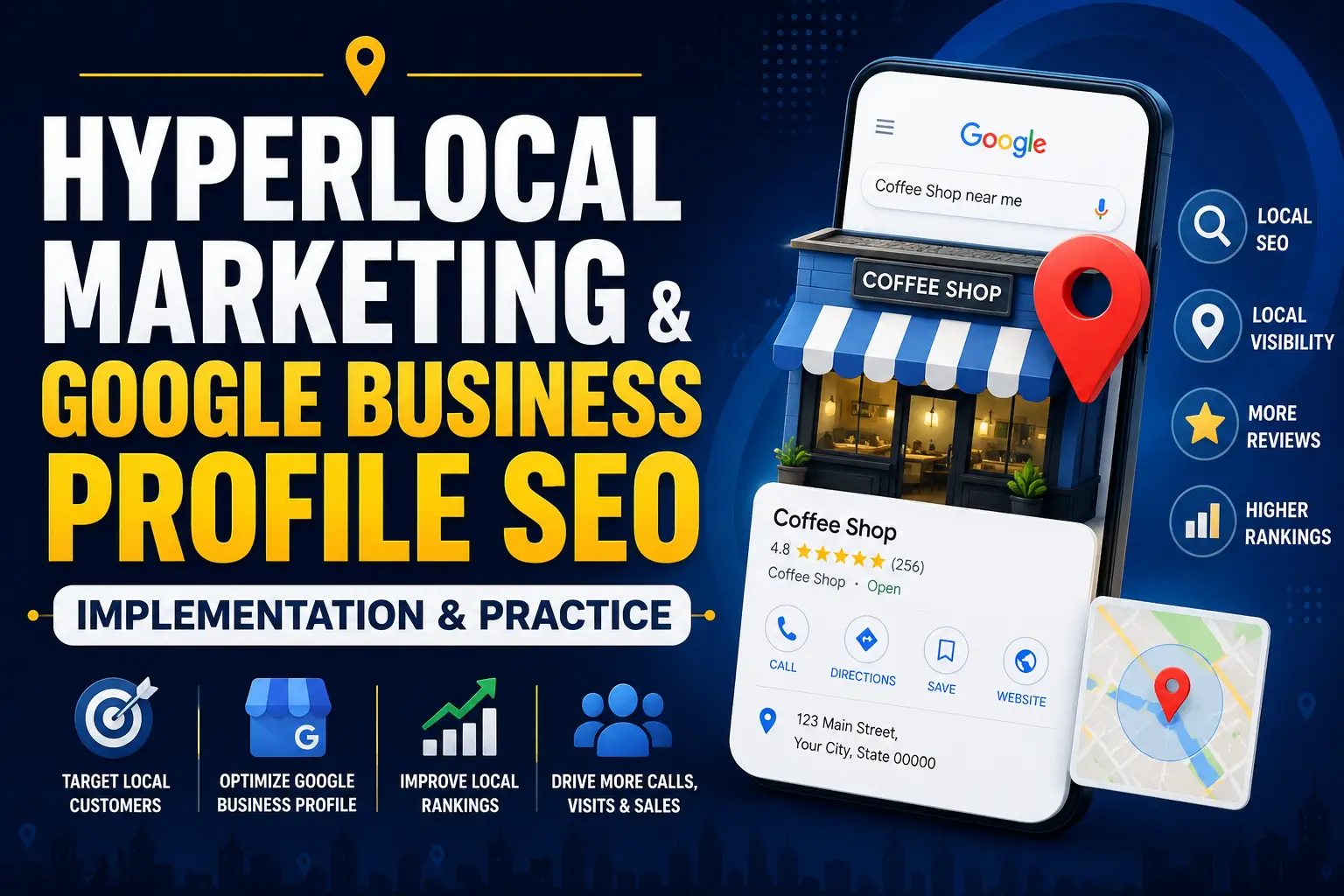
Hyperlocal Marketing & Google Business Profile SEO Implementation & Practice
Introduction
The Hyperlocal Marketing & Google Business Profile SEO Implementation & Practice course is designed for learners who want practical experience in local search optimization and geographic marketing. Instead of focusing only on theory, the course emphasizes implementation, practice, analysis, and improvement.
Local customers often search for businesses, products, and services within a specific geographic area. Therefore, businesses need accurate information and relevant local strategies to appear in front of the right audience.
This course guides learners through practical applications of hyperlocal marketing. Participants will work with Google Business Profile optimization, local keywords, location-based content, reviews, competitor research, service areas, citations, and conversion strategies.
Moreover, the course helps learners understand how individual local SEO activities work together as part of a wider marketing plan.
Understanding Hyperlocal Marketing
Hyperlocal marketing focuses on reaching customers within a clearly defined geographic area. These areas may include neighborhoods, districts, communities, towns, or service zones.
The implementation process begins by identifying where the target customers are located. Next, marketers can connect those locations with customer needs and search behavior.
Learners will practice:
- Defining geographic target areas
- Identifying local customer groups
- Understanding local search behavior
- Finding location-based opportunities
- Creating relevant local messages
- Connecting local visibility with customer actions
As a result, businesses can develop more focused marketing strategies.
Defining the Local Target Audience
A practical hyperlocal strategy starts with a clear audience. Geographic location alone does not explain why customers choose a business.
Participants will consider:
- Customer needs
- Search intent
- Buying behavior
- Service requirements
- Location
- Local preferences
- Customer problems
For example, a restaurant may focus on nearby office workers during lunch hours. Meanwhile, a home-service provider may target homeowners within selected neighborhoods.
Consequently, marketers can create more relevant campaigns.
Geographic Targeting Practice
Learners will practice identifying locations that are most valuable for a business.
Target areas may include:
- Neighborhoods
- Districts
- Cities
- Residential communities
- Commercial zones
- Service areas
The chosen locations should reflect actual business coverage.
Furthermore, participants can evaluate factors such as competition, customer density, accessibility, and service demand.
Understanding Local Search Intent
Local search intent explains what a customer wants when using a location-based search.
Common intentions include:
- Finding a nearby business
- Comparing providers
- Checking business information
- Finding a service
- Requesting directions
- Making a booking
- Contacting a business
- Making a purchase
A search for “plumber near me” can indicate immediate service intent. In contrast, a search for “best plumbers in [location]” may indicate comparison.
Therefore, learners will practice matching local content with different types of search intent.
Google Business Profile Implementation
Google Business Profile is an important part of local search visibility. The course provides practical activities for reviewing and improving profile information.
Learners will practice working with:
- Primary categories
- Additional categories
- Business description
- Services
- Products
- Business hours
- Service areas
- Photos
- Posts
- Reviews
- Contact details
Each element should provide accurate and useful information.
Rather than treating the profile as a one-time setup, participants will learn how to approach it as an ongoing marketing asset.
Google Business Profile Audit
A profile audit helps identify areas that require attention.
Participants will practice reviewing:
- Business information
- Categories
- Services
- Business description
- Hours
- Photos
- Reviews
- Posts
- Service areas
- Customer engagement
After the audit, learners can prioritize improvements according to business needs.
As a result, optimization becomes more structured and measurable.
Applying Business Category Strategies
Business categories help communicate what a company offers. Learners will practice evaluating category choices based on actual products and services.
The process includes:
- Identifying the core offering
- Reviewing relevant categories
- Selecting appropriate additional categories
- Checking category accuracy
- Avoiding irrelevant selections
Accuracy should remain the priority.
Therefore, category optimization should support genuine business representation.
Optimizing Business Information
Customers need reliable information before deciding whether to contact or visit a business.
Participants will practice reviewing:
- Business name
- Address
- Phone number
- Website
- Business hours
- Services
- Service areas
Information should remain accurate across important platforms.
Moreover, regular checks can help identify outdated details before they affect customers.
Creating Business Descriptions
A business description should explain what the company does and whom it serves.
Learners will practice creating descriptions that include:
- Main services
- Products
- Customer benefits
- Service areas
- Business strengths
- Relevant local context
Natural language is essential.
For this reason, descriptions should prioritize customer understanding instead of excessive keyword repetition.
Local Keyword Research Practice
Local keyword research identifies the terms customers use when looking for nearby businesses.
Learners will practice finding:
- Service + location keywords
- Product + location keywords
- Neighborhood searches
- “Near me” searches
- Local questions
- Problem-based searches
- Comparison searches
The activity begins with the main product or service. Next, geographic and intent-based variations are identified.
Then, related terms can be organized into useful groups.
Building Local Keyword Clusters
Keyword clustering makes content planning easier. Related searches can be grouped around a central service or customer need.
For example, a cleaning company may create clusters around:
- Home cleaning
- Deep cleaning
- Office cleaning
- Emergency cleaning
- Cleaning in specific locations
- Local cleaning questions
This structure can guide website content and local marketing campaigns.
Furthermore, clustering can reduce repetitive content.
Neighborhood-Level Marketing Practice
Hyperlocal marketing often involves targeting smaller geographic areas. Learners will practice developing strategies for neighborhoods and communities.
Activities may include:
- Identifying neighborhood needs
- Planning local content
- Creating area-specific FAQs
- Developing neighborhood guides
- Identifying local search terms
- Mapping available services
However, content should only target areas that are genuinely relevant to the business.
Consequently, local targeting remains useful and credible.
Service-Area Strategy
Service-area businesses need accurate geographic coverage.
Learners will practice defining service areas for businesses such as:
- Plumbers
- Electricians
- Cleaning providers
- Repair companies
- Delivery services
- Consultants
- Home improvement businesses
The strategy should reflect where the business can actually serve customers.
Therefore, service-area information must remain realistic and current.
Creating Local Content
Local content helps businesses answer questions that matter to nearby customers.
Participants will practice developing:
- Neighborhood guides
- Local service articles
- Area-specific FAQs
- Local buying guides
- Community resources
- Seasonal content
- Service-area guides
- Location-based case studies
Each content idea should provide a clear customer benefit.
In addition, local content can support both search visibility and customer education.
Creating Location-Specific Pages
Businesses serving multiple locations may need location-focused pages. Learners will practice planning pages that provide genuine value.
A useful page may include:
- Local services
- Service availability
- Customer needs
- Local FAQs
- Relevant testimonials
- Contact options
- Helpful geographic information
Simply changing a location name across identical pages should be avoided.
Instead, every page should provide meaningful and relevant information.
Google Business Profile Post Practice
Profile posts can communicate current information to potential customers.
Learners will practice creating posts around:
- New products
- New services
- Promotions
- Events
- Seasonal updates
- Business announcements
- Educational tips
Different topics can be rotated to keep the content useful.
As a result, businesses can maintain a more active customer communication strategy.
Local Photo Planning
Images can help customers understand a business before making contact.
Participants will practice planning photo categories such as:
- Exterior images
- Interior images
- Products
- Team members
- Services
- Work examples
- Location visuals
Photos should accurately represent the business.
Furthermore, visual content should remain current and relevant.
Customer Review Management Practice
Reviews provide valuable information about customer experiences. Learners will practice building a structured review management process.
Activities include:
- Monitoring new reviews
- Encouraging genuine feedback
- Responding professionally
- Identifying recurring concerns
- Thanking customers
- Using feedback for improvement
Fake reviews should never be part of the strategy.
Instead, businesses should focus on genuine customer experiences.
Writing Review Responses
Participants will practice responding to different review situations.
Positive reviews may require appreciation. Neutral feedback can receive a helpful acknowledgment. Negative reviews require calm and professional communication.
A useful process is:
- Acknowledge the customer.
- Address the main point.
- Maintain professionalism.
- Provide an appropriate next step.
- Follow up when necessary.
This approach can support a stronger customer experience.
Competitor Analysis Practice
Competitor research helps marketers understand the local market.
Learners will practice comparing:
- Business categories
- Services
- Reviews
- Photos
- Profile information
- Local content
- Keywords
- Website pages
- Customer engagement
The goal is to identify opportunities rather than copy competitors.
Therefore, competitor analysis can support differentiation.
Competitor Review Analysis
Customer reviews can reveal what people value most.
Participants will practice identifying:
- Commonly praised services
- Frequent complaints
- Customer expectations
- Service gaps
- Communication issues
- Product concerns
These findings can influence marketing messages.
Moreover, they may highlight opportunities for improving customer experience.
NAP Consistency Practice
NAP means Name, Address, and Phone number. Consistent information helps customers identify and contact a business.
Learners will practice checking NAP details across:
- Website
- Google Business Profile
- Social media
- Local directories
- Industry listings
- Business platforms
If differences appear, participants can identify which information needs correction.
Consequently, regular NAP checks can become part of local SEO maintenance.
Local Citation Management
Citations are online references to a business. They may appear on directories, industry websites, local platforms, and other relevant sources.
Participants will practice reviewing:
- Business name
- Address
- Phone number
- Website
- Category
- Listing accuracy
Not every directory needs to be used.
Instead, businesses should prioritize relevant and trustworthy platforms.
Local Reputation Management
Reputation management involves monitoring how customers perceive a business online.
Learners will practice tracking:
- Reviews
- Customer comments
- Business listings
- Social mentions
- Local platform activity
Regular monitoring can help businesses identify issues earlier.
Furthermore, feedback can provide useful information for marketing and service improvements.
Local Social Media Practice
Social media can support hyperlocal marketing by helping businesses connect with nearby audiences.
Participants will practice developing:
- Local event posts
- Community content
- Customer stories
- Area-specific promotions
- Local tips
- Business updates
Content should remain relevant to the community.
Therefore, local social media can complement search-focused marketing.
Community Marketing
Community engagement can strengthen relationships with local customers.
Practical activities may include:
- Supporting local events
- Sharing community information
- Collaborating with nearby businesses
- Highlighting local customers
- Creating useful local resources
These activities can build familiarity and trust.
As a result, hyperlocal marketing can become more relationship-focused.
Local Conversion Optimization
Getting found is only the first step. Businesses also need to make it easy for customers to take action.
Learners will practice improving:
- Calls
- Messages
- Bookings
- Quote requests
- Website visits
- Store visits
- Purchases
- Direction requests
Clear contact information can reduce friction.
Additionally, strong calls to action can guide customers toward the next step.
Local Customer Journey
Participants will practice mapping the local customer journey.
A typical journey may look like:
Discovery → Research → Comparison → Trust → Action → Retention
During discovery, visibility matters. Next, business information and reviews can support research.
Afterward, trust signals may influence the final decision.
Finally, a positive experience can encourage repeat business.
Local Conversion Tracking
Tracking helps businesses understand whether local marketing creates valuable actions.
Learners will practice monitoring:
- Profile interactions
- Calls
- Messages
- Website visits
- Bookings
- Direction requests
- Quote requests
- Purchases
These metrics should connect with business goals.
Therefore, marketers can focus on meaningful outcomes instead of visibility alone.
Local SEO Audit Practice
Learners will conduct structured local SEO audits.
The audit can include:
- Google Business Profile
- Business information
- Categories
- Services
- Photos
- Reviews
- Keywords
- Local content
- Location pages
- Citations
- Competitors
- Conversion activity
Once the audit is complete, findings can be ranked by priority.
Building a Local SEO Action Plan
An action plan turns observations into implementation tasks.
Learners will practice defining:
- Current issue
- Recommended action
- Priority
- Responsible person
- Timeline
- Expected result
- Measurement method
High-impact tasks can be addressed first.
Meanwhile, lower-priority improvements can be scheduled for later.
Practical Implementation Projects
The course includes hands-on projects that reinforce the concepts covered throughout the program.
Learners can practice:
- Creating a hyperlocal marketing plan
- Defining target locations
- Building local audience segments
- Mapping search intent
- Auditing Google Business Profile
- Improving profile information
- Reviewing categories
- Researching local keywords
- Creating keyword clusters
- Planning neighborhood content
- Developing service-area strategies
- Creating location page outlines
- Planning profile posts
- Developing photo plans
- Creating review response templates
- Analyzing local competitors
- Reviewing competitor feedback
- Auditing NAP information
- Reviewing local citations
- Creating local social media content
- Mapping the customer journey
- Defining local conversion goals
- Tracking customer actions
- Building a local SEO roadmap
These activities help learners develop practical confidence.
Common Implementation Challenges
Real-world local SEO projects can involve several challenges.
Common issues include:
- Incomplete business information
- Incorrect categories
- Weak local keywords
- Limited reviews
- Poor review responses
- Duplicate information
- Inconsistent citations
- Thin location pages
- Repetitive content
- Weak calls to action
- Limited conversion tracking
Fortunately, structured audits can help identify these problems.
Moreover, regular monitoring allows marketers to make improvements over time.
Best Practices for Implementation
Keep Business Information Accurate
Review important business details regularly and correct outdated information.
Focus on Genuine Locations
Target areas where the business actually operates or serves customers.
Use Natural Keywords
Include relevant local keywords without forcing them into every sentence.
Create Useful Content
Build content around genuine customer questions and local needs.
Encourage Genuine Reviews
Focus on delivering strong customer experiences and requesting authentic feedback.
Respond Professionally
Treat both positive and negative feedback with respect.
Analyze Competitors
Use competitor research to discover gaps and opportunities.
Track Meaningful Actions
Measure calls, inquiries, bookings, visits, and other valuable outcomes.
Audit Regularly
Review local SEO performance and update strategies as needed.
What You Will Learn
By completing the Hyperlocal Marketing & Google Business Profile SEO Implementation & Practice course, learners will be able to:
- Apply hyperlocal marketing strategies
- Define geographic target areas
- Identify local customer segments
- Understand local search intent
- Audit Google Business Profile
- Optimize business information
- Review business categories
- Improve business descriptions
- Conduct local keyword research
- Build local keyword clusters
- Apply neighborhood-level targeting
- Develop service-area strategies
- Create local content
- Plan location-specific pages
- Create Google Business Profile posts
- Plan local visual content
- Manage customer reviews
- Write professional review responses
- Analyze local competitors
- Analyze competitor reviews
- Maintain NAP consistency
- Review local citations
- Manage local reputation
- Apply local social media strategies
- Develop community marketing activities
- Improve local conversions
- Map customer journeys
- Track local customer actions
- Conduct local SEO audits
- Build local SEO action plans
- Apply practical local marketing techniques
Skills You Will Gain
Participants will develop practical skills in:
- Hyperlocal marketing
- Local SEO
- Google Business Profile optimization
- Geographic targeting
- Local keyword research
- Search intent analysis
- Keyword clustering
- Local content creation
- Location page planning
- Service-area marketing
- Review management
- Reputation management
- Competitor analysis
- Citation management
- NAP auditing
- Local social media
- Conversion optimization
- Customer journey mapping
- Performance tracking
- SEO auditing
- Marketing implementation
Benefits of This Course
Practical Local SEO Experience
Learners apply local SEO concepts through realistic activities rather than relying only on theoretical knowledge.
Better Google Business Profile Management
Participants gain hands-on experience reviewing and improving important profile elements.
Stronger Geographic Targeting
The course helps learners develop strategies for reaching customers in specific neighborhoods, districts, and service areas.
Improved Local Content Planning
Participants learn how to create useful location-focused content that addresses customer needs.
Better Review Management
Learners practice professional review responses and develop methods for monitoring customer feedback.
Stronger Competitor Insights
Competitor analysis helps participants identify market gaps and opportunities for differentiation.
Improved Local Reputation
The course provides practical methods for monitoring business information, reviews, and customer feedback.
Conversion-Focused Marketing
Learners connect local search visibility with calls, bookings, inquiries, visits, and purchases.
Actionable SEO Planning
Participants finish with practical knowledge for creating structured local SEO action plans.
Who Should Enroll?
The Hyperlocal Marketing & Google Business Profile SEO Implementation & Practice course is suitable for:
- SEO Professionals
- Local SEO Specialists
- Digital Marketing Executives
- Digital Marketing Managers
- Local Marketing Specialists
- Business Owners
- Entrepreneurs
- Marketing Consultants
- Social Media Managers
- Content Marketers
- Freelancers
- Brand Managers
- Local Business Marketers
- Search Marketing Professionals
It is particularly valuable for learners who want to move from understanding local SEO concepts to applying them in realistic situations.
Career Opportunities
The practical skills from this course can support roles such as:
- Local SEO Specialist
- SEO Executive
- Digital Marketing Executive
- Local Marketing Specialist
- Search Marketing Specialist
- Digital Marketing Consultant
- Local Search Strategist
- Reputation Management Specialist
- Content Marketing Specialist
- Business Marketing Manager
These skills can be applied across restaurants, retail, hospitality, professional services, home services, education, healthcare, real estate, and other location-focused industries.
Practical Applications
The techniques covered in this course can be used across many business models.
A restaurant can improve local discovery through profile optimization, reviews, local content, and customer engagement. Similarly, a home-service provider can use service-area strategies to reach customers across selected neighborhoods.
A retail business can connect local search with store visits and promotions. Meanwhile, a professional service provider can use local keywords, reviews, and location-specific content to generate relevant inquiries.
Therefore, the course provides practical knowledge that can support both customer acquisition and local brand growth.
Certification
Upon successful completion of the Hyperlocal Marketing & Google Business Profile SEO Implementation & Practice course, learners receive a professional course completion certificate.
The certificate recognizes practical knowledge of hyperlocal marketing, Google Business Profile optimization, local keyword research, local content, review management, competitor analysis, reputation management, citation management, and local conversion strategies.
Additionally, the certificate can strengthen a professional portfolio. It may demonstrate practical skills relevant to local SEO, digital marketing, search marketing, content strategy, and customer acquisition.
Conclusion
The Hyperlocal Marketing & Google Business Profile SEO Implementation & Practice course is built around practical learning and real-world application.
Successful local marketing requires accurate business information, relevant geographic targeting, useful content, genuine customer reviews, strong reputation management, and measurable conversion strategies.
Throughout the course, learners practice auditing Google Business Profile, researching local keywords, developing location-focused content, analyzing competitors, managing reviews, checking citations, and tracking customer actions.
Furthermore, participants learn how to turn audit findings into clear action plans. They can then apply these strategies to restaurants, retail businesses, service providers, professional firms, and other local organizations.
Whether the goal is to support clients, manage local SEO campaigns, improve a business’s online presence, or develop practical digital marketing skills, this course provides a structured pathway for implementing hyperlocal marketing and Google Business Profile SEO strategies.
Frequently Asked Questions
1. What is the Hyperlocal Marketing & Google Business Profile SEO Implementation & Practice course?
It is a practical course focused on applying hyperlocal marketing, Google Business Profile optimization, local SEO, review management, content planning, and conversion strategies.
2. Who should enroll in this course?
SEO professionals, digital marketers, business owners, entrepreneurs, consultants, local marketing specialists, and freelancers can benefit from the course.
3. Is this course focused on practical implementation?
Yes. The course includes audits, keyword research, content planning, competitor analysis, review management, and local SEO action planning.
4. Will I learn Google Business Profile optimization?
Yes. Participants practice reviewing categories, business information, services, photos, posts, reviews, and service areas.
5. Does the course cover local keyword research?
Yes. Learners practice identifying local keywords, geographic modifiers, search intent, neighborhood terms, and keyword clusters.
6. Will I learn how to target neighborhoods?
Yes. The course includes neighborhood-level targeting and location-focused content planning.
7. Does the course cover customer reviews?
Yes. Participants learn how to monitor reviews, encourage genuine feedback, and create professional responses.
8. Will I practice competitor analysis?
Yes. Learners analyze competitor profiles, services, reviews, content, and customer engagement to identify opportunities.
9. Does the course cover local citations?
Yes. Participants practice reviewing business listings and maintaining accurate Name, Address, and Phone information.
10. Can these strategies be used for different industries?
Yes. The techniques can be applied to restaurants, retail businesses, home services, professional services, hospitality, education, real estate, and other local businesses.
11. Will I learn how to track local conversions?
Yes. The course covers calls, messages, bookings, website visits, inquiries, direction requests, and other customer actions.
12. Will I receive a certificate?
Yes. Learners receive a professional course completion certificate after successfully completing the Hyperlocal Marketing & Google Business Profile SEO Implementation & Practice course.



Reviews
There are no reviews yet.