
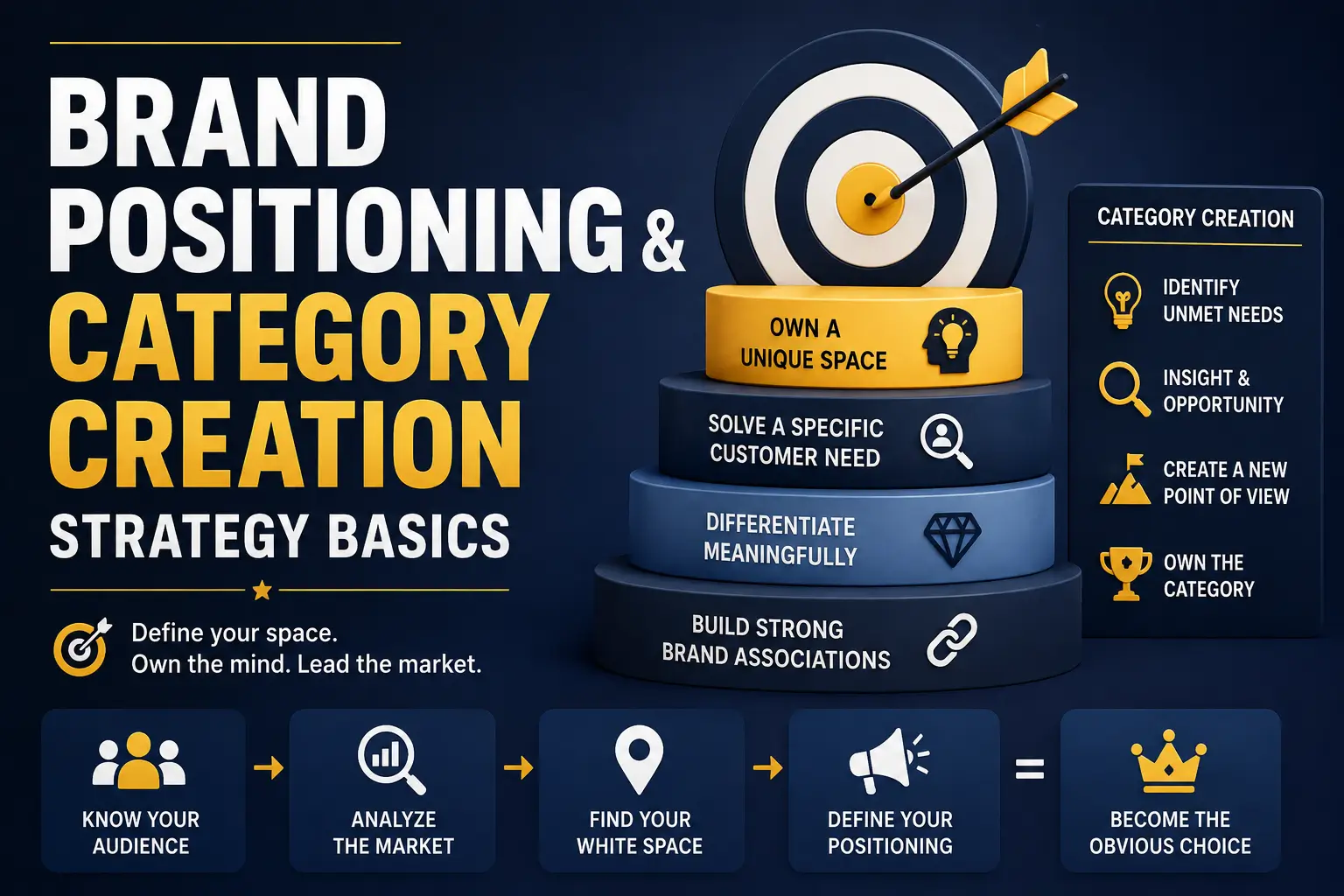
Brand Positioning & Category Creation Strategy Basics
Introduction
The Brand Positioning & Category Creation Strategy Basics course introduces the core principles of building a distinctive brand and creating a meaningful market position. In competitive markets, businesses need more than a good product. They also need a clear reason for customers to choose them.
Brand positioning helps define how a business should be understood by its target audience. Category creation, meanwhile, focuses on shaping a new market space or redefining an existing one.
This course brings both concepts together. Learners will explore customer needs, competitive positioning, value propositions, market categories, differentiation, messaging, and basic strategy development.
Moreover, practical examples will help participants connect branding concepts with real business situations.
Understanding Brand Positioning
Brand positioning describes the place a brand aims to occupy in the minds of its target customers.
A strong position should answer important questions:
- Who is the brand for?
- What problem does it solve?
- What makes it different?
- Why should customers believe it?
- Why should customers choose it?
Clear answers create a stronger foundation for marketing.
Therefore, positioning should be specific, relevant, and easy for customers to understand.
The Role of Brand Differentiation
Differentiation helps a brand stand apart from competitors. However, being different is not enough. The difference should also matter to customers.
Learners will explore differentiation based on:
- Product features
- Customer experience
- Service quality
- Expertise
- Innovation
- Convenience
- Price approach
- Brand personality
For example, a business may compete through specialized expertise instead of lower pricing.
As a result, differentiation can become a meaningful part of the brand strategy.
Identifying the Target Audience
Effective positioning begins with a clear understanding of the customer.
Participants will explore:
- Customer segments
- Customer needs
- Buying motivations
- Pain points
- Preferences
- Expectations
- Decision factors
A broad audience can make positioning vague.
Instead, marketers should identify the customers who are most likely to value the brand’s offering.
Understanding Customer Problems
Strong brands often connect their position with a specific customer problem.
Learners will practice identifying:
- Functional problems
- Emotional needs
- Business challenges
- Buying barriers
- Unmet expectations
- Customer frustrations
Understanding these problems can improve both positioning and messaging.
Furthermore, customer problems can reveal opportunities for category creation.
Creating a Value Proposition
A value proposition explains the value a brand provides to its target audience.
A practical value proposition can communicate:
- Target customer
- Customer problem
- Solution
- Main benefit
- Differentiating factor
The message should remain simple.
Consequently, customers can understand the brand’s value without unnecessary complexity.
Analyzing Competitor Positioning
Competitor analysis helps marketers understand how brands are currently positioned.
Learners will explore competitor factors such as:
- Target audience
- Core benefits
- Pricing
- Messaging
- Brand personality
- Product strengths
- Customer experience
- Market category
This analysis can reveal crowded areas and positioning gaps.
Therefore, competitor research is useful when developing a differentiated brand position.
Creating a Positioning Map
A positioning map can visually compare brands based on selected customer-relevant factors.
Possible dimensions include:
- Price vs. quality
- Traditional vs. innovative
- Basic vs. premium
- Generalist vs. specialist
- Convenience vs. customization
Learners will understand how positioning maps can reveal competitive patterns.
Moreover, these maps can highlight potential spaces for differentiation.
Understanding Market Categories
A market category groups products or services that customers view as related.
Examples include:
- Project management software
- Online education
- Fitness services
- Digital banking
- Customer relationship management
- Business consulting
Category membership influences customer expectations.
Therefore, choosing or shaping the right category can affect how a brand is evaluated.
Introduction to Category Creation
Category creation involves establishing a new market space or changing how customers understand an existing problem.
Instead of competing only within an established category, a company may create a new category around a different customer need.
For example, an emerging technology may combine features from several existing markets.
As a result, category creation can provide an alternative path to differentiation.
Category Creation vs. Product Innovation
Product innovation focuses primarily on developing something new or improved.
Category creation goes further. It changes how the market understands the problem, solution, or competitive space.
Learners will compare:
- Product innovation
- Brand differentiation
- Market repositioning
- Category creation
This distinction helps marketers choose an appropriate strategic approach.
Identifying Category Opportunities
New categories often emerge from changes in customer behavior, technology, or market expectations.
Learners will explore opportunities created by:
- Unmet customer needs
- Emerging technologies
- Changing lifestyles
- New business models
- Industry gaps
- Customer frustrations
- Shifting expectations
The goal is to identify a meaningful opportunity.
Therefore, category creation should begin with a real customer or market problem.
Defining a Category Problem
A category needs a clear reason to exist.
Participants will practice defining:
- The existing customer problem
- Why current solutions are insufficient
- What customers want instead
- How a new approach could solve the problem
Clear problem definition makes category communication easier.
Furthermore, it helps ensure that the proposed category offers meaningful value.
Developing a Category Concept
A category concept explains what the new market space represents.
It may define:
- The problem
- The solution approach
- Target audience
- Category name
- Key benefits
- Differentiating characteristics
A strong category concept should be simple enough to understand.
At the same time, it should offer enough distinction to stand apart from existing alternatives.
Creating a Category Name
Category names influence how customers understand a market space.
A useful category name should be:
- Clear
- Relevant
- Memorable
- Easy to communicate
- Connected to customer needs
Avoiding unnecessary complexity is important.
Consequently, a simple category name can make education and adoption easier.
Building Category Language
Category creation requires consistent language. Customers, employees, sales teams, and partners should understand what the category means.
Learners will explore how to define:
- Category terminology
- Key concepts
- Customer benefits
- Supporting language
- Common problems
- Differentiating ideas
Consistent language creates stronger market communication.
Developing Brand Messaging
Brand positioning needs to appear consistently across marketing channels.
Participants will explore messaging for:
- Websites
- Social media
- Advertising
- Sales presentations
- Product pages
- Email campaigns
- Content marketing
Each message should reinforce the same core position.
Therefore, consistency can strengthen brand recognition.
Positioning Statement Basics
A positioning statement provides an internal framework for communicating the brand.
It can clarify:
- Target audience
- Market category
- Customer problem
- Main benefit
- Differentiation
- Reason to believe
The statement does not need to become a public slogan.
Instead, it can guide broader brand communication.
Brand Promise
A brand promise describes the experience or value customers can expect.
An effective promise should be:
- Relevant
- Credible
- Distinctive
- Customer-focused
- Consistent
Overpromising can weaken trust.
For this reason, brand promises should align with the actual customer experience.
Understanding Brand Perception
Brand positioning reflects the intended position. Brand perception reflects how customers actually see the brand.
These two views may not always match.
Learners will explore factors that influence perception, including:
- Customer experience
- Product performance
- Reviews
- Advertising
- Social media
- Sales interactions
- Public communication
Therefore, businesses should regularly evaluate whether customer perception matches their desired position.
Aligning Product and Brand Positioning
A brand position should match the product experience.
If a company claims to offer premium service, customers should experience premium quality and support.
Similarly, a brand focused on convenience should make the buying process simple.
As a result, product delivery becomes an important part of positioning credibility.
Building Brand Credibility
A strong position needs supporting evidence.
Credibility can come from:
- Customer reviews
- Case studies
- Expertise
- Product results
- Testimonials
- Certifications
- Demonstrations
- Partnerships
These elements provide reasons for customers to believe the brand’s claims.
Moreover, evidence can make positioning more persuasive.
Understanding Category Leadership
Category leadership means becoming strongly associated with a particular market space.
Leadership may develop through:
- Clear positioning
- Consistent messaging
- Customer education
- Product innovation
- Thought leadership
- Strong customer experiences
However, leadership is not created through claims alone.
Instead, businesses need to demonstrate meaningful value over time.
Customer Education for New Categories
New categories often require customer education.
People may not immediately understand why the category matters or how it differs from existing solutions.
Therefore, marketers can use:
- Educational articles
- Guides
- Videos
- Webinars
- Case studies
- FAQs
- Demonstrations
These formats can explain the problem and introduce the new category.
Category Awareness
Category awareness develops when customers understand that a particular market space exists.
Businesses can increase awareness by explaining:
- The existing problem
- Why current solutions have limitations
- The new approach
- The benefits
- The reasons to consider change
This sequence makes category education easier.
Furthermore, consistent communication can improve recognition.
Creating Thought Leadership
Thought leadership can support both positioning and category creation.
Useful thought leadership topics may include:
- Industry problems
- Emerging trends
- New approaches
- Customer challenges
- Market predictions
- Educational frameworks
The content should provide genuine insight.
Consequently, the brand can become associated with expertise within its chosen space.
Applying Content Strategy
Content can reinforce brand positioning and educate the market.
Learners will explore content formats such as:
- Blog articles
- Case studies
- Guides
- White papers
- Videos
- Webinars
- Social media posts
- Infographics
Each format can serve a different purpose.
For example, educational content can introduce a new problem, while case studies can demonstrate results.
Sales and Positioning Alignment
Sales teams need to communicate the same positioning as marketing teams.
Learners will explore how positioning can influence:
- Sales presentations
- Pitch decks
- Discovery conversations
- Product demonstrations
- Objection handling
- Proposal messaging
Consistent communication creates a smoother customer journey.
Therefore, brand positioning should not remain only within the marketing department.
Category Creation and Customer Adoption
Creating a category does not automatically guarantee adoption.
Customers need to understand the value and feel comfortable changing their existing behavior.
Adoption can be supported through:
- Education
- Demonstrations
- Trial experiences
- Customer stories
- Clear comparisons
- Strong proof points
Gradually, these activities can reduce uncertainty.
Measuring Brand Positioning
Positioning can be evaluated through different indicators.
Useful measures may include:
- Brand awareness
- Brand associations
- Customer perception
- Search interest
- Engagement
- Conversion rates
- Customer feedback
- Competitive perception
Qualitative feedback can be particularly useful.
For instance, customer interviews may reveal how people naturally describe the brand.
Measuring Category Development
Category creation also requires measurement.
Possible indicators include:
- Category awareness
- Search growth
- Content engagement
- Media coverage
- Customer adoption
- Competitor participation
- Market interest
These signals can show whether the category is gaining recognition.
Furthermore, ongoing measurement helps marketers refine their strategy.
Common Positioning Mistakes
Several mistakes can weaken a brand position.
Common examples include:
- Trying to appeal to everyone
- Copying competitors
- Using vague messaging
- Focusing only on features
- Ignoring customer needs
- Changing positioning too frequently
- Making unsupported claims
Clear positioning requires discipline.
Therefore, brands should prioritize relevance and differentiation over complexity.
Common Category Creation Challenges
Creating a new category can be difficult because customers may already use familiar solutions.
Common challenges include:
- Low category awareness
- Customer confusion
- Strong existing competitors
- Education requirements
- Unclear terminology
- Weak differentiation
- Limited market understanding
However, clear communication and customer education can reduce these barriers.
Practical Exercises
This course includes practical activities that help learners apply foundational concepts.
Participants will practice:
- Defining target audiences
- Identifying customer problems
- Creating value propositions
- Analyzing competitor positioning
- Building positioning maps
- Identifying market gaps
- Defining category opportunities
- Developing category concepts
- Creating category names
- Building category language
- Drafting positioning statements
- Developing brand promises
- Creating messaging frameworks
- Planning customer education
- Developing thought leadership topics
- Aligning sales and marketing messages
- Identifying positioning metrics
- Creating basic category measurement plans
These exercises connect strategic concepts with realistic business situations.
What You Will Learn
By completing the Brand Positioning & Category Creation Strategy Basics course, learners will be able to:
- Understand brand positioning
- Identify target audiences
- Analyze customer needs
- Identify customer problems
- Develop value propositions
- Understand brand differentiation
- Analyze competitor positioning
- Create basic positioning maps
- Understand market categories
- Explore category creation
- Identify category opportunities
- Define category problems
- Develop category concepts
- Create category names
- Build category language
- Develop positioning statements
- Create brand promises
- Understand brand perception
- Align product and brand positioning
- Build brand credibility
- Understand category leadership
- Plan customer education
- Develop thought leadership ideas
- Create positioning-focused content
- Align sales and marketing messaging
- Measure basic brand positioning
- Track category development
- Avoid common positioning mistakes
Skills You Will Gain
Participants will develop practical skills in:
- Brand positioning
- Market segmentation
- Customer research
- Competitive analysis
- Value proposition development
- Brand differentiation
- Positioning mapping
- Category analysis
- Category creation
- Category naming
- Brand messaging
- Positioning statement development
- Brand promise development
- Customer education
- Content strategy
- Thought leadership
- Sales messaging
- Brand perception analysis
- Marketing measurement
Benefits of This Course
Build Clearer Brand Positioning
Learners understand how to create a focused position that connects with a specific customer audience.
Improve Differentiation
The course helps participants identify meaningful ways to separate a brand from competitors.
Understand Customer Needs
Participants learn how customer problems and expectations influence positioning decisions.
Explore Category Creation
Learners gain a foundation for identifying opportunities to create or reshape market categories.
Strengthen Brand Messaging
The course helps develop clearer and more consistent messaging across marketing channels.
Support Customer Education
Participants learn how educational content can explain new solutions and emerging categories.
Improve Competitive Understanding
Competitor analysis provides useful context for identifying gaps and differentiation opportunities.
Connect Strategy With Marketing
Learners understand how positioning can influence content, sales, advertising, and customer communication.
Who Should Enroll?
The Brand Positioning & Category Creation Strategy Basics course is suitable for:
- Marketing Professionals
- Brand Managers
- Digital Marketers
- Product Managers
- Entrepreneurs
- Business Owners
- Startup Founders
- Marketing Consultants
- Content Strategists
- Sales Professionals
- Product Marketing Professionals
- Advertising Professionals
- Freelancers
It is particularly useful for professionals who want to build foundational knowledge of brand positioning and market category strategy.
Career Opportunities
The concepts covered in this course can support roles such as:
- Brand Marketing Executive
- Brand Strategist
- Product Marketing Executive
- Marketing Manager
- Product Manager
- Digital Marketing Specialist
- Content Strategist
- Market Research Analyst
- Marketing Consultant
- Business Development Professional
These skills can be applied across technology, consumer products, professional services, education, retail, healthcare, and other industries.
Practical Applications
Brand positioning and category creation can support many types of businesses.
A technology company may position a product around a specific customer problem. Similarly, a consulting firm can differentiate itself through specialized expertise.
A startup may create a new category around an emerging customer need. Meanwhile, an established brand can reposition itself when customer expectations change.
Therefore, these concepts can support both new and existing businesses.
Certification
Upon successful completion of the Brand Positioning & Category Creation Strategy Basics course, learners receive a professional course completion certificate.
The certificate recognizes foundational knowledge of brand positioning, differentiation, customer analysis, competitive positioning, value propositions, market categories, category creation, and brand messaging.
Additionally, the certificate can strengthen a professional portfolio. It may demonstrate relevant skills for marketing, branding, product marketing, strategy, and business development roles.
Conclusion
The Brand Positioning & Category Creation Strategy Basics course provides a practical foundation for understanding how brands establish distinctive positions and how new market categories can emerge.
Strong positioning starts with customer understanding. It then connects customer needs with a clear value proposition and meaningful differentiation.
Category creation takes this process further by identifying opportunities to define new market spaces or reshape existing ones.
Throughout the course, learners explore target audiences, customer problems, competitor positioning, value propositions, category concepts, brand messaging, customer education, and basic measurement.
Furthermore, practical exercises help participants apply these ideas to realistic business situations.
Whether the goal is to strengthen an existing brand, support product marketing, develop a startup strategy, or build professional marketing skills, this course provides a useful starting point for brand positioning and category creation strategy.
Frequently Asked Questions
1. What is the Brand Positioning & Category Creation Strategy Basics course?
It is a foundational course that explains how businesses can develop clear brand positions, differentiate from competitors, and explore new market categories.
2. Who should take this course?
Marketing professionals, entrepreneurs, brand managers, product managers, consultants, and business owners can benefit from the course.
3. What is brand positioning?
Brand positioning defines how a business wants its target customers to understand and perceive its brand compared with alternatives.
4. What is category creation?
Category creation involves developing a new market space or changing how customers understand an existing problem and solution.
5. Does the course cover competitor analysis?
Yes. Learners explore competitor positioning, messaging, customer benefits, and market gaps.
6. Will I learn how to create a value proposition?
Yes. The course explains how to connect a target audience, customer problem, solution, benefit, and differentiation.
7. Does the course cover positioning statements?
Yes. Participants learn the basic elements of a positioning statement and how it can guide brand communication.
8. Will I learn about category naming?
Yes. The course introduces principles for creating clear, relevant, and memorable category names.
9. Does the course include practical exercises?
Yes. Learners practice audience definition, competitor analysis, positioning maps, value propositions, category concepts, messaging, and measurement.
10. Can startups benefit from this course?
Yes. Startups can use positioning and category concepts to communicate their value and identify opportunities in emerging markets.
11. Can established businesses use these strategies?
Yes. Established businesses can use positioning principles when differentiating products, entering new markets, or responding to changing customer needs.
12. Will I receive a certificate?
Yes. Learners receive a professional course completion certificate after successfully completing the Brand Positioning & Category Creation Strategy Basics course.



Reviews
There are no reviews yet.