
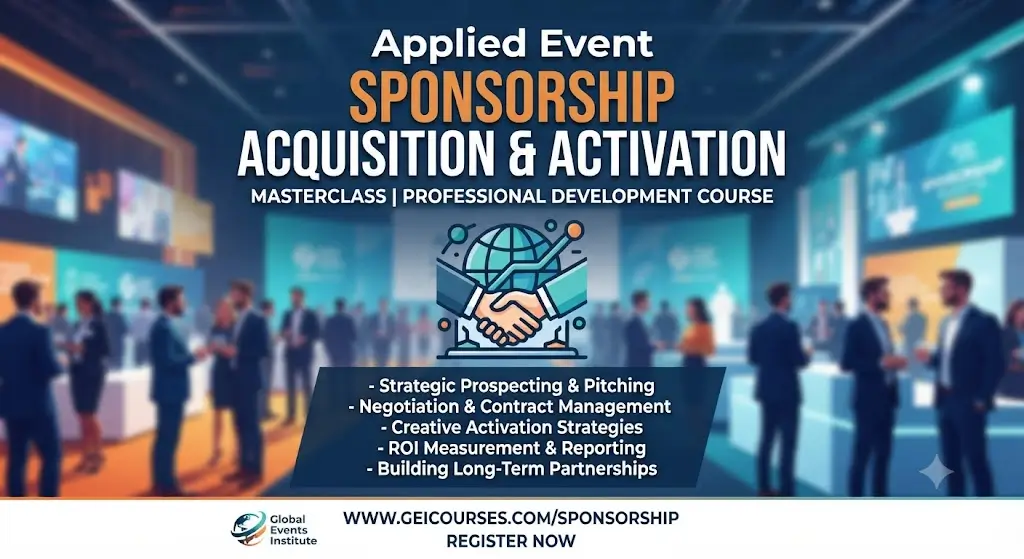
Applied Event Sponsorship Acquisition & Activation
From Sponsorship Strategy to Practical Execution
Event sponsorship becomes more valuable when organizers can connect sponsor objectives with audience needs, event assets, activation opportunities, and measurable outcomes.
Applied Event Sponsorship Acquisition & Activation is designed to help learners move from understanding sponsorship concepts to applying them in realistic business and event scenarios.
The course follows the complete sponsorship journey:
Research → Prospect → Qualify → Package → Pitch → Negotiate → Contract → Activate → Measure → Report → Renew
What You Will Learn
1. Applied Sponsorship Strategy
Learn how to translate an event’s objectives into a practical sponsorship strategy.
Topics include:
- Sponsorship objectives
- Event positioning
- Audience analysis
- Sponsor categories
- Sponsorship inventory
- Revenue objectives
- Partnership opportunities
- Sponsor-event alignment
2. Sponsor Prospecting
Practice identifying and prioritizing potential sponsors.
Learners can work with:
- Sponsor research
- Industry mapping
- Prospect databases
- Brand research
- Competitor sponsorship analysis
- Audience overlap
- Sponsor qualification
- Prospect scoring
- Outreach planning
A practical prospecting workflow can be:
Event Audience → Sponsor Objectives → Brand Fit → Potential Value → Prospect Priority
3. Sponsor Qualification
Learn how to determine whether a company is a suitable sponsorship prospect.
Evaluation factors can include:
- Target audience alignment
- Brand relevance
- Geographic presence
- Marketing objectives
- Customer overlap
- Activation potential
- Budget potential
- Existing partnerships
4. Sponsorship Packaging
Apply sponsorship packaging concepts to real event scenarios.
Learners can develop:
- Sponsorship tiers
- Title sponsorship
- Presenting sponsorship
- Category exclusivity
- Branding packages
- Digital benefits
- Content opportunities
- Speaking opportunities
- Hospitality
- Product integration
- Sampling opportunities
- Lead-generation opportunities
The goal is to create packages based on sponsor value, not simply a list of logos and signage.
5. Sponsor Value Proposition
Learn how to connect event assets with sponsor business objectives.
A practical framework:
Sponsor Goal → Target Audience → Event Asset → Activation → KPI → Business Value
Learners can practice creating customized value propositions for different sponsor types.
6. Sponsorship Proposal Development
Develop practical sponsorship proposals that communicate value clearly.
Topics include:
- Event overview
- Audience profile
- Sponsorship objectives
- Sponsorship benefits
- Activation opportunities
- Deliverables
- Investment
- Measurement
- Timeline
- Next steps
7. Sponsor Outreach & Sales
Apply a structured sponsorship sales process:
Research → Outreach → Discovery → Qualification → Proposal → Presentation → Follow-Up → Negotiation → Close
Learners can practice:
- Initial outreach
- Sponsor discovery questions
- Follow-up planning
- Objection handling
- Meeting preparation
- Proposal presentation
- Closing conversations
8. Sponsorship Negotiation
Develop practical negotiation skills around:
- Sponsorship value
- Rights and benefits
- Exclusivity
- Deliverables
- Activation rights
- Hospitality
- Media exposure
- Custom benefits
- Payment considerations
- Renewal opportunities
The emphasis is on creating mutually valuable partnerships rather than simply reducing or increasing sponsorship price.
9. Deliverable & Activation Planning
Learn how to translate sponsorship agreements into an execution plan.
You can practice creating:
- Deliverable checklists
- Sponsor timelines
- Responsibility matrices
- Content schedules
- Branding requirements
- Approval workflows
- Activation deadlines
- Event-day responsibilities
10. Applied Sponsorship Activation
Explore how to turn sponsorship rights into audience experiences.
Activation examples include:
- Product demonstrations
- Sampling
- Interactive installations
- Contests
- Branded content
- Workshops
- VIP experiences
- Hospitality
- Social media activations
- Digital experiences
- Community initiatives
- Lead-generation activities
Industry measurement guidance distinguishes passive exposure from active audience experiences and recommends measuring activation across brand/business impact, performance, and other relevant outcomes. (eventmarketer.com)
11. Pre-Event Activation
Develop practical plans before the event begins.
Topics include:
- Activation objectives
- Audience journey
- Staffing
- Venue requirements
- Branding
- Technology
- Content
- Promotional activity
- Lead capture
- Social amplification
- Risk planning
12. Event-Day Execution
Practice managing sponsor deliverables during the event.
Learners can work through:
- Sponsor check-in
- Branding verification
- Activation setup
- Staff coordination
- Guest management
- Lead capture
- Content collection
- Sponsor communication
- Issue escalation
- Deliverable tracking
13. Sponsor Engagement & Lead Generation
Explore ways to create measurable interactions between sponsors and attendees.
Topics include:
- Engagement activities
- Product trials
- Lead capture
- QR experiences
- Surveys
- Contact qualification
- CRM handoff
- Follow-up planning
For B2B events, current industry examples increasingly emphasize designing trackable interactions and connecting event engagement with CRM and pipeline outcomes. (eventmarketer.com)
14. Sponsorship KPI Development
Create practical KPI frameworks before activation begins.
Potential metrics include:
Exposure
- Reach
- Impressions
- Visibility
- Media exposure
Engagement
- Participants
- Interactions
- Product trials
- Content engagement
- Social activity
Commercial
- Leads
- Qualified leads
- Pipeline
- Sales
- Customer acquisition
Relationship
- Sponsor satisfaction
- Attendee satisfaction
- Renewal intention
Measurement should be connected to predefined objectives rather than added only after the event.
15. Sponsorship ROI Application
Learn how to evaluate sponsorship investment using relevant performance indicators.
Possible measures include:
- Cost per lead
- Cost per engagement
- Qualified leads
- Pipeline contribution
- Sales contribution
- Customer acquisition
- Brand outcomes
- Activation efficiency
Learners can practice comparing sponsorship investment against defined business outcomes.
16. Post-Event Reporting
Develop a professional sponsor performance report.
A practical report can include:
- Sponsorship objectives
- Deliverables completed
- Audience reach
- Engagement
- Leads
- Activation performance
- Social performance
- Brand feedback
- Commercial outcomes
- KPI performance
- Recommendations
17. Sponsor Renewal
Learn how to turn successful sponsorships into longer-term relationships.
Topics include:
- Sponsor feedback
- Results presentation
- Performance review
- Renewal conversations
- Package improvement
- Upselling
- Multi-event partnerships
- Long-term relationship management
Current event-industry guidance increasingly frames sponsor success around mutual value for attendees, sponsors, and organizers—not just sponsorship revenue. (eventmarketer.com)
Practical Exercises & Case Scenarios
Case 1: Sponsor Prospecting
Create and prioritize a list of potential sponsors for a hypothetical event.
Case 2: Sponsor Qualification
Evaluate several companies and determine which prospects offer the strongest event-sponsor fit.
Case 3: Sponsorship Package
Create Bronze, Silver, Gold, and Premium sponsorship packages with differentiated benefits.
Case 4: Sponsor Proposal
Develop a sponsor-specific proposal based on the company’s marketing objectives.
Case 5: Sponsor Pitch
Prepare and present a sponsorship pitch using audience data, event value, activation ideas, and KPIs.
Case 6: Negotiation
Work through a negotiation involving sponsorship investment, exclusivity, deliverables, and activation rights.
Case 7: Activation Planning
Create a complete sponsor activation plan for an event.
Case 8: KPI Dashboard
Develop a pre-event, event-day, and post-event measurement framework.
Case 9: ROI Analysis
Analyze sponsorship performance and determine whether the partnership delivered sufficient value against predefined objectives.
Case 10: Renewal Strategy
Create a renewal proposal using event results, sponsor feedback, and future activation opportunities.
Applied Sponsorship Framework
Event Objective → Audience → Sponsor Research → Qualification → Sponsorship Package → Value Proposition → Outreach → Proposal → Negotiation → Contract → Activation → Measurement → Reporting → Renewal
This framework provides a repeatable process for applying sponsorship acquisition and activation concepts to practical event situations.
Who Should Take This Course?
This course is suitable for:
- Event managers
- Sponsorship managers
- Event marketers
- Partnership managers
- Business development professionals
- Sports marketing professionals
- Entertainment marketers
- Conference organizers
- Festival organizers
- Association professionals
- Nonprofit event teams
- Marketing agencies
- Brand partnership professionals
- Entrepreneurs
Skills You Can Develop
Learners can develop practical skills in:
- Sponsor prospecting
- Sponsor qualification
- Sponsorship sales
- Sponsorship packaging
- Proposal development
- Sponsor pitching
- Negotiation
- Activation planning
- Event-day execution
- Audience engagement
- Lead generation
- KPI development
- Sponsorship measurement
- ROI analysis
- Post-event reporting
- Sponsor renewal
Course Outcome
After completing the course, learners can apply a structured process for finding sponsors, evaluating sponsor fit, developing proposals, negotiating partnership terms, executing activation plans, measuring results, and building stronger renewal opportunities.
Apply event sponsorship strategies in realistic scenarios and develop practical skills for acquiring, activating, measuring, and growing sponsor partnerships.
Q1. What is Applied Event Sponsorship Acquisition & Activation?
It is practical training focused on applying sponsorship concepts to real-world situations involving prospecting, packaging, pitching, negotiation, activation, measurement, and renewal.
Q2. Who should take this course?
Event professionals, sponsorship managers, marketers, partnership professionals, business development teams, sports and entertainment marketers, agencies, and entrepreneurs can benefit from the course.
Q3. What is the difference between basic and applied sponsorship training?
Basic training focuses on concepts and terminology, while applied training focuses on using those concepts to solve sponsorship and activation scenarios.
Q4. Will I learn how to find potential sponsors?
Yes. The course covers sponsor research, prospecting, qualification, prioritization, outreach, and sponsor-event fit.
Q5. Does the course cover sponsorship proposals?
Yes. Learners can practice developing sponsorship packages, value propositions, proposals, benefits, activation opportunities, and measurement plans.
Q6. Will I learn sponsorship negotiation?
Yes. The course covers negotiation around investment, rights, deliverables, exclusivity, activation opportunities, and partnership value.
Q7. What is sponsorship activation?
Sponsorship activation is the practical execution of sponsorship rights to create audience engagement and value for the sponsor, such as product experiences, content, hospitality, sampling, or interactive activities.
Q8. How is sponsorship performance measured?
Depending on objectives, performance can be evaluated using reach, engagement, leads, qualified leads, pipeline, sales, brand outcomes, sponsor satisfaction, and other relevant KPIs.
Q9. Does the course cover sponsor renewal?
Yes. Learners can explore post-event reporting, sponsor feedback, performance reviews, renewal proposals, package improvements, and long-term partnership strategies.
Q10. What should I study after this course?
A recommended progression is Event Sponsorship Acquisition & Activation Implementation & Practice → Event Sponsorship Acquisition & Activation Masterclass.



Reviews
There are no reviews yet.