
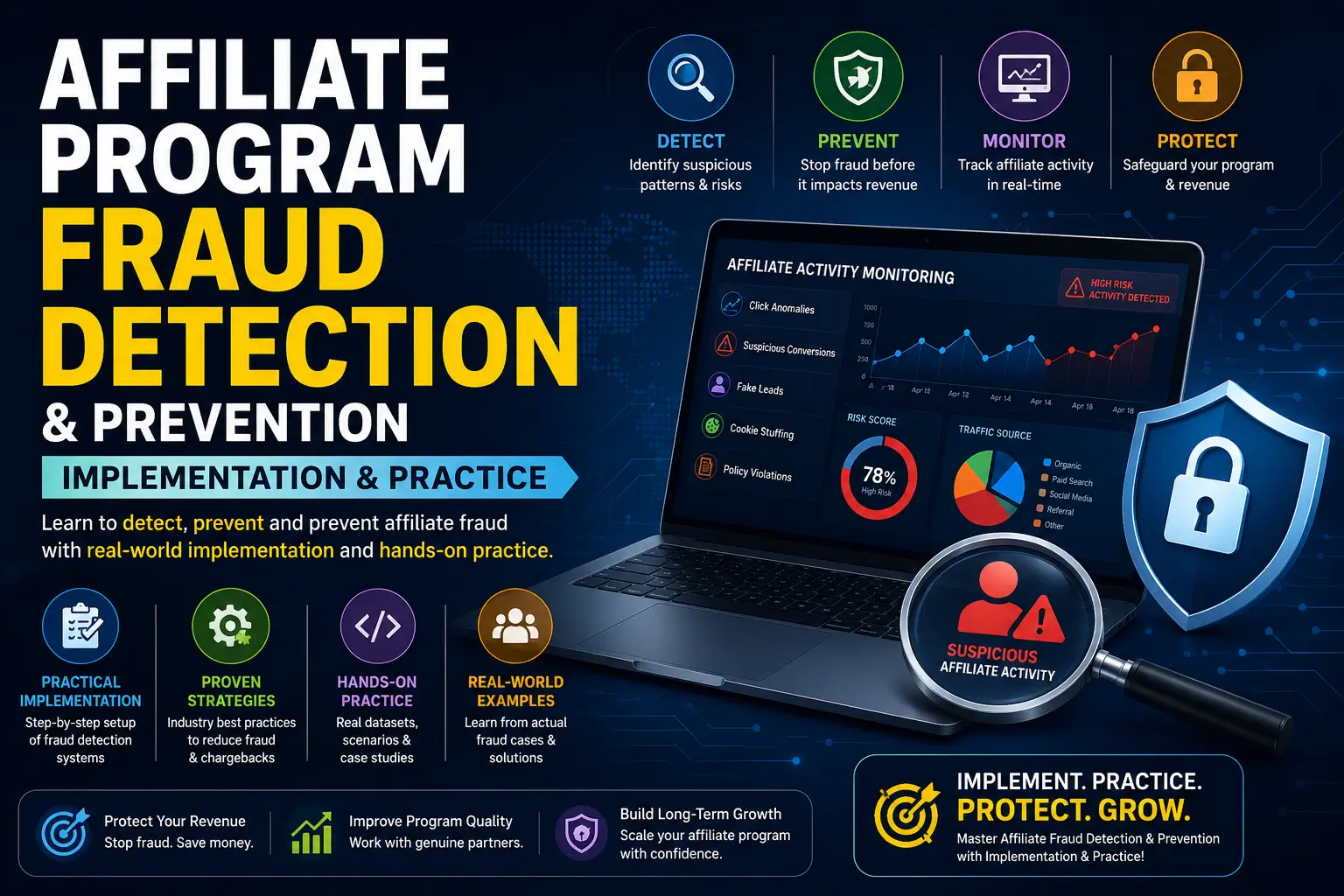
Affiliate Program Fraud Detection & Prevention Implementation & Practice
Affiliate marketing relies on accurate tracking, trustworthy partners, quality traffic, and legitimate conversions. When suspicious or fraudulent activity occurs, it can create challenges for affiliate managers and businesses.
The Affiliate Program Fraud Detection & Prevention Implementation & Practice course focuses on developing practical knowledge for identifying potential affiliate fraud and implementing prevention-oriented approaches.
Instead of looking at fraud detection only as a theoretical topic, this course emphasizes implementation and practice. Learners can develop a more structured understanding of how fraud risks can be monitored, investigated, and managed within affiliate programs.
What You Will Learn
This course covers important concepts related to:
- Affiliate fraud detection
- Affiliate fraud prevention
- Suspicious affiliate activity
- Fraud indicators and warning signs
- Affiliate traffic monitoring
- Conversion monitoring
- Tracking irregularities
- Affiliate risk assessment
- Fraud-prevention implementation
- Affiliate program monitoring
- Practical fraud investigation concepts
- Affiliate program security
- Risk-management practices
Understanding Affiliate Fraud
Affiliate fraud refers to activities that can manipulate or violate the rules of an affiliate marketing program for an improper benefit.
Potential issues can involve traffic quality, conversions, tracking, promotional methods, affiliate behavior, or other program activities. Because fraudulent behavior can take different forms, affiliate managers need to understand how to recognize unusual patterns and determine when additional investigation may be appropriate.
This course introduces learners to the concepts needed to approach these situations more systematically.
Affiliate Fraud Detection and Prevention
Effective affiliate fraud prevention starts with understanding what legitimate affiliate activity should look like and recognizing patterns that may require closer attention.
Learners will explore the relationship between detection and prevention. Detection helps identify potential issues, while prevention focuses on reducing risks through monitoring, controls, policies, review processes, and appropriate program-management practices.
The course therefore combines both sides of the process rather than treating them as completely separate topics.
Implementation & Practice
A key feature of this course is its focus on implementation and practice.
Learners can develop an understanding of how fraud-prevention concepts can be incorporated into affiliate program operations. This includes considering how affiliate activity can be monitored, how unusual patterns can be reviewed, and how potential risks can be documented and evaluated.
Practical learning can help bridge the gap between knowing about affiliate fraud and understanding how fraud-prevention processes may be applied.
Key Skills You Can Develop
By working through the course, learners can develop knowledge and practical skills related to:
- Recognizing potential affiliate fraud indicators
- Reviewing affiliate traffic and conversion activity
- Identifying unusual affiliate patterns
- Understanding affiliate tracking risks
- Evaluating potential fraud-related concerns
- Applying affiliate fraud prevention concepts
- Developing monitoring approaches
- Understanding risk-management processes
- Improving affiliate program oversight
- Making more informed affiliate management decisions
Who Should Take This Course?
This course is suitable for professionals and learners interested in affiliate marketing, performance marketing, and affiliate program management.
It can be particularly relevant for:
- Affiliate program managers
- Affiliate marketers
- Performance marketers
- Digital marketing professionals
- Affiliate network professionals
- E-commerce professionals
- Marketing analysts
- Online business owners
- Advertising professionals
- Students learning affiliate marketing
- Professionals responsible for campaign monitoring
Benefits of Affiliate Fraud Prevention Knowledge
Fraud awareness can help businesses approach affiliate program management more carefully.
Learning about affiliate fraud prevention can help professionals understand potential risks before making decisions about affiliate partners, campaign performance, commissions, or suspicious activity.
A structured approach to monitoring can also help teams distinguish between normal variations in campaign performance and activity that may warrant further investigation.
Business and Career Relevance
Affiliate fraud prevention is relevant to businesses that rely on affiliate marketing, performance marketing, e-commerce, and other partnership-based digital advertising models.
Professionals who understand both affiliate marketing and fraud prevention can bring an additional risk-management perspective to affiliate program operations.
The knowledge developed through this course can complement broader skills in digital marketing, affiliate management, analytics, e-commerce, and performance marketing.
Learning Outcomes
After completing the course, learners should be able to:
- Understand the fundamentals of affiliate fraud.
- Identify common affiliate fraud risks and warning signs.
- Understand the role of affiliate fraud detection.
- Apply basic affiliate fraud prevention concepts.
- Understand how affiliate activity can be monitored.
- Recognize unusual traffic and conversion patterns.
- Understand potential tracking-related risks.
- Develop a more structured approach to fraud-risk assessment.
- Understand how prevention practices can be implemented.
- Apply course concepts through practical learning and exercises.
Why This Course Is Useful
Affiliate program management involves more than recruiting partners and tracking conversions. Maintaining a reliable program also requires awareness of potential risks and the ability to review unusual activity.
This course brings together affiliate fraud detection, affiliate fraud prevention, implementation, and practice in one focused learning experience.
It is useful for learners who want to move beyond basic affiliate marketing concepts and understand the risk-management side of running and monitoring affiliate programs.
Start Learning
Build practical knowledge of affiliate fraud detection and prevention, strengthen your understanding of affiliate program risks, and learn how prevention concepts can be implemented through structured monitoring and practice.
FAQ SECTION
1. What is affiliate fraud prevention?
Affiliate fraud prevention involves practices designed to identify and reduce fraudulent or suspicious activity within an affiliate marketing program.
2. What does this Affiliate Fraud Prevention course cover?
The course covers affiliate fraud detection, prevention strategies, monitoring, risk identification, suspicious activity, implementation concepts, and practical application.
3. Is this course suitable for beginners?
Yes. The course can help beginners build foundational knowledge while also providing relevant concepts for professionals working with affiliate programs.
4. What is the difference between affiliate fraud detection and prevention?
Detection focuses on identifying potentially fraudulent or suspicious activity, while prevention focuses on reducing the likelihood and impact of such activity through appropriate processes and controls.
5. Who can benefit from this course?
Affiliate managers, digital marketers, performance marketers, affiliate network professionals, e-commerce professionals, business owners, and students interested in affiliate marketing can benefit from the course.
6. What practical skills can I learn?
You can develop skills related to monitoring affiliate activity, recognizing potential warning signs, evaluating suspicious patterns, understanding risks, and applying fraud-prevention concepts.
7. Why is affiliate fraud prevention important?
It can help affiliate program managers identify potential risks, improve program oversight, and make more informed decisions when reviewing affiliate activity.
8. Do I need previous affiliate marketing experience?
Previous experience can be useful but is not necessarily required. Learners with an interest in affiliate marketing and digital marketing can use the course to develop relevant knowledge.
9. Does the course include implementation and practice?
Yes. The course specifically emphasizes implementation and practice so learners can better understand how affiliate fraud detection and prevention concepts can be applied to affiliate program management.
10. Is affiliate fraud prevention useful for e-commerce businesses?
Yes. Businesses using affiliate marketing can benefit from understanding potential affiliate fraud risks and developing appropriate monitoring and prevention practices.



Reviews
There are no reviews yet.