
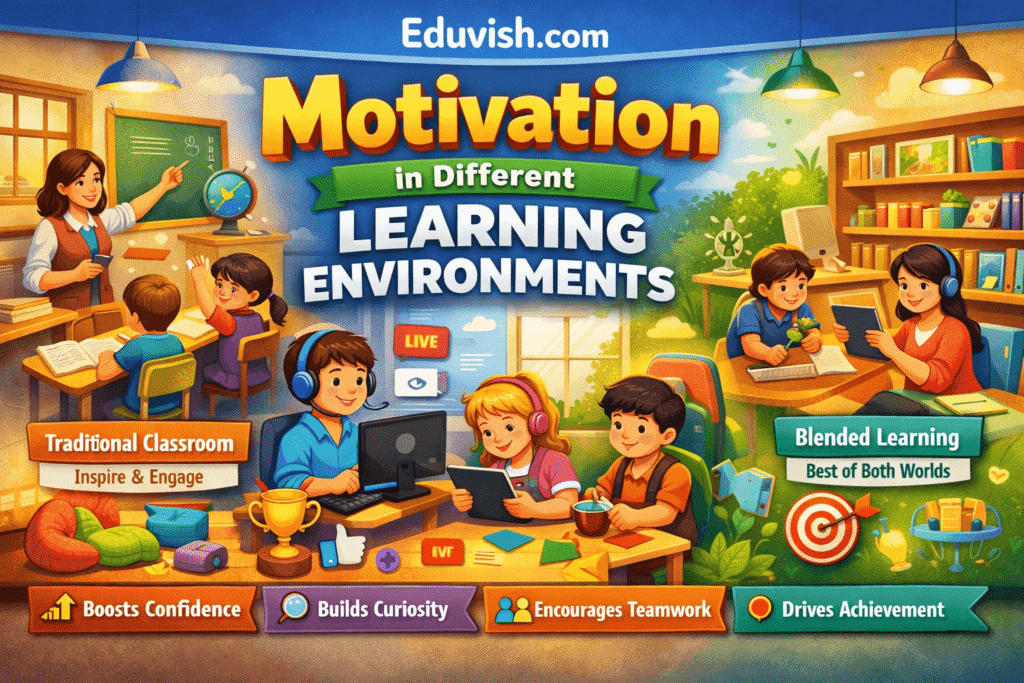
Introduction
Motivation is the heartbeat of learning. It drives curiosity, persistence, and achievement. Whether in traditional classrooms, online platforms, or experiential setups, motivation determines how deeply students engage with their studies. At Eduvish.com, we explore how different learning environments influence motivation, and how educators can nurture it to create meaningful educational experiences.
What Is Motivation in Learning?
Learning motivation refers to the internal drive that pushes students to acquire knowledge and skills. It can be intrinsic (driven by curiosity and interest) or extrinsic (influenced by rewards, grades, or recognition). Understanding these types helps teachers design environments that inspire students to learn willingly and effectively.
Types of Learning Environments
- Traditional classroom – Structured, teacher‑led, and interactive.
- Online learning – Flexible, technology‑driven, and self‑paced.
- Blended learning – Combines classroom and digital experiences.
- Experiential learning – Hands‑on, project‑based, and reflective.
- Collaborative learning – Peer‑driven and teamwork‑oriented.
Each environment affects motivation differently based on structure, interaction, and autonomy.
Motivation in Traditional Classrooms
Traditional classrooms rely on face‑to‑face interaction, discipline, and teacher guidance.
- Teacher influence: Encouragement and feedback boost confidence.
- Peer competition: Healthy rivalry enhances performance.
- Physical environment: Lighting, seating, and décor affect focus.
- Recognition: Awards and praise sustain motivation.
Motivation in Online Learning
Online learning offers flexibility but demands self‑discipline.
- Autonomy: Learners control pace and schedule.
- Gamification: Points and badges make learning fun.
- Interactive tools: Videos, quizzes, and forums keep engagement high.
- Community support: Peer discussions reduce isolation.
Motivation in Blended Learning
Blended learning merges the best of both worlds.
- Personalized learning: Students choose how they learn.
- Technology integration: Digital tools enhance creativity.
- Teacher facilitation: Guidance ensures balance between online and offline tasks.
- Feedback loops: Continuous assessment keeps motivation alive.
Motivation in Experiential Learning
Experiential learning connects theory with practice.
- Real‑world relevance: Students see the impact of their work.
- Hands‑on activities: Doing fosters deeper understanding.
- Reflection: Students analyze successes and failures.
- Collaboration: Team projects build social motivation.
Motivation in Collaborative Learning
Collaboration encourages social interaction and shared goals.
- Peer learning: Students learn from each other’s strengths.
- Group accountability: Shared responsibility drives effort.
- Communication skills: Builds confidence and empathy.
- Sense of belonging: Emotional connection enhances motivation.
Factors Affecting Motivation Across Environments
| Factor | Description |
|---|---|
| Autonomy | Freedom to choose learning paths increases engagement. |
| Feedback | Constructive feedback reinforces effort. |
| Goal clarity | Clear objectives guide motivation. |
| Social interaction | Collaboration boosts emotional connection. |
| Technology | Interactive tools make learning dynamic. |
| Environment design | Comfortable spaces improve focus and creativity. |
Role of Teachers and Mentors
Educators play a vital role in sustaining motivation:
- Encouragement: Positive reinforcement builds confidence.
- Adaptability: Adjusting methods for diverse learners.
- Empathy: Understanding student challenges.
- Goal setting: Helping learners define achievable targets.
Strategies to Enhance Motivation
- Gamify learning – Use rewards and challenges.
- Create engaging content – Visuals and stories attract attention.
- Encourage collaboration – Group tasks promote teamwork.
- Provide autonomy – Let students make choices.
- Offer feedback – Recognize effort and improvement.
- Use technology wisely – Blend digital tools with human interaction.

