
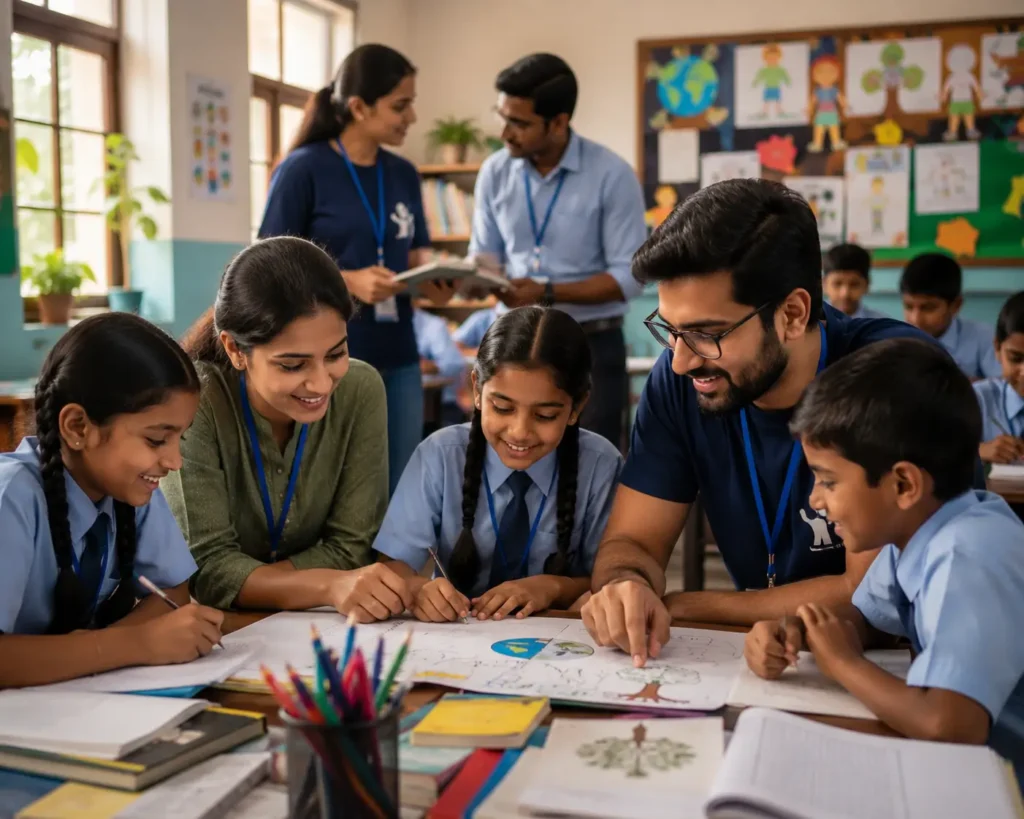
Partnerships Between NGOs and Schools in Education
Introduction
India’s education system faces challenges of scale, quality, and equity. While government schools provide access, many lack trained teachers, infrastructure, and modern pedagogy. Here, NGO-school partnerships step in as strategic collaborators, not just charity providers, to strengthen schools and empower communities.
Role of NGO-School Partnerships
- Enhancing learning outcomes – Remedial programs improve literacy and numeracy.
- Teacher training – Continuous professional development for educators.
- Infrastructure support – Toilets, libraries, labs, and digital classrooms.
- Curriculum innovation – Activity-based learning and critical thinking.
- Community engagement – Parents and local leaders involved in sustaining education.
Leading NGO-School Collaborations
| NGO | Focus Area | Impact |
|---|---|---|
| Pratham | Literacy campaigns | ASER surveys + remedial learning |
| Smile Foundation | Holistic education | 200,000+ children supported |
| Teach For India | Volunteer teaching | Alumni impacting 33M children |
| Room to Read India | Literacy & gender equality | 870,000+ girls supported |
| Digantar (Jaipur) | Child-centered learning | Innovative pedagogy |
| Shiksha Karmi Project | Tackling teacher absenteeism | Rural Rajasthan schools |
Case Studies
- Pratham’s ASER Survey: Identified literacy gaps, leading to remedial programs.
- Shiksha Karmi Project: Reduced absenteeism by training local teachers.
- Lok Jumbish Movement: Grassroots initiative for universal education.
Challenges in Partnerships
- Funding limitations – Reliance on CSR and donations.
- Policy integration – Aligning NGO models with government schemes.
- Scaling issues – Expanding pilot projects nationwide.
- Social barriers – Tackling child labor and gender bias.
Future Prospects
- Digital learning partnerships – Smart classrooms and e-learning.
- Inclusive education models – Focus on gender and disability.
- Community-driven governance – Stronger local participation.
- Global collaborations – UNESCO and international NGOs supporting Indian schools.
Conclusion
NGO-school partnerships are strategic enablers of quality education. By combining grassroots innovation with government frameworks, they ensure that every child—urban or rural—has access to meaningful learning. The future of Indian education lies in collaborative models that unite policy, community, and innovation.

