
Introduction
Proposal writing is a critical skill for students, researchers, and professionals. Whether it’s a research proposal, business proposal, or project plan, the way you present your ideas determines whether they will be accepted or rejected. Unfortunately, many proposals fail because of avoidable mistakes. Understanding these errors helps writers create clear, persuasive, and successful proposals.
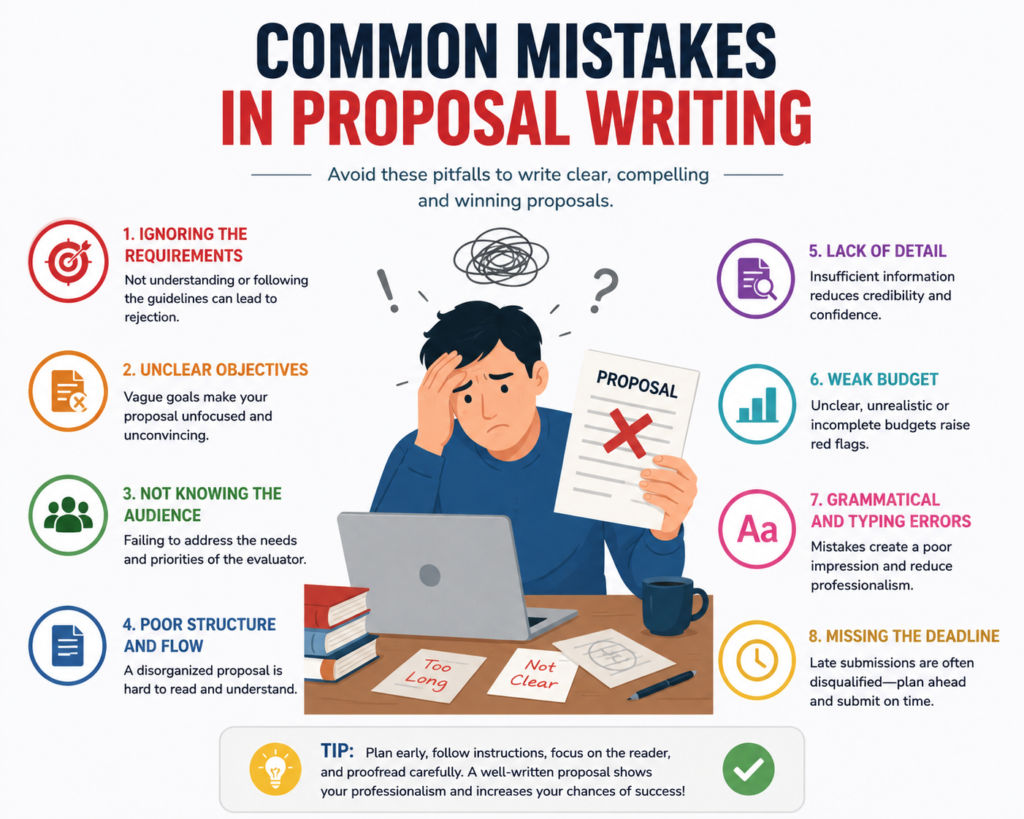
Common Mistakes in Proposal Writing
1. Lack of Clear Objectives
Proposals without well‑defined goals confuse readers and weaken credibility.
2. Weak Structure
Disorganized proposals make it hard for reviewers to follow the argument.
3. Poor Research
Failing to provide evidence or background data reduces trustworthiness.
4. Overuse of Jargon
Complicated language alienates readers. Simple, clear writing is more effective.
5. Ignoring Guidelines
Not following submission instructions or formatting rules leads to rejection.
6. Weak Budget Planning
Unrealistic or unclear budgets raise doubts about feasibility.
7. Failure to Address Audience Needs
Proposals that don’t consider the reader’s perspective fail to persuade.
8. Lack of Proofreading
Grammar and spelling errors reduce professionalism.
9. Too Much or Too Little Detail
Overloading with unnecessary information or leaving gaps weakens impact.
10. Weak Conclusion
Ending without a strong summary or call to action leaves readers unconvinced.
Comparison Table
| Mistake | Impact | Solution |
|---|---|---|
| Lack of objectives | Confuses readers | Define clear goals |
| Weak structure | Hard to follow | Organize logically |
| Poor research | Low credibility | Use reliable data |
| Overuse of jargon | Alienates audience | Write simply |
| Ignoring guidelines | Risk of rejection | Follow instructions |
| Weak budget | Doubts feasibility | Plan realistically |
| Not addressing audience | Fails to persuade | Focus on reader needs |
| Lack of proofreading | Unprofessional | Edit carefully |
| Wrong detail level | Weak impact | Balance information |
| Weak conclusion | No persuasion | End with strong summary |
How to Avoid These Mistakes
- Define clear objectives before writing.
- Organize logically with headings and subheadings.
- Support with research using credible sources.
- Write simply to ensure readability.
- Follow guidelines strictly.
- Plan budgets carefully with realistic estimates.
- Proofread thoroughly to eliminate errors.
- End with impact by summarizing and persuading.

