
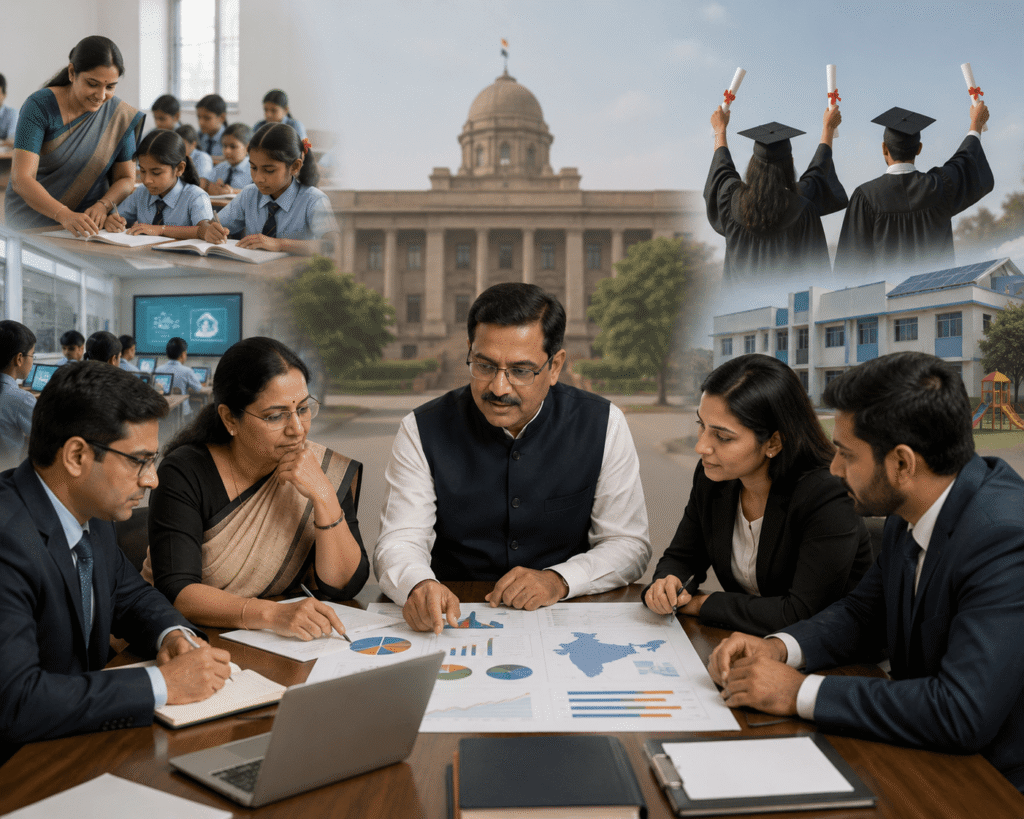
Role of Government Officials in Education Reform
Introduction
Education reform in India is not just about policy documents—it is about government officials at every level ensuring that reforms reach classrooms. Their role spans from designing national frameworks to implementing state-level programs and monitoring outcomes.
Key Responsibilities of Government Officials
- Policy formulation – Drafting reforms like NEP 2020.
- Infrastructure development – Ensuring schools have toilets, electricity, and digital classrooms.
- Teacher training – Continuous professional development programs.
- Monitoring and evaluation – Tracking literacy, dropout rates, and learning outcomes.
- Equity and inclusion – Special focus on marginalized groups, girls, and rural communities.
Case Studies of Reform
Tamil Nadu – Education ministers emphasized inclusive access and skill development.
Uttar Pradesh – 96% of schools now have basic facilities; smart classrooms and AI-driven learning introduced.
National Level – NEP 2020 restructured the school system into a 5+3+3+4 model, focusing on early childhood care and holistic learning.
Challenges Faced by Officials
- Funding gaps – Limited budgets for large-scale reforms.
- Teacher shortages – Vacancies in rural and remote schools.
Exam irregularities – Issues like NEET-UG paper leaks highlight governance challenges.
Equity concerns – Ensuring reforms benefit disadvantaged groups equally.
Future Directions
- Technology integration – AI-driven learning, digital classrooms, and e-content.
- Public-private partnerships – Collaborations with NGOs and corporates.
- Community engagement – Awareness campaigns to reduce dropout rates.
- Global benchmarking – Aligning reforms with international best practices.
Conclusion
Government officials are drivers of systemic change in education. Their decisions on policy, infrastructure, and teacher training directly impact learning outcomes. With stronger accountability, technology adoption, and inclusive frameworks, India’s education reform can truly deliver quality education for all.

