
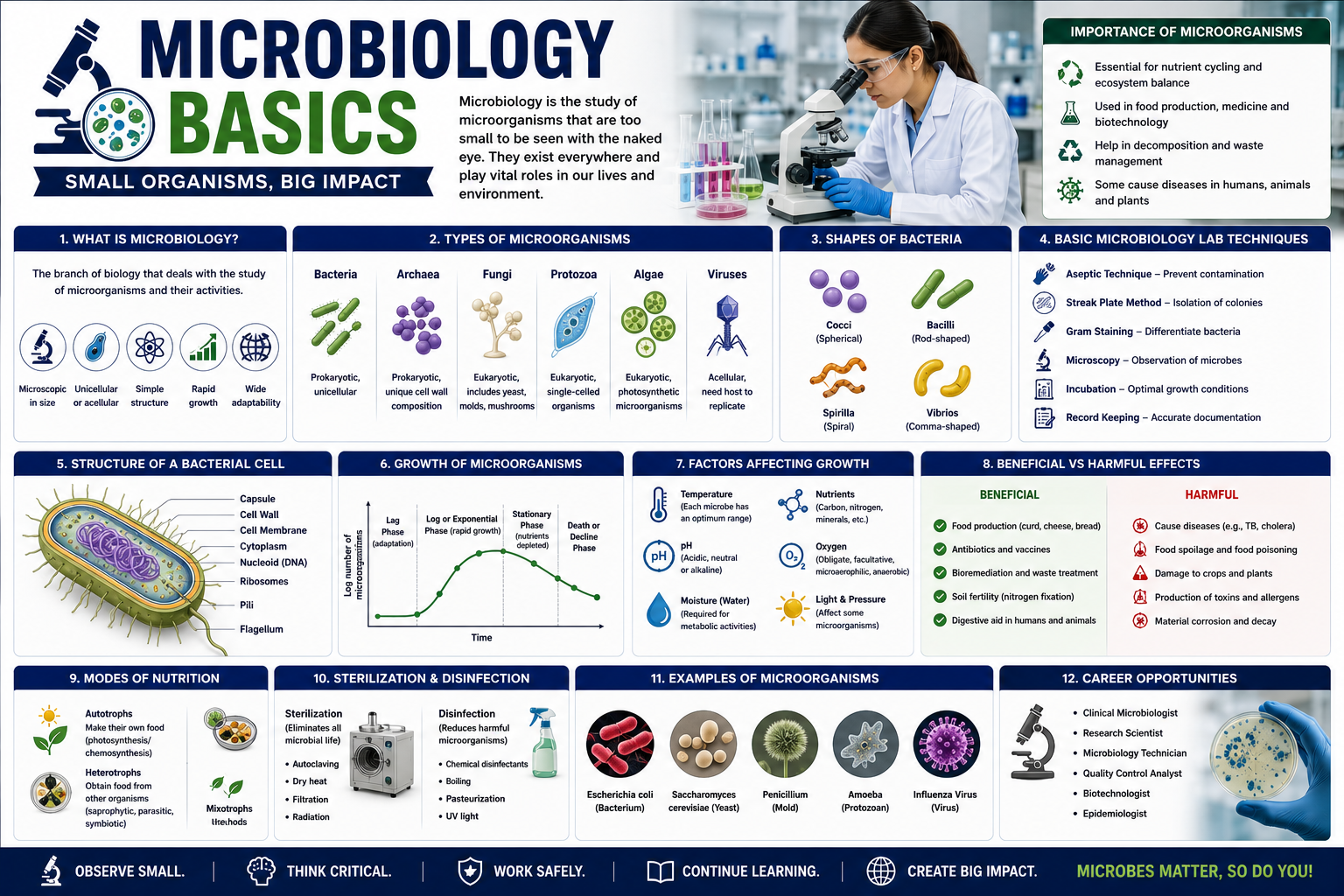
Microbiology Basics is a foundational course designed to introduce learners to the study of microorganisms and their impact on health, environment, and industry. This program explores the fundamentals of bacteria, viruses, fungi, and protozoa, while also covering laboratory techniques, microbial genetics, and applications of microbiology in medicine and biotechnology.
Students will gain insights into microbial structure, growth, and reproduction, as well as the role of microorganisms in disease, immunity, and ecological balance. The course emphasizes both theoretical knowledge and practical skills, preparing learners to work with microbiological concepts in academic, healthcare, and industrial settings.
By the end of this course, participants will be able to:
- Understand the fundamentals of microbiology and microbial diversity.
- Explore the structure and function of bacteria, viruses, fungi, and protozoa.
- Apply laboratory techniques such as staining, culturing, and microscopy.
- Analyze microbial genetics and their role in evolution.
- Study the impact of microorganisms on human health and disease.
- Evaluate industrial and environmental applications of microbiology.
- Gain exposure to modern microbiological research and biotechnology.
This course is ideal for students, healthcare professionals, and science enthusiasts interested in biology, medicine, and biotechnology. With case studies, lab-focused assignments, and real-world applications, you’ll gain the confidence to explore the microscopic world and its significance in everyday life.
FAQ SECTION
What is microbiology?
Microbiology is the branch of science that studies microorganisms such as bacteria, viruses, fungi, protozoa, and algae.
Who should enroll in the Microbiology Basics Course?
Science students, healthcare aspirants, laboratory professionals, researchers, teachers, and biology enthusiasts can benefit from this course.
Do I need prior biology knowledge?
No. The course is designed for beginners and provides foundational microbiology concepts.
What topics are covered in the course?
The course covers microorganisms, microbial classification, microbial growth, laboratory safety, human health, and environmental microbiology.
Will I learn about bacteria and viruses?
Yes. The course includes detailed introductions to bacteria, viruses, fungi, protozoa, and other microorganisms.
Does the course include laboratory concepts?
Yes. Learners are introduced to laboratory equipment, safety practices, and microbiological procedures.
Will I receive a certificate?
Yes. Participants receive a course completion certificate after successfully completing the training.
What career opportunities are available after this course?
Career opportunities include Laboratory Assistant, Research Assistant, Microbiology Technician, Biotechnology Associate, and Quality Control Assistant.
Is microbiology important in healthcare?
Yes. Microbiology plays a critical role in understanding infections, disease prevention, diagnostics, and public health.
Can this course help prepare me for advanced biology studies?
Yes. The course provides a strong foundation for higher education in microbiology, biotechnology, healthcare, and life sciences.



Reviews
There are no reviews yet.