
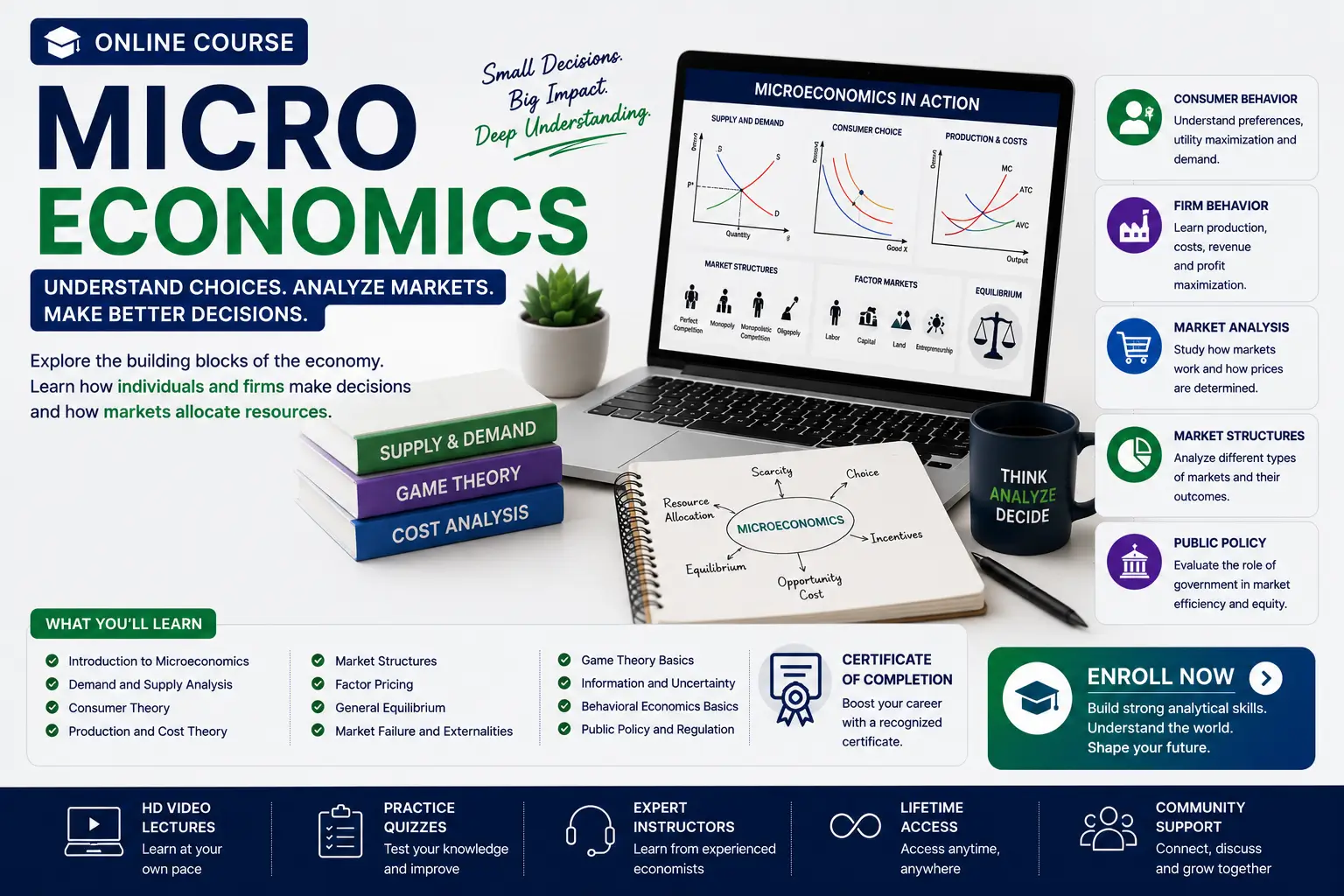
Microeconomics: Understand Individual Choices and Market Dynamics
Microeconomics is the study of how individuals, households, and businesses make decisions about resource allocation, consumption, and production. Unlike macroeconomics, which looks at the economy as a whole, microeconomics focuses on the smaller units that drive everyday economic activity. The Microeconomics course is designed to provide learners with a strong foundation in economic theory and practical applications, helping them understand how markets function and how decisions impact supply, demand, and pricing.
Why Learn Microeconomics?
Microeconomics is essential for anyone who wants to understand how markets operate and how consumers and producers interact. From analyzing demand curves to understanding market structures, microeconomics equips learners with the tools to interpret data, make informed decisions, and anticipate outcomes in competitive environments. These skills are highly valuable in careers across finance, business, consulting, and public policy.
What You’ll Learn
- Introduction to Microeconomics: Scope, importance, and differences from macroeconomics.
- Demand & Supply Analysis: Learn how prices are determined in competitive markets.
- Elasticity: Explore price elasticity of demand and supply, income elasticity, and cross elasticity.
- Consumer Behavior: Study utility theory, preferences, and decision‑making models.
- Production & Costs: Understand short‑run and long‑run production functions, cost curves, and economies of scale.
- Market Structures: Analyze perfect competition, monopoly, monopolistic competition, and oligopoly.
- Factor Markets: Learn how labor, capital, and land markets operate.
- Welfare Economics: Explore efficiency, equity, and government interventions.
- Game Theory & Strategy: Understand strategic decision‑making in competitive environments.
- Case Studies: Examine real‑world examples of microeconomic principles in action.
Benefits of the Course
- Career Advancement: Build skills valued in finance, consulting, and business analysis.
- Practical Knowledge: Learn how microeconomic principles apply to everyday decisions.
- Future‑Ready Skills: Understand consumer behavior, market competition, and pricing strategies.
- Versatility: Applicable for careers in economics, business, and government.
- Confidence Building: Develop the ability to analyze and interpret market data.
Target Audience
This course is ideal for:
- Students pursuing economics, commerce, or business studies
- Professionals working in finance, consulting, or public policy
- Entrepreneurs seeking to understand market dynamics and pricing strategies
- Anyone interested in learning how individual choices shape economic outcomes
Why Choose This Course?
- SEO‑optimized content designed to rank well on Google
- Easy‑to‑read language for general audiences
- Structured with headings, bullet points, and clear formatting
- Includes benefits, learning outcomes, and target audience insights
By the end of the Microeconomics course, you’ll be able to understand the forces that drive individual decision‑making, analyze market structures, and interpret consumer and producer behavior. This course empowers you to confidently engage with economic discussions, whether you are preparing for a career in finance or simply want to understand how everyday choices impact the economy.
FAQ SECTION
1. What is Microeconomics?
Microeconomics studies how individuals and businesses make decisions regarding the allocation of resources and interact within markets.
2. Is this course suitable for beginners?
Yes. The course starts with fundamental concepts and gradually covers advanced microeconomic topics.
3. What topics are covered in Microeconomics?
Topics include demand and supply, elasticity, consumer behavior, production, costs, market structures, and government intervention.
4. Why is Microeconomics important?
Microeconomics helps understand market behavior, pricing strategies, consumer decisions, and business operations.
5. Can this course help in competitive exams?
Yes. Microeconomics is an important subject for many academic and competitive examinations.
6. Are practical examples included?
Yes. Real-world examples and case studies are used to explain economic concepts.
7. Do I need prior economics knowledge?
No. The course is designed for beginners as well as learners seeking advanced understanding.
8. Is certification provided?
Yes. Learners receive a certificate upon successful completion of the course.
9. Who should enroll in this course?
Students, entrepreneurs, business professionals, economists, and anyone interested in economics.
10. What career opportunities are available after learning Microeconomics?
Career paths include business analysis, economics, research, finance, banking, and policy development.





Reviews
There are no reviews yet.