
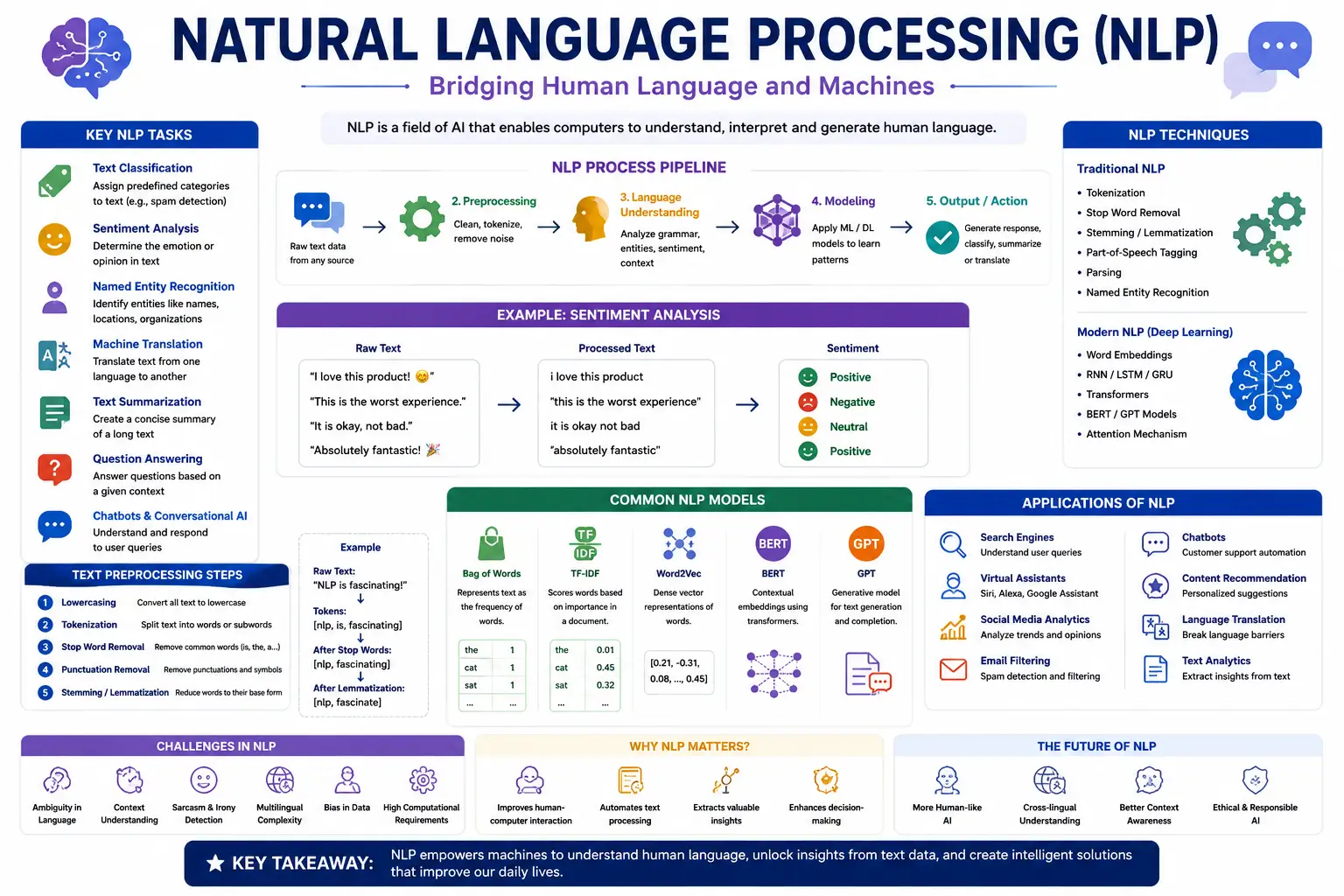
Natural Language Processing (NLP) Course Overview
Natural Language Processing (NLP) is one of the most exciting fields in Artificial Intelligence, bridging the gap between human communication and computer understanding. This comprehensive course is designed to help learners master the techniques, tools, and applications of NLP, making it ideal for students, professionals, and businesses looking to harness the power of language data.
What You’ll Learn
- Foundations of NLP: Understand the basics of linguistics, syntax, semantics, and text representation.
- Text Preprocessing: Learn tokenization, stemming, lemmatization, and stop‑word removal to prepare raw text for analysis.
- Machine Learning for NLP: Explore supervised and unsupervised models, including Naive Bayes, SVM, and clustering techniques.
- Deep Learning in NLP: Dive into advanced models like RNNs, LSTMs, GRUs, and Transformers.
- Applications of NLP: Build chatbots, sentiment analysis tools, text summarizers, and machine translation systems.
- Hands‑on Projects: Work on real‑world datasets to apply concepts practically.
Why This Course?
With the explosion of digital communication, NLP has become a critical skill for industries ranging from healthcare and finance to e‑commerce and education. By mastering NLP, you’ll be able to:
- Analyze customer feedback and reviews.
- Automate business communication with intelligent chatbots.
- Extract insights from large volumes of text data.
- Enhance search engines and recommendation systems.
Career Opportunities
Completing this course opens doors to roles such as:
- NLP Engineer
- AI Researcher
- Data Scientist
- Machine Learning Specialist
- Computational Linguist
FAQ SECTION
1. What is a Natural Language Processing Course?
A Natural Language Processing Course teaches how computers understand, process, and analyze human language using AI and machine learning techniques.
2. Who should enroll in this course?
Students, developers, AI enthusiasts, data scientists, and machine learning professionals can benefit from this course.
3. Is this course suitable for beginners?
Yes, beginners with basic programming knowledge can start learning NLP concepts.
4. What programming language is used?
Python is commonly used for NLP implementation and practical projects.
5. Will I receive a certificate?
Yes, participants receive a course completion certificate.
6. Does the course cover sentiment analysis?
Yes, sentiment analysis and text classification are important modules in the course.
7. Will I learn about chatbots?
Yes, the course includes chatbot and conversational AI concepts.
8. Are practical projects included?
Yes, learners complete real-world NLP projects and case studies.
9. Is the course available online?
Yes, learners can complete the course online.
10. What career opportunities are available after this course?
NLP Engineer, AI Engineer, Machine Learning Engineer, Data Scientist, and Text Analytics Specialist.





Reviews
There are no reviews yet.