
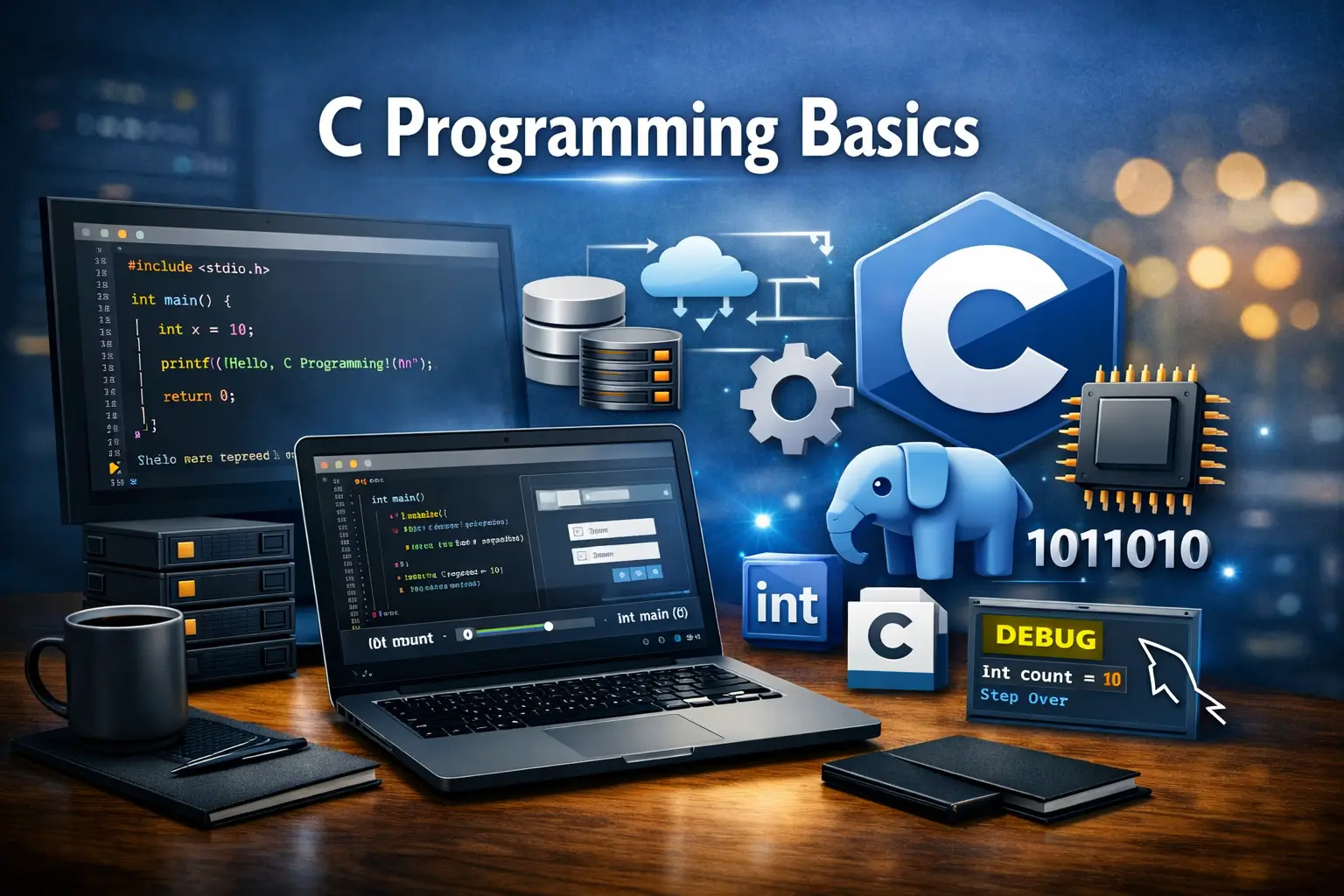
Introduction to C Programming
The C Programming Course is a beginner-friendly program designed to introduce learners to one of the most influential programming languages in the world. Developed as a foundational language for software development, C remains widely used in operating systems, embedded systems, application development, and system programming.
Learning C programming provides a solid understanding of how software works at a lower level while strengthening logical thinking and problem-solving abilities. Many modern programming languages, including C++, Java, and Python, share concepts that originated from C, making it an excellent starting point for aspiring developers.
This course covers the essential principles of C programming and provides hands-on experience through coding exercises and practical examples.
Why Learn C Programming?
C is often considered the foundation of modern programming. It helps learners understand core programming concepts that can be applied to almost any programming language.
Benefits of learning C include:
- Strong programming foundation
- Improved logical thinking
- Better understanding of computer systems
- Preparation for advanced programming languages
- Valuable software development skills
- Increased career opportunities
Because of its efficiency and flexibility, C continues to be used in software engineering, embedded systems, operating systems, and hardware programming.
What You Will Learn
The C Programming Course introduces learners to the essential building blocks of programming.
Topics covered include:
- Introduction to programming concepts
- C language syntax
- Variables and constants
- Data types
- Operators and expressions
- Conditional statements
- Loops and iterations
- Functions
- Arrays and strings
- Pointers
- File handling
- Program debugging techniques
These concepts help learners develop confidence in writing and understanding code.
Core Concepts Covered
Variables and Data Types
Learn how programs store and manage data using different data types and variables.
Topics include:
- Integer data types
- Floating-point values
- Character variables
- Constants
- Variable declarations
Operators and Expressions
Understand how calculations and logical operations are performed.
Topics include:
- Arithmetic operators
- Relational operators
- Logical operators
- Assignment operators
Control Structures
Control structures help programs make decisions and repeat tasks efficiently.
Topics include:
- If statements
- If-else statements
- Switch statements
- For loops
- While loops
- Do-while loops
Functions
Functions improve code organization and reusability.
Learners will explore:
- Function declaration
- Function definition
- Function calls
- Parameters and arguments
- Return values
Arrays and Strings
Learn how to store and manipulate collections of data.
Topics include:
- One-dimensional arrays
- Multi-dimensional arrays
- String handling
- Character arrays
Pointers Fundamentals
Pointers are among the most powerful features of C programming.
Topics include:
- Memory addresses
- Pointer variables
- Pointer operations
- Pointer applications
File Handling Basics
Understand how programs interact with external files.
Topics include:
- Opening files
- Reading files
- Writing files
- Closing files
Skills You Will Gain
Upon completing this course, learners will be able to:
- Write basic C programs
- Solve programming problems
- Use variables and data structures
- Create functions and reusable code
- Work with arrays and strings
- Understand memory management concepts
- Perform file operations
- Debug simple programs
These skills create a strong foundation for future software development learning.
Benefits of the Course
Beginner-Friendly Learning
The course starts with fundamental concepts and gradually progresses to more advanced topics.
Practical Coding Experience
Gain hands-on coding experience through exercises and mini-projects.
Career Preparation
Build technical skills valued in software development and technology industries.
Strong Programming Foundation
Develop knowledge that supports learning advanced languages such as C++, Java, Python, and JavaScript.
Flexible Online Learning
Study at your own pace from anywhere with internet access.
Who Should Enroll?
This course is suitable for:
- School and college students
- Engineering students
- Computer science learners
- Beginner programmers
- Software development aspirants
- IT professionals
- Career changers entering technology
No prior programming experience is required.
Career Opportunities
Learning C programming supports various technical career paths, including:
- Software Developer
- Junior Programmer
- Embedded Systems Developer
- Application Developer
- Technical Support Engineer
- QA Tester
- Systems Programmer
- Computer Science Research Assistant
The knowledge gained also serves as a stepping stone toward advanced programming and software engineering roles.
Certification Benefits
Upon successful completion, learners receive a C Programming Certification that demonstrates foundational programming knowledge.
Certification benefits include:
- Enhanced resume value
- Improved employability
- Academic skill development
- Industry-recognized learning achievement
- Preparation for advanced programming courses
Conclusion
The C Programming Basics Course provides an excellent starting point for anyone interested in software development and computer programming. By learning core concepts such as variables, loops, functions, arrays, and pointers, learners gain a strong technical foundation that supports future growth in programming and technology careers. Whether you are a student, aspiring developer, or professional looking to expand your skills, this course offers the practical knowledge and confidence needed to begin your coding journey successfully.
10. FAQ SECTION
1. What is C Programming?
C Programming is a general-purpose programming language used for software development, system programming, and embedded systems.
2. Is this course suitable for beginners?
Yes, the course is specifically designed for beginners with no prior programming experience.
3. Will I receive a certificate?
Yes, learners receive a certificate upon successful completion.
4. What topics are covered?
Variables, data types, loops, functions, arrays, pointers, file handling, and programming fundamentals.
5. Do I need coding experience?
No, the course starts from the basics.
6. Is C still relevant today?
Yes, C remains widely used in operating systems, embedded systems, and software development.
7. Can I learn C online?
Yes, this course is designed for flexible online learning.
8. What skills will I gain?
Programming logic, problem-solving, coding fundamentals, debugging, and software development basics.
9. How does C help with other programming languages?
C teaches core programming concepts that apply to languages like C++, Java, Python, and JavaScript.
10. What career opportunities can this course support?
Software development, embedded systems, technical support, QA testing, and programming-related careers.


Reviews
There are no reviews yet.