
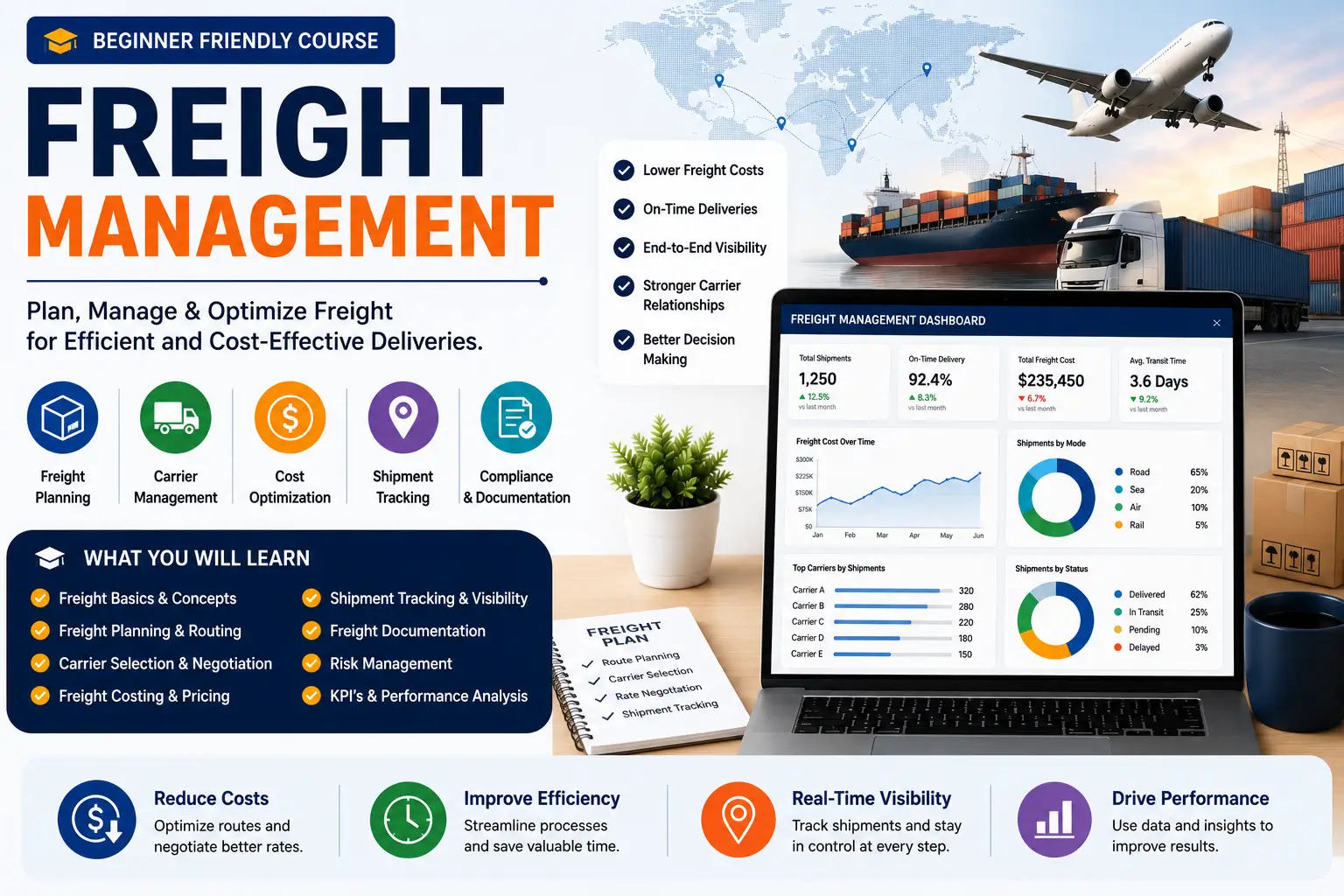
Freight Management Course
The Freight Management Course is designed to help learners understand the planning, coordination, and movement of goods through domestic and international transportation networks. Moreover, the course provides practical knowledge of freight operations, cargo management, shipping procedures, and logistics coordination. As a result, learners gain valuable skills that support efficient transportation and supply chain management.
Course Overview
Freight management is a critical component of global trade and logistics operations. Therefore, businesses rely on skilled professionals to manage cargo movement, transportation planning, and freight coordination. This Freight Management Course provides a comprehensive understanding of freight systems and logistics management practices.
In addition, learners explore transportation methods, freight documentation, and operational planning. Furthermore, they gain insights into industry standards and modern freight management technologies.
Fundamentals of Freight Management
The course begins with the fundamentals of freight management. Therefore, students learn key concepts related to cargo transportation, freight operations, and logistics planning. Moreover, they understand how freight management contributes to supply chain efficiency and customer satisfaction.
These foundations help learners build strong logistics management skills.
Freight Transportation Systems
Transportation is at the heart of freight operations. Consequently, learners study road, rail, air, and sea freight transportation systems. In addition, they explore the advantages, limitations, and operational requirements of each transport mode.
As a result, students gain practical knowledge of freight transportation planning.
Cargo Handling and Freight Operations
Efficient cargo handling improves freight performance. Therefore, the course covers cargo processing, loading procedures, storage practices, and freight movement operations. Furthermore, learners understand how proper handling reduces delays and operational risks.
These skills support successful freight management activities.
Freight Forwarding and Shipping Management
Freight forwarding plays an important role in logistics. Consequently, students learn about shipment coordination, carrier selection, route planning, and shipping documentation. In addition, they explore the responsibilities of freight forwarders in global trade operations.
These concepts prepare learners for professional freight management roles.
Supply Chain and Logistics Coordination
Freight management works closely with supply chain operations. Therefore, learners study logistics coordination, inventory movement, warehouse integration, and transportation scheduling. Moreover, they understand how effective coordination improves operational efficiency.
As a result, students develop comprehensive logistics management skills.
Freight Cost Management
Controlling transportation costs is essential for business success. Consequently, the course introduces freight budgeting, transportation cost analysis, and optimization techniques. In addition, learners explore strategies that improve profitability and operational performance.
These skills help businesses manage freight expenses effectively.
Risk Management and Compliance
Freight operations involve regulatory and operational risks. Therefore, students study transportation regulations, safety requirements, and risk mitigation strategies. Furthermore, they learn how businesses maintain compliance while ensuring efficient cargo movement.
These concepts support responsible freight management practices.
Practical Learning and Case Studies
The Freight Management Course includes practical assignments, logistics simulations, and industry case studies. Moreover, learners apply freight management concepts to real-world transportation and supply chain scenarios.
As a result, students gain hands-on experience and industry-relevant knowledge.
Learning Outcomes
By the end of this course, learners will be able to:
- Understand freight management principles and processes.
- Coordinate freight transportation and cargo operations.
- Apply freight forwarding and shipping management techniques.
- Support supply chain and logistics activities.
- Analyze freight costs and operational performance.
- Manage transportation risks and compliance requirements.
- Improve freight efficiency through effective planning.
Who Should Enroll?
This course is ideal for logistics professionals, freight coordinators, supply chain specialists, warehouse managers, entrepreneurs, students, and transportation professionals. Moreover, it benefits anyone interested in logistics and freight operations.
Conclusion
The Freight Management Course provides comprehensive training in freight operations, transportation planning, cargo handling, and logistics coordination. Furthermore, it combines theoretical knowledge with practical applications. As a result, learners gain the expertise needed to manage freight operations efficiently and support modern supply chain activities.
9. FAQ SECTION
What is a Freight Management Course?
A Freight Management Course teaches freight operations, transportation planning, cargo handling, and logistics management.
Who can enroll in this course?
Students, logistics professionals, transportation managers, and beginners can enroll.
Do I need prior logistics experience?
No, beginners can join and learn freight management fundamentals.
What skills will I learn?
You will learn freight coordination, transportation planning, cargo handling, and logistics management.
Is practical training included?
Yes, the course includes projects, case studies, and logistics simulations.
Will I receive a certificate?
Yes, learners receive a course completion certificate.
Does the course cover international freight operations?
Yes, international freight and shipping management concepts are included.
What career opportunities are available?
Career options include Freight Manager, Logistics Coordinator, Transportation Planner, Freight Forwarding Executive, and Supply Chain Specialist.
Can entrepreneurs benefit from this course?
Yes, entrepreneurs can improve logistics efficiency and transportation planning for their businesses.
Why should I study Freight Management?
The course helps develop logistics, transportation, and supply chain management skills that are valuable across industries.





Reviews
There are no reviews yet.