
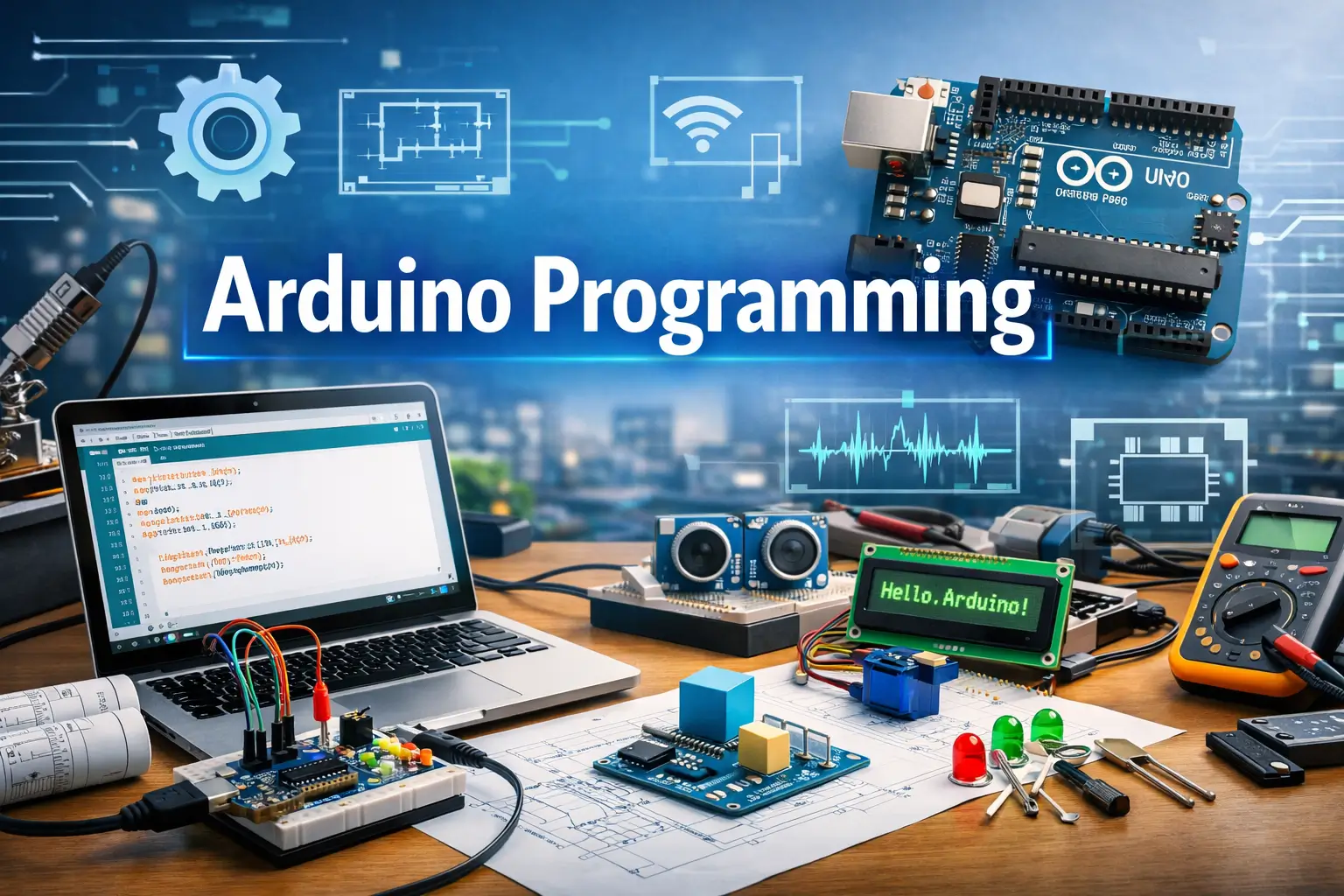
The Arduino Programming Course is a hands-on technical training program designed for students, engineers, hobbyists, and beginners who want to learn electronics, coding, and embedded systems development.
Arduino is an open-source microcontroller platform widely used in robotics, IoT systems, automation, and DIY electronics projects. It allows users to build interactive electronic devices using simple programming and hardware components.
This course provides practical knowledge of Arduino programming, helping learners build real-world projects and understand embedded system design.
Course Overview
The Arduino Programming Course introduces learners to microcontroller programming, hardware interfacing, sensor integration, and IoT applications.
Students will learn how to program Arduino boards using C++ and create functional electronic systems such as smart devices, robots, and automation tools.
The curriculum is designed to combine theory with practical project-based learning.
What You Will Learn
Throughout this course, students will learn:
- Basics of Arduino hardware
- Introduction to microcontrollers
- C++ programming for Arduino
- Digital input and output control
- Analog sensor interfacing
- Motor and servo control
- LED and display programming
- IoT integration with Arduino
- Wireless communication modules
- Real-world electronics projects
Skills You Will Gain
After completing this course, you will develop:
- Embedded programming skills
- Electronics fundamentals
- Arduino C++ coding ability
- Hardware troubleshooting skills
- IoT development knowledge
- Robotics control skills
- Sensor integration expertise
- Problem-solving in hardware systems
- Circuit design understanding
- Project development skills
Benefits of the Arduino Programming Course
Hands-On Learning
Build real electronic projects instead of only theory.
High Demand Skills
Embedded systems and IoT developers are highly valued.
Beginner Friendly
No advanced electronics background required.
Project-Based Training
Learn by building robots, sensors, and smart devices.
Career-Ready Skills
Useful for engineering and automation careers.
Who Should Enroll?
This course is ideal for:
- Engineering students
- Electronics enthusiasts
- Robotics beginners
- IoT learners
- School/college students
- Hobbyists and makers
- Computer science students
- DIY electronics learners
No prior coding experience is required.
Career Opportunities
After completing the Arduino Programming Course, learners can pursue roles such as:
- Embedded Systems Developer
- IoT Developer
- Robotics Engineer (Junior Level)
- Electronics Technician
- Hardware Developer
- Automation Engineer
- Product Prototype Developer
Career opportunities exist in:
- IoT startups
- Robotics companies
- Electronics manufacturing
- Automation industries
- R&D labs
- EdTech and innovation labs
Certification Details
Students who complete the course successfully receive a certification demonstrating skills in Arduino programming, embedded systems, and IoT development.
FAQ SECTION
What is an Arduino Programming Course?
It is a course that teaches how to program Arduino boards for electronics, robotics, and IoT projects.
Who can learn Arduino?
Beginners, students, and engineering learners can easily learn Arduino.
Do I need coding experience?
No, basic programming is taught from scratch.
Is Arduino used in real industry?
Yes, it is widely used in IoT, robotics, and automation systems.
How long is the course?
Typically 1 to 4 months depending on depth.
Will I get a certificate?
Yes, a certification is provided after completion.
What projects will I build?
LED systems, sensors, robots, and IoT devices.
Is Arduino good for career?
Yes, it helps in embedded systems and IoT careers.
What language is used in Arduino?
C and C++ based programming.
Can school students learn Arduino?
Yes, it is very beginner-friendly.




Reviews
There are no reviews yet.