
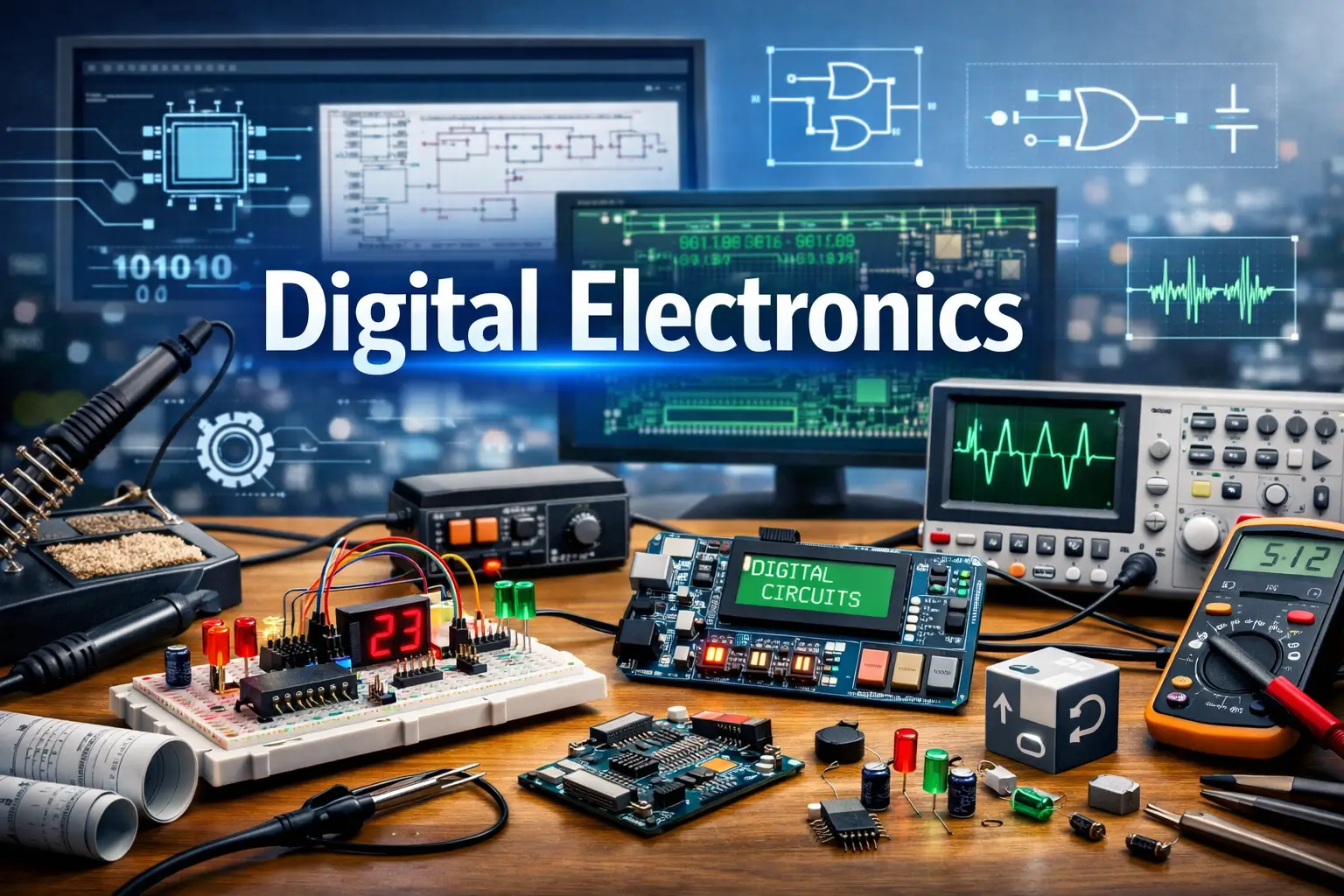
The Digital Electronics Course is a foundational program designed for students, engineering aspirants, and electronics enthusiasts who want to build a strong understanding of modern electronic systems.
Digital electronics is the backbone of all modern devices, including computers, smartphones, communication systems, and embedded systems. It focuses on digital signals, logic circuits, and system design principles that power today’s technology-driven world.
This course provides a clear, structured, and practical understanding of digital electronics concepts, making it ideal for beginners and engineering students.
Course Overview
The Digital Electronics Course introduces learners to binary systems, logic gates, combinational and sequential circuits, and digital system design.
Students will learn how electronic systems process information using digital signals and how complex circuits are built from simple logic components.
The curriculum is aligned with electronics engineering fundamentals used in academic and industry environments.
What You Will Learn
Throughout this course, students will learn:
- Number systems and binary arithmetic
- Boolean algebra fundamentals
- Logic gates (AND, OR, NOT, NAND, NOR, XOR)
- Combinational circuit design
- Sequential circuit design
- Flip-flops and timing circuits
- Counters and registers
- Memory devices basics
- Digital system architecture
- Introduction to VLSI concepts
Skills You Will Gain
After completing this course, you will develop:
- Electronics fundamentals
- Logic design skills
- Circuit analysis ability
- Problem-solving in digital systems
- Engineering mathematics application
- Hardware system understanding
- Analytical thinking
- Design optimization skills
- Technical reasoning
- Foundation for advanced electronics
Benefits of the Digital Electronics Course
Strong Engineering Foundation
Build core knowledge required for electronics and computer engineering.
Industry-Relevant Concepts
Understand systems used in modern computing devices.
Essential for Higher Studies
Helpful for VLSI, embedded systems, and microelectronics.
Beginner Friendly
Designed for students with no prior experience.
Career-Oriented Knowledge
Builds foundation for electronics careers.
Who Should Enroll?
This course is ideal for:
- Electronics engineering students
- Electrical engineering students
- Computer science students
- Diploma students
- Beginners in electronics
- Competitive exam aspirants
- Hobby electronics learners
No prior experience is required.
Career Opportunities
After completing the Digital Electronics Course, learners can pursue roles such as:
- Electronics Technician
- Hardware Assistant Engineer
- Embedded Systems Trainee
- Circuit Design Assistant
- VLSI Entry-Level Roles (with advanced study)
- Testing and Quality Engineer
- Electronics Lab Assistant
Career opportunities exist in:
- Electronics manufacturing
- IT hardware companies
- Semiconductor industry
- R&D labs
- Automation industries
- Education and training institutes
Certification Details
Students who complete the course successfully receive a certification validating their understanding of digital electronics fundamentals and circuit design concepts.
FAQ SECTION
What is a Digital Electronics Course?
It is a course that teaches how digital systems work using logic gates, circuits, and binary systems.
Who can enroll in this course?
Engineering students, diploma students, and beginners can enroll.
Do I need prior electronics knowledge?
No, this course starts from basics.
Is digital electronics difficult?
No, it becomes easy with structured learning.
How long is the course?
Usually 1 to 3 months depending on depth.
Will I get a certificate?
Yes, certification is provided after completion.
What topics are included?
Logic gates, Boolean algebra, and digital circuits.
Is this useful for engineering exams?
Yes, it is very important for electronics exams.
Can beginners learn it?
Yes, it is designed for beginners.
What comes after digital electronics?
You can move into VLSI, embedded systems, or IoT.


Reviews
There are no reviews yet.