
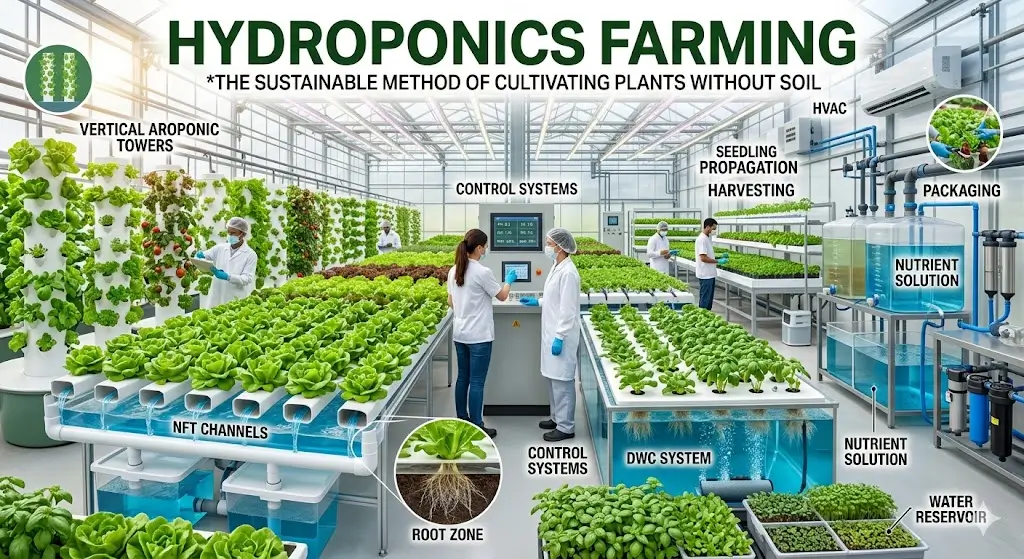
Hydroponics Farming: Growing Plants Without Soil
Hydroponics is a modern farming technique that allows plants to grow in nutrient‑rich water solutions instead of soil. The Hydroponics Farming course introduces learners to the science, systems, and practices behind soilless cultivation. With rising demand for sustainable agriculture, hydroponics offers efficient solutions for food production in urban areas, greenhouses, and commercial farms.
Why Hydroponics Matters
Hydroponics is transforming agriculture by enabling higher yields, faster growth, and reduced resource use. Effective hydroponics farming ensures:
- Sustainable food production with minimal land requirements
- Efficient water usage compared to traditional farming
- Year‑round cultivation regardless of climate
- Reduced pesticide use and healthier crops
- Opportunities for urban and commercial farming ventures
By mastering hydroponics, learners will be able to design, manage, and scale farming systems that meet modern food challenges.
What You’ll Learn
- Hydroponics Fundamentals: Understand the principles of soilless farming and plant nutrition.
- Hydroponic Systems: Explore NFT, DWC, aeroponics, and drip systems.
- Nutrient Solutions: Learn how to prepare and balance essential nutrients.
- Water & pH Management: Discover techniques to monitor and adjust water quality.
- Lighting & Environment: Study artificial lighting, temperature, and humidity control.
- Crop Selection: Identify suitable crops such as lettuce, herbs, and tomatoes.
- Pest & Disease Control: Learn integrated management for healthy plants.
- Commercial Applications: Explore business models, scalability, and profitability.
Benefits of the Course
- Gain practical knowledge in hydroponic farming systems
- Learn sustainable techniques for resource efficiency
- Improve crop yield and quality with controlled environments
- Build entrepreneurial skills for agribusiness ventures
- Contribute to food security and urban farming initiatives
Target Audience
This course is ideal for:
- Students in agriculture, botany, or environmental studies
- Entrepreneurs exploring agritech opportunities
- Farmers seeking sustainable alternatives to soil farming
- Hobbyists and urban gardeners interested in modern cultivation
Career Opportunities
Completing this course opens doors to roles such as:
- Hydroponics Farmer
- Aristech Entrepreneur
- Greenhouse Manager
- Sustainable Agriculture Consultant
- Research Assistant in plant sciences
FAQ SECTION
What is a Hydroponics Farming Course?
A Hydroponics Farming Course teaches learners how to grow crops without soil using nutrient-rich water systems.
Who can enroll in this course?
Students, farmers, entrepreneurs, urban gardeners, and anyone interested in sustainable farming can enroll.
Do I need prior farming experience?
No, beginners can easily join this course.
Is the course available online?
Yes, many institutes offer online, offline, and hybrid learning formats.
How long does the course take?
Most Hydroponics Farming Courses range from 1 month to 6 months.
Will I receive a certificate after completing the course?
Yes, students receive a professional certificate upon successful completion.
What crops can be grown using hydroponics?
Common crops include lettuce, spinach, herbs, tomatoes, cucumbers, and strawberries.
Is hydroponics profitable in India?
Yes, hydroponics is gaining popularity due to increasing demand for fresh and pesticide-controlled produce.
What career opportunities are available after completing this course?
You can become a Hydroponics Farmer, Urban Farming Entrepreneur, Agricultural Consultant, or Greenhouse Manager.
Can I start a hydroponics farm at home?
Yes, small-scale hydroponic systems can be established at home before expanding commercially.




Reviews
There are no reviews yet.