
Introduction
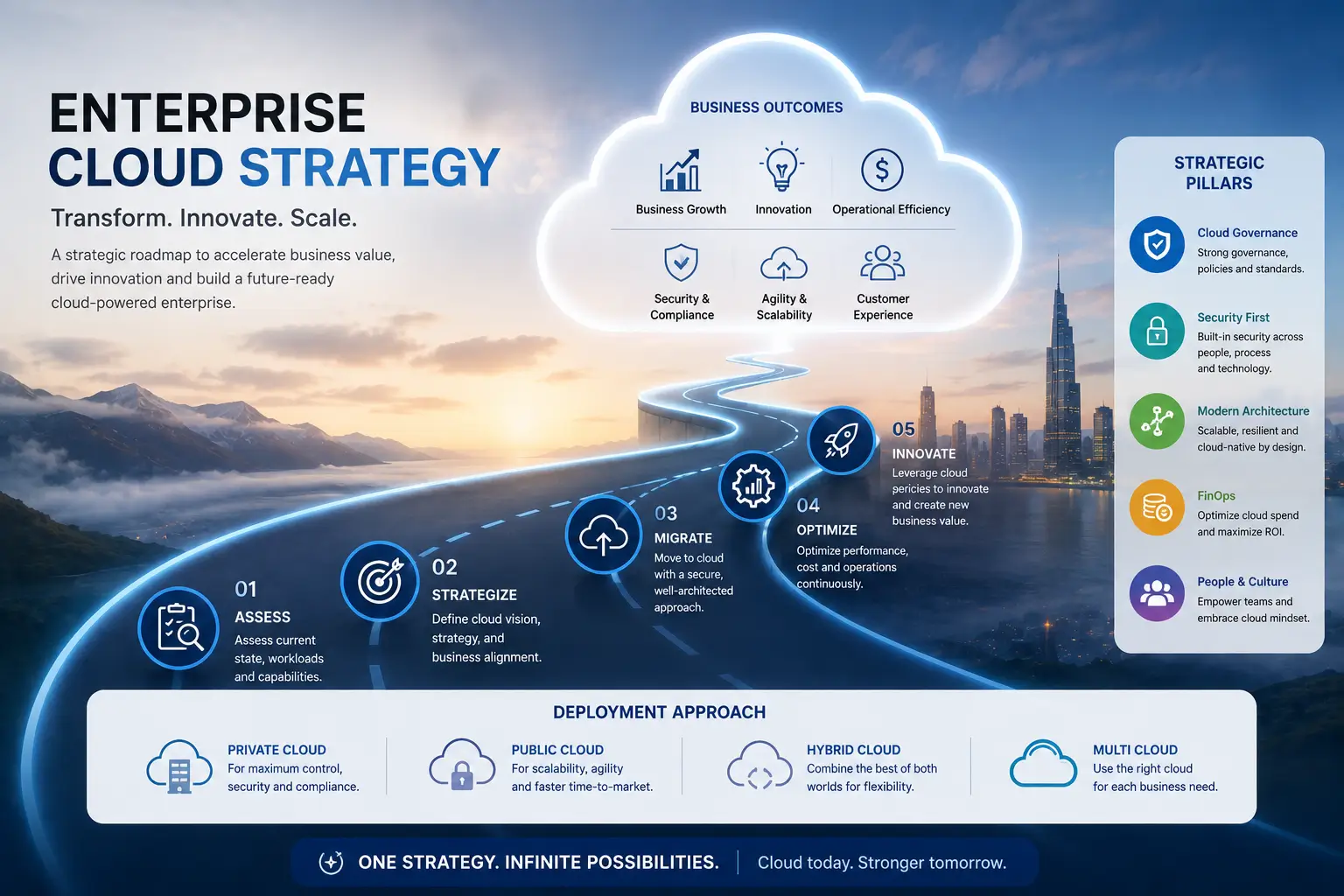
The Enterprise Cloud Strategy course is a professional training program that explains how organizations plan and manage cloud adoption at a large scale. It focuses on aligning business goals with cloud technologies to achieve digital transformation.
Today, companies are rapidly moving to cloud environments. Therefore, having a strong cloud strategy is essential for success. In addition, businesses need structured planning to manage data, applications, and infrastructure efficiently.
This course is part of modern Cloud Computing and enterprise IT transformation practices.
Moreover, it helps organizations improve scalability, reduce costs, and increase operational efficiency.
Course Overview
This course explains how enterprise cloud strategies are designed and implemented. It also shows how businesses transition from traditional systems to cloud-based infrastructure.
For example, companies use cloud migration strategies to move applications to cloud platforms. As a result, they achieve better performance and flexibility.
In addition, learners will understand hybrid cloud and multi-cloud approaches. Therefore, organizations can choose the best cloud solutions for their needs.
What You Will Learn
In this course, learners will understand how enterprise cloud strategies are developed and executed.
They will learn how businesses plan cloud adoption and migration. In addition, they will explore hybrid and multi-cloud architectures.
The course also covers cloud governance, cost management, and digital transformation planning. Therefore, learners gain complete knowledge of enterprise cloud systems.
Moreover, learners will understand how cloud strategy aligns with business goals and IT infrastructure.
Skills You Will Gain
After completing this course, learners will understand how enterprise cloud strategies work in real organizations.
They will also learn how to design cloud adoption plans and architecture models. In addition, they will gain knowledge of cloud governance and business alignment.
This course also improves strategic thinking and IT planning skills. Therefore, learners become ready for cloud consulting and architecture roles.
Benefits of the Course
This course helps learners understand how cloud strategy improves business operations. It explains how cloud adoption supports scalability and efficiency.
For example, organizations can reduce IT costs by moving to cloud systems. Therefore, they improve performance and flexibility.
In addition, learners gain knowledge of modern cloud transformation practices. This improves career opportunities in IT and enterprise architecture fields.
Who Should Enroll
This course is suitable for IT professionals, business analysts, and cloud learners. It is also useful for managers and beginners interested in cloud strategy.
In addition, system architects and technical consultants can also join this course. No advanced technical background is required.
Career Opportunities
After completing this course, learners can work in roles such as:
- Cloud Strategy Analyst
- Enterprise Cloud Consultant
- Cloud Architecture Assistant
- IT Transformation Specialist
- Cloud Planning Analyst
These roles are important in modern enterprise IT environments.
Certification
After completion of the Enterprise Cloud Strategy course, learners receive a certificate. This certificate shows knowledge of cloud planning, digital transformation, and enterprise architecture.
Why Choose This Course
This course explains enterprise cloud planning in a simple and practical way. It connects business strategy with modern cloud technologies.
As a result, learners understand how organizations successfully adopt cloud systems. In addition, it helps build strong strategic and cloud computing skills.
FAQ Section
1. What is Enterprise Cloud Strategy Course
It is a course that teaches how businesses plan and implement cloud adoption strategies.
2. Is this course beginner friendly
Yes, it is designed for beginners. Therefore, anyone can learn it easily.
3. What will I learn in this course
You will learn cloud planning, architecture, and digital transformation strategies.
4. Do I need technical knowledge
Basic IT knowledge is enough to start.
5. What jobs can I get after this course
You can work in cloud consulting and IT strategy roles.
6. Why is cloud strategy important
It helps businesses improve efficiency, scalability, and cost management.
7. Will I get a certificate
Yes, a certificate is provided after completion.
8. Where is it used
It is used in enterprise IT systems and cloud-based organizations.
9. Is multi-cloud included
Yes, multi-cloud and hybrid cloud concepts are included.
10. Can it help in career growth
Yes, it helps build careers in cloud strategy and enterprise IT.




Reviews
There are no reviews yet.