
Introduction
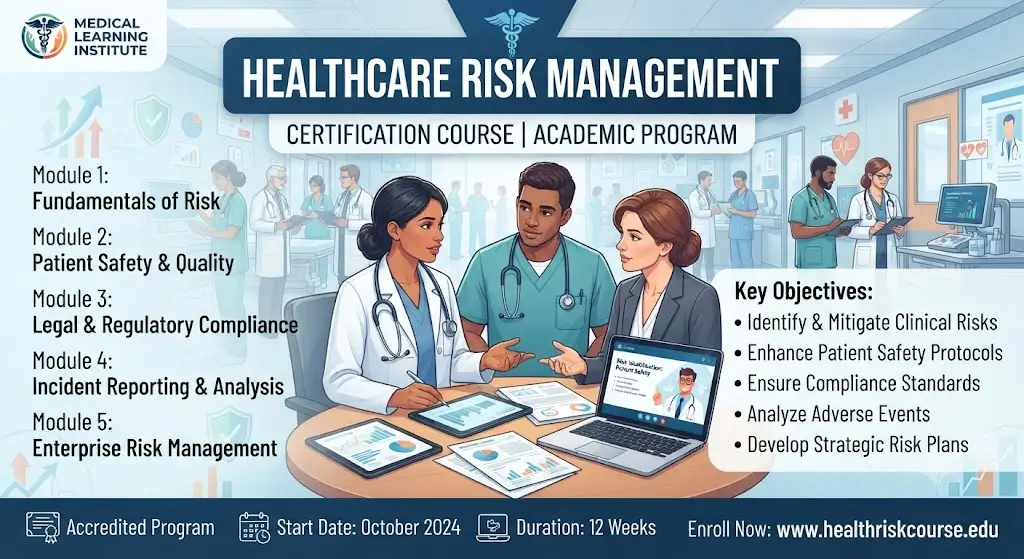
The Healthcare Risk Management Course is a comprehensive program designed to help learners understand how risks in healthcare environments are identified and managed. Risk management ensures patient safety, reduces medical errors, and improves healthcare quality.
In modern healthcare systems, managing risks is essential to avoid legal issues, operational failures, and patient harm. Therefore, understanding risk management is critical for healthcare professionals.
This course introduces learners to healthcare safety systems, clinical risk assessment, hospital policies, and compliance frameworks. Moreover, participants gain practical understanding of managing healthcare risks effectively.
Whether you are a student, healthcare professional, or administrator, this course provides essential skills for healthcare risk management.
Course Overview
Healthcare organizations face various risks, including medical errors, operational failures, and compliance issues. Consequently, risk management plays a vital role in ensuring safe healthcare delivery.
The Healthcare Risk Management Course provides learners with a structured understanding of patient safety systems, risk identification methods, healthcare audits, and safety reporting. Additionally, participants explore how risk management improves healthcare outcomes.
The course combines healthcare knowledge, safety principles, and management strategies to help learners understand healthcare risk systems.
What You Will Learn
The Healthcare Risk Management Course covers a wide range of healthcare safety and management topics. First, learners study the fundamentals of healthcare risks and safety systems.
Next, participants explore risk identification, patient safety protocols, incident reporting, and healthcare audits. Furthermore, the course explains quality control systems, compliance rules, and safety improvement strategies.
In addition, learners gain knowledge of clinical risk evaluation, healthcare governance, and medical liability basics. These topics provide a complete understanding of healthcare risk systems.
Moreover, learners also study real-world hospital safety case studies and risk scenarios.
Skills You Will Gain
Upon successful completion of the course, learners will develop valuable skills, including:
- Healthcare risk identification
- Patient safety management
- Clinical risk assessment
- Hospital safety systems
- Incident reporting skills
- Healthcare compliance understanding
- Quality control basics
- Risk mitigation strategies
- Healthcare governance knowledge
- Safety auditing skills
Moreover, these skills are highly valuable across hospitals, healthcare organizations, clinics, insurance companies, and regulatory bodies.
Benefits of the Course
The Healthcare Risk Management Course offers numerous benefits for learners interested in healthcare safety. First, it builds strong understanding of risk and safety systems.
Additionally, the course improves analytical and decision-making skills. Furthermore, participants gain practical knowledge that helps reduce errors in healthcare systems.
Because patient safety is a top priority, professionals with risk management skills are highly valued. As a result, learners can improve career opportunities in healthcare administration and safety roles.
The course also develops attention to detail, critical thinking, and problem-solving skills.
Who Should Enroll?
This course is ideal for:
- Healthcare students
- Hospital administrators
- Nurses
- Medical staff
- Healthcare managers
- Quality control professionals
- Compliance officers
- Clinic staff
- Safety officers
- Beginners in healthcare management
No advanced background is required. Therefore, beginners can also enroll.
Career Opportunities
After completing the course, learners may pursue opportunities such as:
- Healthcare Risk Manager
- Patient Safety Officer
- Hospital Quality Analyst
- Clinical Risk Coordinator
- Healthcare Compliance Officer
- Safety Auditor
- Medical Risk Analyst
- Healthcare Administrator
- Quality Improvement Specialist
- Hospital Operations Safety Manager
Additionally, learners can work in hospitals, healthcare organizations, insurance companies, and regulatory agencies.
Certification
Upon successful completion of the Healthcare Risk Management Course, participants receive a certification recognizing their ability to identify, assess, and manage risks in healthcare environments.
This certification can strengthen professional credibility and support career growth in healthcare safety and management roles.
Why Choose This Course?
The Healthcare Risk Management Course combines healthcare safety, compliance, and operational management to provide a practical learning experience. Moreover, it equips learners with skills essential for safe healthcare systems.
The curriculum focuses on risk assessment, patient safety, and healthcare quality improvement. Furthermore, learners gain insights into real-world healthcare safety challenges.
Whether your goal is to work in hospitals, healthcare administration, or safety management, this course provides the knowledge and confidence needed to succeed.
Conclusion
The Healthcare Risk Management Course provides a strong foundation in patient safety, healthcare risk assessment, and quality management systems. Through topics such as incident reporting, compliance, and safety protocols, learners gain valuable knowledge applicable across healthcare industries.
Moreover, as healthcare systems become more complex, professionals with risk management expertise are becoming highly valuable. Therefore, this course serves as an excellent starting point for individuals seeking careers in healthcare safety and risk management.
FAQ SECTION
1. What is Healthcare Risk Management?
It is the process of identifying, analyzing, and reducing risks in healthcare systems to ensure patient safety.
2. Is this course suitable for beginners?
Yes, beginners can easily learn healthcare risk management concepts.
3. What topics are covered in this course?
It includes patient safety, risk assessment, compliance, and hospital safety systems.
4. Do I need medical experience?
No, basic healthcare interest is enough.
5. What skills will I gain from this course?
You will learn risk analysis, safety management, and compliance understanding.
6. Can this course help in my career?
Yes, it helps in healthcare safety, compliance, and hospital management roles.
7. Is this course practical?
Yes, it includes real-world hospital risk case studies.
8. Who should enroll in this course?
Healthcare students, nurses, hospital staff, and safety officers.
9. Why is risk management important in healthcare?
It prevents errors, improves patient safety, and ensures smooth hospital operations.
10. What is patient safety in this course?
It refers to preventing harm to patients during healthcare treatment and processes.




Reviews
There are no reviews yet.