
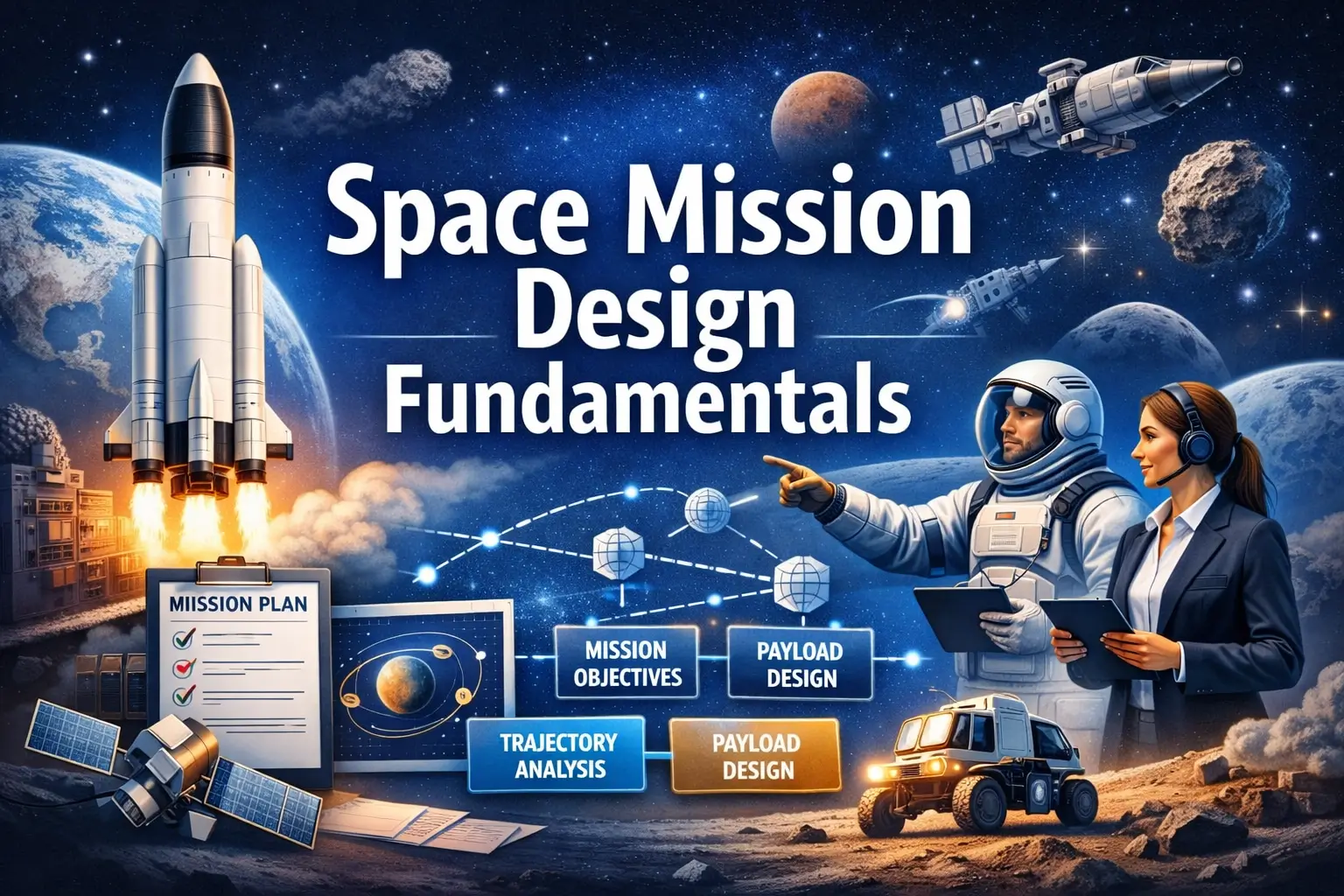
The Space Mission Design Fundamentals Course is a comprehensive training program designed to help learners understand the principles, methodologies, and processes involved in planning and designing successful space missions. As space exploration continues to advance globally, mission design has become a critical discipline that ensures spacecraft can achieve scientific, commercial, and operational objectives safely and efficiently.
Modern space missions require the integration of multiple engineering disciplines, including spacecraft systems, orbital mechanics, mission analysis, communications, and risk management. Therefore, organizations involved in space exploration continuously seek professionals who understand the complexities of mission planning and execution.
This course introduces learners to the foundations of space mission design, mission architecture, spacecraft systems, and mission operations. Moreover, participants gain practical knowledge of mission objectives, payload requirements, orbital selection, and mission lifecycle management.
Whether you are an aspiring aerospace professional, engineering student, researcher, educator, or space enthusiast, this course provides valuable knowledge and practical skills that support professional development and career advancement.
Course Overview
Space missions involve extensive planning, coordination, and engineering expertise. Every successful mission begins with clearly defined objectives and a structured design process.
In this course, learners explore the foundations of mission planning, spacecraft design, orbital analysis, and operational strategies. Additionally, participants gain an understanding of how scientific, communication, Earth observation, and exploration missions are developed.
The course combines theoretical concepts with practical industry applications, helping learners understand how space missions are conceived, planned, designed, and executed.
Participants will also examine various mission types and understand the technological systems that support mission success.
What You Will Learn
The Space Mission Design Fundamentals Course covers a broad range of aerospace and mission planning topics. First, learners study the fundamentals of space missions and the importance of mission objectives in determining overall mission success.
Next, they explore mission architecture development, orbital mechanics principles, and spacecraft subsystem integration.
Furthermore, the course explains launch vehicle selection, payload design considerations, communication systems, and mission operations planning.
Learners also gain knowledge of risk assessment techniques, mission constraints, resource allocation, and contingency planning procedures.
In addition, participants examine emerging technologies, commercial space missions, deep space exploration initiatives, and future trends shaping the global space industry.
These topics provide a complete understanding of modern space mission design practices.
Skills You Will Gain
Upon successful completion of the course, learners will develop valuable skills, including:
- Space mission planning
- Spacecraft design fundamentals
- Orbital mechanics understanding
- Mission architecture development
- Space systems engineering
- Payload integration knowledge
- Mission analysis techniques
- Risk assessment skills
- Technical problem-solving
- Space operations planning
Moreover, these skills are highly valued across aerospace organizations, research institutions, satellite companies, and space agencies.
Benefits of the Course
The Space Mission Design Fundamentals Course offers numerous benefits for learners interested in aerospace and space exploration careers.
First, it provides a strong understanding of the mission design process used throughout the space industry.
Additionally, the course helps learners develop practical skills related to mission planning, systems integration, and operational decision-making.
Furthermore, participants gain industry-relevant knowledge that supports career growth within aerospace organizations, satellite companies, and research institutions.
Because the global space sector is rapidly expanding, professionals with mission planning expertise are increasingly in demand.
The course also enhances analytical thinking, technical understanding, and problem-solving abilities. As a result, learners become better prepared to contribute to future space projects.
Who Should Enroll?
This course is ideal for:
- Aerospace engineering students
- Space science students
- Aspiring aerospace professionals
- Satellite engineers
- Researchers
- STEM educators
- Space enthusiasts
- Systems engineering professionals
- Technical professionals seeking aerospace knowledge
- Individuals pursuing careers in the space industry
No prior space industry experience is required. Therefore, beginners can confidently enroll and build foundational knowledge.
Career Opportunities
After completing the course, learners may pursue opportunities such as:
- Space Mission Analyst
- Mission Planning Specialist
- Aerospace Systems Engineer
- Satellite Operations Specialist
- Spacecraft Systems Engineer
- Mission Operations Coordinator
- Payload Integration Specialist
- Space Research Associate
- Aerospace Project Coordinator
- Space Technology Consultant
Additionally, learners can apply their knowledge across space agencies, aerospace companies, satellite operators, research institutions, and emerging commercial space organizations.
Certification
Upon successful completion of the Space Mission Design Fundamentals Course, participants receive a certification recognizing their understanding of mission planning principles, spacecraft systems, orbital mechanics, and space mission architecture.
This certification can strengthen professional credibility and improve career opportunities in aerospace and space technology industries.
Why Choose This Course?
The Space Mission Design Fundamentals Course combines aerospace engineering principles with real-world mission planning practices to provide a practical and comprehensive learning experience.
Moreover, it equips learners with professional skills that can be applied in various space-related careers.
The curriculum focuses on mission architecture, orbital mechanics, spacecraft systems, risk management, and mission operations planning.
Furthermore, learners gain industry-relevant insights that support long-term professional development.
Whether your goal is to work for a space agency, join a satellite company, pursue aerospace engineering, or expand your understanding of space exploration, this course provides the knowledge, confidence, and practical understanding needed to succeed.
Enroll today and build a strong foundation in space mission design, spacecraft planning, and modern aerospace operations.
FAQ Section
1. What is the Space Mission Design Fundamentals Course?
This course teaches the fundamentals of planning, designing, and managing space missions, including spacecraft systems and mission operations.
2. Is this course suitable for beginners?
Yes. The course is designed for beginners, students, and aspiring aerospace professionals.
3. What topics are covered?
Topics include mission architecture, orbital mechanics, spacecraft systems, payload integration, risk management, and mission planning.
4. Will I receive a certificate?
Yes. Participants receive a certificate upon successful completion of the course.
5. Do I need prior aerospace experience?
No. The course introduces space mission concepts in a beginner-friendly format.
6. Who should enroll in this course?
Students, engineers, researchers, STEM professionals, and space enthusiasts can benefit from this course.
7. Is the course fully online?
Yes. The course offers flexible online learning opportunities.
8. What skills will I gain?
You will gain skills in mission planning, spacecraft design, orbital mechanics, systems engineering, and risk assessment.
9. Can this course help my career?
Yes. Space mission planning skills are highly valued across aerospace organizations, satellite companies, and research institutions.
10. Why is space mission design important?
Space mission design ensures missions are safe, efficient, cost-effective, and capable of achieving their scientific and operational objectives.




Reviews
There are no reviews yet.