
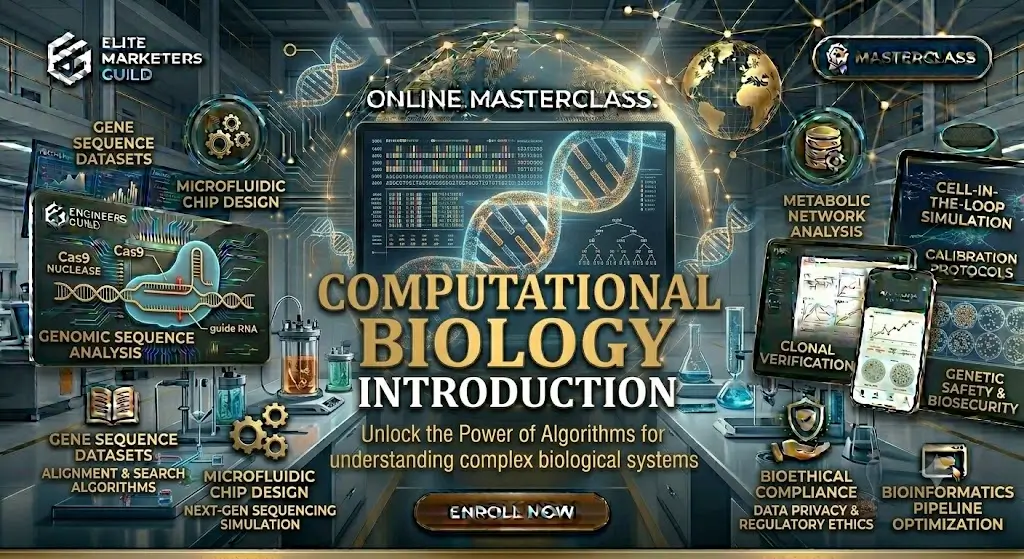
Introduction to Computational Biology Introduction Course
The Computational Biology Introduction Course helps learners understand how computer science supports biological research and scientific discoveries. First, you will explore how biological data is collected and analyzed.
Moreover, healthcare and biotechnology industries increasingly rely on computational technologies. Therefore, learning these concepts can help build future-ready scientific skills.
Computational Biology Introduction Course Overview
This course introduces the foundations of computational biology and bioinformatics. First, you will learn how computers process biological information. Then, you will understand how scientists analyze large biological datasets.
Moreover, you will explore genomics, protein analysis, and biological modeling. Additionally, you will understand how organizations use data to improve research outcomes.
Therefore, this course provides a strong foundation in modern biological sciences.
What You Will Learn in Computational Biology Introduction Course
First, you will understand bioinformatics fundamentals. Then, you will learn how biological data is analyzed.
Moreover, you will explore genomics, biological databases, and computational tools. Additionally, you will understand how technology supports scientific discoveries.
Therefore, you will gain practical knowledge that can be applied across multiple industries.
Skills You Will Gain
After completing this course, you will gain:
- Computational biology fundamentals
- Bioinformatics knowledge
- Biological data analysis skills
- Genomics awareness
- Research methodology understanding
- Analytical thinking skills
- Problem-solving abilities
- Data interpretation knowledge
- Scientific computing concepts
- Biotechnology awareness
Moreover, these skills are highly valuable in modern scientific environments.
Benefits of the Computational Biology Introduction Course
This course helps learners understand how technology is transforming biological sciences. Moreover, it improves analytical and scientific thinking abilities.
Additionally, industries increasingly seek professionals who understand biology and data analysis. Therefore, these skills can support long-term career growth.
Who Should Enroll
This course is ideal for:
- Students
- Biotechnology enthusiasts
- Biology learners
- Researchers
- Healthcare professionals
- Data analysts
- Technology enthusiasts
- Science graduates
- Startup founders
- Career changers
Moreover, no prior computational biology experience is required.
Career Opportunities
After completing the course, learners may pursue opportunities such as:
- Bioinformatics Associate
- Computational Biology Analyst
- Research Assistant
- Biotechnology Associate
- Scientific Data Analyst
- Genomics Technician
- Laboratory Data Specialist
- Research Coordinator
- Healthcare Data Associate
- Biotechnology Support Specialist
Moreover, these opportunities exist across healthcare, biotechnology, pharmaceuticals, research institutions, and life sciences industries.
Certification
Upon successful completion, learners receive a certificate validating their understanding of computational biology, bioinformatics, and biological data analysis.
Additionally, this certification can strengthen professional credibility.
Why Choose Computational Biology Introduction Course
The Computational Biology Introduction Course combines biology, data science, and technology into a practical learning experience.
Moreover, the curriculum focuses on real-world scientific applications. Therefore, learners gain valuable knowledge that can be applied immediately in academic and professional environments.
Whether your goal is to understand bioinformatics, explore genomics, or build biotechnology skills, this course provides a strong foundation to get started.
FAQ SECTION
1. What is the Computational Biology Introduction Course?
It teaches how computers and data analysis support biological research and scientific discoveries.
2. Is this course suitable for beginners?
Yes. It is designed for beginners.
3. What topics are covered?
Bioinformatics, genomics, biological data analysis, and research technologies.
4. Will I receive a certificate?
Yes. Participants receive a certificate after successful completion.
5. Do I need coding experience?
No. Prior coding experience is not required.
6. Is the course fully online?
Yes. It offers flexible online learning.
7. What skills will I gain?
You will gain bioinformatics, data analysis, and computational biology knowledge.
8. Can this course help my career?
Yes. It supports careers in biotechnology, healthcare, and life sciences.
9. Where is computational biology used?
It is used in healthcare, pharmaceuticals, biotechnology, genomics, and scientific research.
10. Why is computational biology important?
It helps researchers analyze complex biological data and accelerate scientific discoveries.





Reviews
There are no reviews yet.