
Introduction
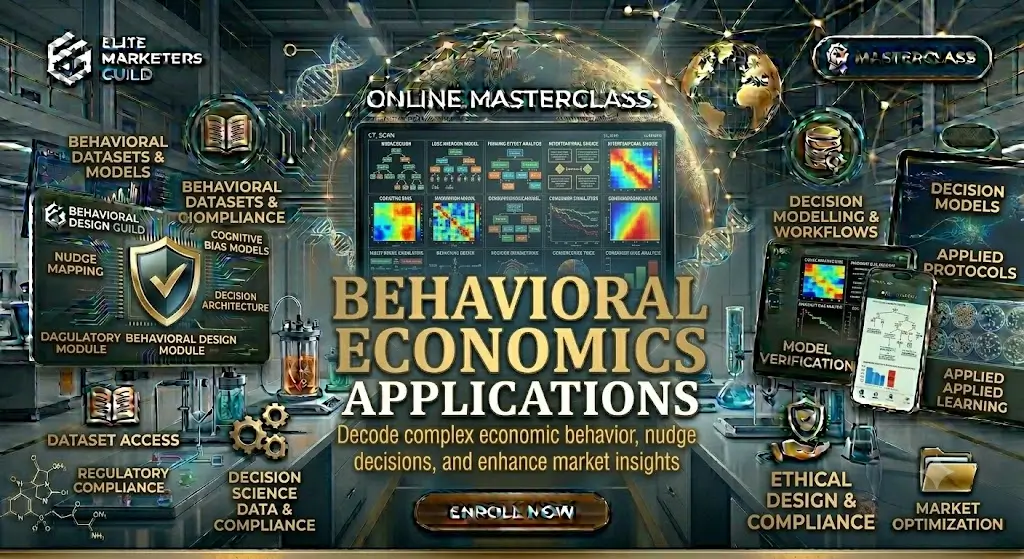
The Behavioral Economics Applications Course is a comprehensive program designed to help learners understand how psychological factors influence economic decisions. It combines psychology and economics to explain how humans actually behave in real-world situations.
Traditional economics assumes rational decision-making, but behavioral economics shows that emotions, biases, and mental shortcuts often influence choices. Therefore, understanding human behavior is essential for better decision-making and policy design.
This course introduces learners to behavioral science, cognitive biases, decision-making models, and consumer psychology. Moreover, participants gain practical knowledge of how behavioral principles are applied in business and policy.
Whether you are a student, business professional, or researcher, this course provides essential skills for behavioral economics applications.
Course Overview
In modern economics, understanding human behavior is crucial for effective decision-making. Consequently, behavioral economics is widely used in business, finance, and public policy.
The Behavioral Economics Applications Course provides learners with a structured understanding of cognitive biases, heuristics, nudging techniques, and market behavior analysis. Additionally, participants explore how people make irrational yet predictable decisions.
The course combines economics, psychology, and behavioral science to help learners understand real-world decision-making patterns.
What You Will Learn
The Behavioral Economics Applications Course covers a wide range of psychology and economics topics. First, learners study the fundamentals of behavioral economics and human decision theory.
Next, participants explore cognitive biases, loss aversion, framing effects, anchoring, and heuristics. Furthermore, the course explains how these biases influence financial, business, and consumer decisions.
In addition, learners gain knowledge of nudge theory, choice architecture, and experimental economics methods. These topics provide a complete understanding of behavioral decision-making.
Moreover, learners also analyze real-world case studies in marketing, finance, and public policy.
Skills You Will Gain
Upon successful completion of the course, learners will develop valuable skills, including:
- Behavioral decision analysis
- Cognitive bias identification
- Consumer behavior understanding
- Nudge theory application
- Economic psychology interpretation
- Market behavior analysis
- Policy behavior design
- Experimental economics basics
- Financial decision behavior analysis
- Choice architecture design
Moreover, these skills are highly valuable across marketing, finance, consulting, policy-making, business strategy, and research sectors.
Benefits of the Course
The Behavioral Economics Applications Course offers numerous benefits for learners interested in psychology and economics. First, it builds strong understanding of real human decision-making behavior.
Additionally, the course improves analytical thinking and strategic decision skills. Furthermore, participants gain practical knowledge that helps improve business, marketing, and policy outcomes.
Because behavioral economics is widely used in industries, professionals with these skills are highly in demand. As a result, learners can improve career opportunities in business, finance, consulting, and public policy.
The course also develops critical thinking, problem-solving, and analytical reasoning skills.
Who Should Enroll?
This course is ideal for:
- Economics students
- Business professionals
- Psychology learners
- Marketing specialists
- Finance professionals
- Policy makers
- Researchers
- Students
- Data analysts
- Management learners
No advanced economics background is required. Therefore, beginners can confidently enroll and build foundational behavioral economics knowledge.
Career Opportunities
After completing the course, learners may pursue opportunities such as:
- Behavioral Analyst
- Market Research Analyst
- Economic Consultant
- Policy Analyst
- Consumer Behavior Specialist
- Behavioral Finance Analyst
- UX Research Analyst
- Business Strategist
- Data Insights Analyst
- Behavioral Science Research Assistant
Additionally, learners can apply these skills across consulting firms, banks, marketing agencies, government bodies, and research organizations.
Certification
Upon successful completion of the Behavioral Economics Applications Course, participants receive a certification recognizing their understanding of human decision-making, behavioral science, and economic psychology.
This certification can strengthen professional credibility and support career growth in business, economics, and policy fields.
Why Choose This Course?
The Behavioral Economics Applications Course combines economics, psychology, and real-world decision science to provide a practical, future-focused learning experience. Moreover, it equips learners with skills essential for understanding human behavior in markets and organizations.
The curriculum focuses on cognitive biases, nudging, and behavioral analysis. Furthermore, learners gain insights into real-world applications in business and policy design.
Whether your goal is to become a business strategist, economist, or behavioral researcher, this course provides the knowledge and confidence needed to succeed.
Conclusion
The Behavioral Economics Applications Course provides a strong foundation in human decision-making, psychology, and economic behavior. Through topics such as cognitive biases, nudging, and consumer behavior, learners gain valuable knowledge applicable across modern industries.
Moreover, as organizations increasingly rely on behavioral insights, professionals with expertise in this field are becoming highly valuable. Therefore, this course serves as an excellent starting point for individuals seeking careers in economics, business strategy, and behavioral science.
FAQ SECTION
1. What is the Behavioral Economics Applications Course?
It teaches how psychology influences economic and business decisions.
2. Is this course suitable for beginners?
Yes. Beginners can easily understand behavioral economics basics.
3. What topics are covered in this course?
It includes cognitive biases, nudging, and decision-making psychology.
4. Will I receive a certificate?
Yes. A certificate is provided after completion.
5. Do I need economics knowledge?
No. The course starts from basic concepts.
6. Who should enroll in this course?
Students, business professionals, and researchers.
7. Is this course practical?
Yes. It includes real-world behavioral case studies.
8. What skills will I gain?
You will gain skills in behavioral and decision analysis.
9. Can this course help my career?
Yes. It improves opportunities in business and policy fields.
10. Why is behavioral economics important?
It helps understand real human decision-making behavior.




Reviews
There are no reviews yet.