
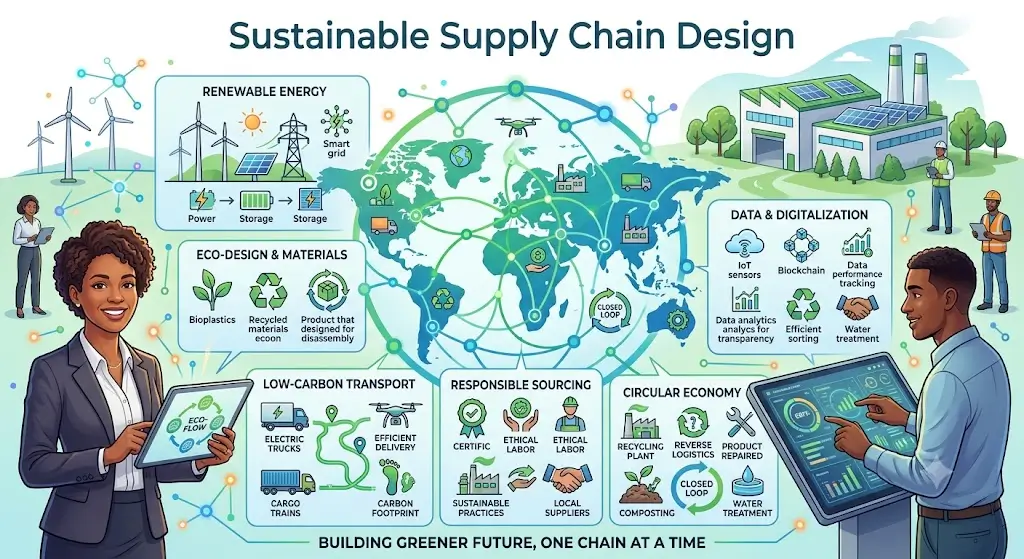
Introduction to Sustainable Business Operations
Businesses today are focusing on reducing waste, improving efficiency, and creating environmentally responsible operations. Organizations are redesigning their supply networks to support long-term sustainability goals.
Moreover, companies across different industries are adopting greener practices to meet customer expectations and environmental regulations. Therefore, understanding sustainable operations has become an important professional skill.
Sustainable Supply Chain Design Course Overview
The Sustainable Supply Chain Design Course introduces the principles of responsible sourcing, logistics, and operational planning.
First, you will learn how products move from suppliers to customers. Then, you will explore methods that help businesses reduce environmental impact while maintaining productivity.
Moreover, you will understand sustainable procurement, resource optimization, and waste reduction strategies.
Therefore, this course provides a strong foundation in modern business sustainability practices.
Learn Green Logistics and Resource Management
You will explore how businesses build efficient transportation networks and optimize resources.
Moreover, you will understand circular economy concepts, inventory planning, and responsible sourcing practices. Additionally, you will learn how organizations measure environmental performance and improve operational efficiency.
Therefore, you will develop practical knowledge that can be applied across multiple industries.
Skills You Will Gain
After completing this course, you will gain:
- Sustainable logistics knowledge
- Resource optimization skills
- Procurement awareness
- Environmental impact understanding
- Operational planning abilities
- Problem-solving skills
- Strategic thinking abilities
- Business sustainability knowledge
- Analytical thinking skills
- Circular economy awareness
Benefits of Sustainable Supply Chain Design Course
This course helps learners understand how organizations balance profitability with environmental responsibility.
Moreover, businesses increasingly seek professionals who understand responsible operations and sustainable business models. Therefore, these skills can support long-term career growth.
Career Opportunities
After completing this course, learners may explore opportunities such as:
- Supply Chain Analyst
- Sustainability Associate
- Logistics Coordinator
- Operations Specialist
- Procurement Associate
- Sustainability Consultant
- Business Analyst
- ESG Operations Specialist
- Operations Coordinator
- Resource Planning Associate
These opportunities exist across manufacturing, retail, healthcare, logistics, consulting, and technology sectors.
Why Choose Sustainable Supply Chain Design Course
The Sustainable Supply Chain Design Course combines sustainability, logistics, and business operations into a practical learning experience.
Moreover, the curriculum focuses on real-world applications that organizations are adopting globally.
Whether your goal is to understand green logistics, improve operational efficiency, or build sustainability skills, this course provides a strong foundation to get started.
FAQ SECTION
1. What is the Sustainable Supply Chain Design Course?
It teaches how businesses create environmentally responsible and efficient supply chain systems.
2. Is this course suitable for beginners?
Yes. It is designed for beginners.
3. What topics are covered?
Sustainable supply chains, green logistics, procurement, and circular economy principles.
4. Will I receive a certificate?
Yes. Participants receive a certificate after successful completion.
5. Do I need supply chain experience?
No. Prior experience is not required.
6. Is the course fully online?
Yes. It offers flexible online learning.
7. What skills will I gain?
You will gain sustainability, logistics, and operational management skills.
8. Can this course help my career?
Yes. It supports careers in logistics, operations, and sustainability.
9. Where are sustainable supply chains used?
They are used in manufacturing, retail, healthcare, logistics, and global businesses.
10. Why are sustainable supply chains important?
They help organizations reduce waste, improve efficiency, and support environmental goals.




Reviews
There are no reviews yet.