
Introduction to Anthropology Basics
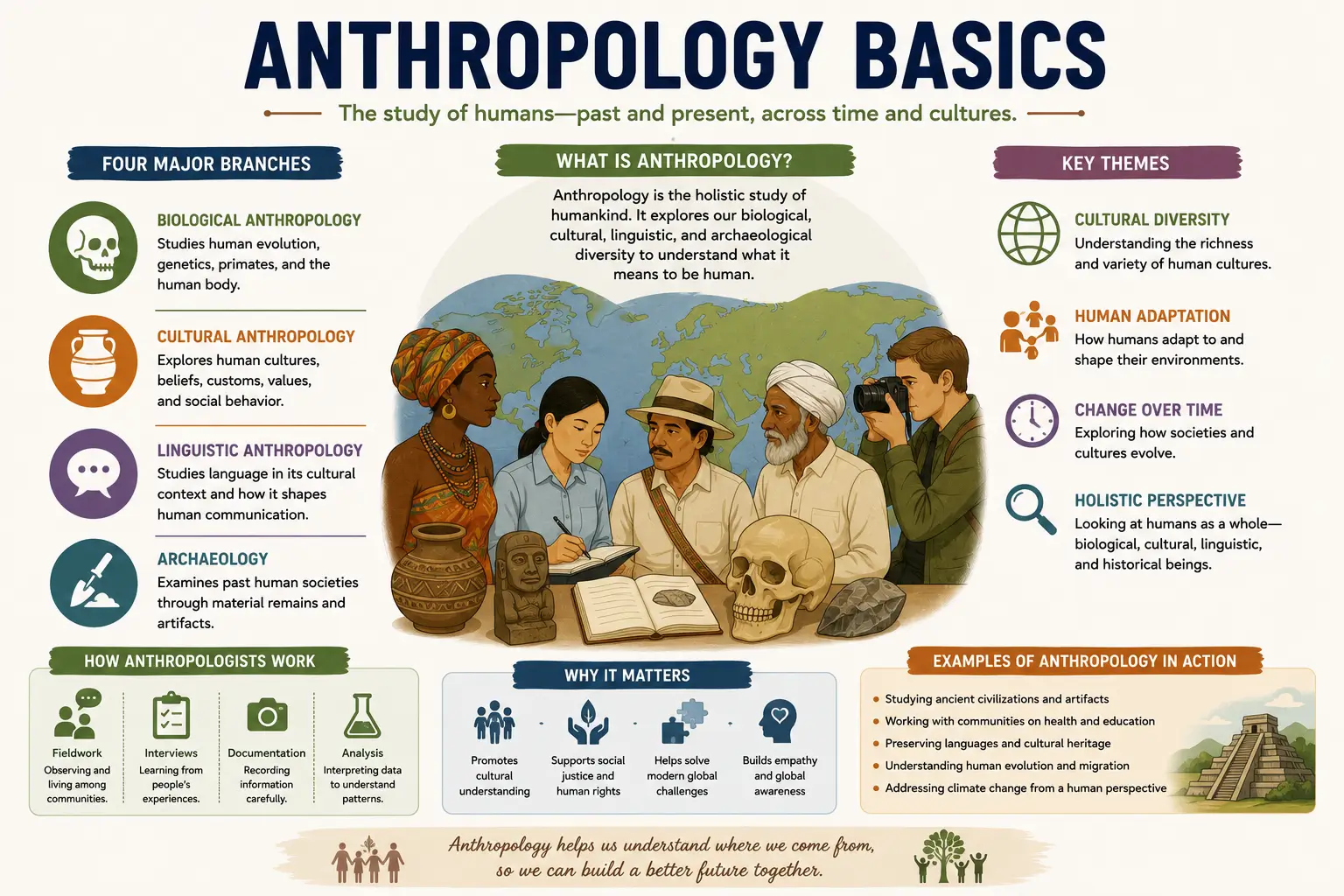
Anthropology is the study of humans, their cultures, societies, behaviors, and development throughout history. The Anthropology Basics course provides learners with a comprehensive introduction to the principles and concepts that help explain how people live, interact, organize communities, and create cultural traditions.
Anthropologists study both past and present societies to understand the diversity of human experiences. Through anthropology, learners gain insights into cultural practices, social structures, language, traditions, and the ways communities adapt to different environments.
This course introduces the foundations of anthropology and explores how human societies have developed across time while highlighting the importance of cultural understanding and global awareness.
Importance of Anthropology Basics
Anthropology helps people understand human diversity and cultural development.
Studying anthropology helps learners:
- Understand cultural differences
- Improve global awareness
- Appreciate social diversity
- Explore human history
- Understand community structures
- Develop cultural sensitivity
- Learn about traditions and customs
- Gain knowledge of human development
These concepts help learners better understand people and societies around the world.
Understanding Human Cultures
Culture is one of the central areas of anthropology.
Cultural Awareness
Learners explore how cultures influence daily life and behavior.
Traditions and Customs
The course explains how communities develop and maintain traditions.
Cultural Practices
Participants gain awareness of different ways people live and interact.
Shared Values
Learners understand how beliefs and values contribute to cultural identity.
Studying culture helps explain the diversity of human experiences.
Human Societies and Social Organization
Anthropology examines how people organize themselves into groups and communities.
The course introduces:
Social Structures
Understanding how societies are organized.
Community Life
Learning how individuals interact within communities.
Family Systems
Exploring the role of family and social relationships.
Social Roles
Understanding how responsibilities and expectations vary across societies.
These concepts help learners understand how human groups function and develop.
Human Evolution and Development
Anthropology also studies human origins and development.
Learners explore:
Human Evolution Awareness
Understanding how humans have changed over time.
Adaptation Concepts
Learning how people adapt to different environments.
Historical Development
Exploring the growth of human societies through history.
Biological Perspectives
Understanding basic concepts related to human development.
These topics provide insights into humanity’s long-term development.
Language and Communication
Language plays an important role in culture and society.
The course covers:
Communication Systems
Understanding how people share information and ideas.
Language Diversity
Learning about different languages and communication practices.
Cultural Expression
Exploring how language reflects culture and identity.
Social Interaction
Understanding the role of communication in community life.
Language helps connect individuals and preserve cultural traditions.
Cultural Diversity and Global Perspectives
Anthropology encourages appreciation of cultural diversity.
Learners gain awareness of:
- Cultural differences
- Global communities
- Social traditions
- Human adaptation
- Community practices
- Cross-cultural understanding
These concepts support respect, inclusion, and global awareness.
Anthropology in Modern Society
Anthropological knowledge is valuable in many fields.
The course discusses applications in:
Education
Understanding cultural diversity within learning environments.
Community Development
Exploring ways to support diverse populations.
Research and Social Studies
Applying anthropological methods to study human societies.
Global Understanding
Improving awareness of cultures and social systems worldwide.
Anthropology provides useful perspectives for addressing social and cultural challenges.
Human Behavior and Cultural Influence
Culture and society strongly influence human behavior.
Learners understand:
Behavioral Patterns
How culture shapes actions and decisions.
Social Influence
How communities affect individual behavior.
Identity Formation
Understanding how people develop cultural identities.
Cultural Continuity
Exploring how traditions are passed between generations.
These concepts help explain the relationship between culture and behavior.
Skills You Will Gain
Upon completing this course, learners may develop:
- Cultural awareness
- Social understanding
- Cross-cultural communication awareness
- Community analysis skills
- Human behavior understanding
- Global perspective awareness
- Research awareness
- Social observation skills
- Historical understanding
- Cultural sensitivity
These skills are valuable in education, community work, research, and social sciences.
Benefits of Studying Anthropology Basics
This course offers several valuable benefits:
- Improved understanding of human cultures
- Increased awareness of social diversity
- Enhanced cultural sensitivity
- Better understanding of human development
- Improved communication awareness
- Broader global perspective
- Appreciation of cultural traditions
- Preparation for advanced social science studies
The knowledge gained helps learners understand the richness and diversity of human societies.
Who Should Join
This course is suitable for:
- Students
- Teachers
- Researchers
- Social science learners
- Community workers
- Cultural studies enthusiasts
- Development professionals
- History learners
- Lifelong learners
- Beginners interested in anthropology
No prior experience is required.
Career Opportunities
After completing this course, learners may explore opportunities such as:
- Research Assistant
- Community Development Assistant
- Cultural Program Coordinator
- Social Research Support Assistant
- Education Support Assistant
- Museum Assistant
- Heritage Program Assistant
- Community Outreach Worker
- Cultural Affairs Assistant
- Social Studies Support Staff
FAQ Section
1. What is Anthropology Basics?
It is a beginner-friendly course that introduces the study of humans, cultures, and societies.
2. Who can join this course?
Students, educators, researchers, and anyone interested in human cultures can join.
3. Do I need prior knowledge of anthropology?
No, the course is designed for beginners.
4. What will I learn?
You will learn about cultures, societies, traditions, human development, and social behavior.
5. Why is anthropology important?
Anthropology helps us understand cultural diversity and human societies.
6. Does the course cover cultural studies?
Yes, learners gain awareness of cultural traditions, customs, and social practices.
7. What skills will I gain?
You will gain cultural awareness, social understanding, and cross-cultural communication knowledge.
8. Is this course suitable for beginners?
Yes, it is specifically designed for learners with no prior experience.
9. Can this course support social science studies?
Yes, it provides foundational knowledge useful for anthropology, sociology, history, and cultural studies.
10. Is Anthropology Basics useful for understanding global cultures?
Yes, it helps learners appreciate cultural diversity and understand societies around the world.





Reviews
There are no reviews yet.