
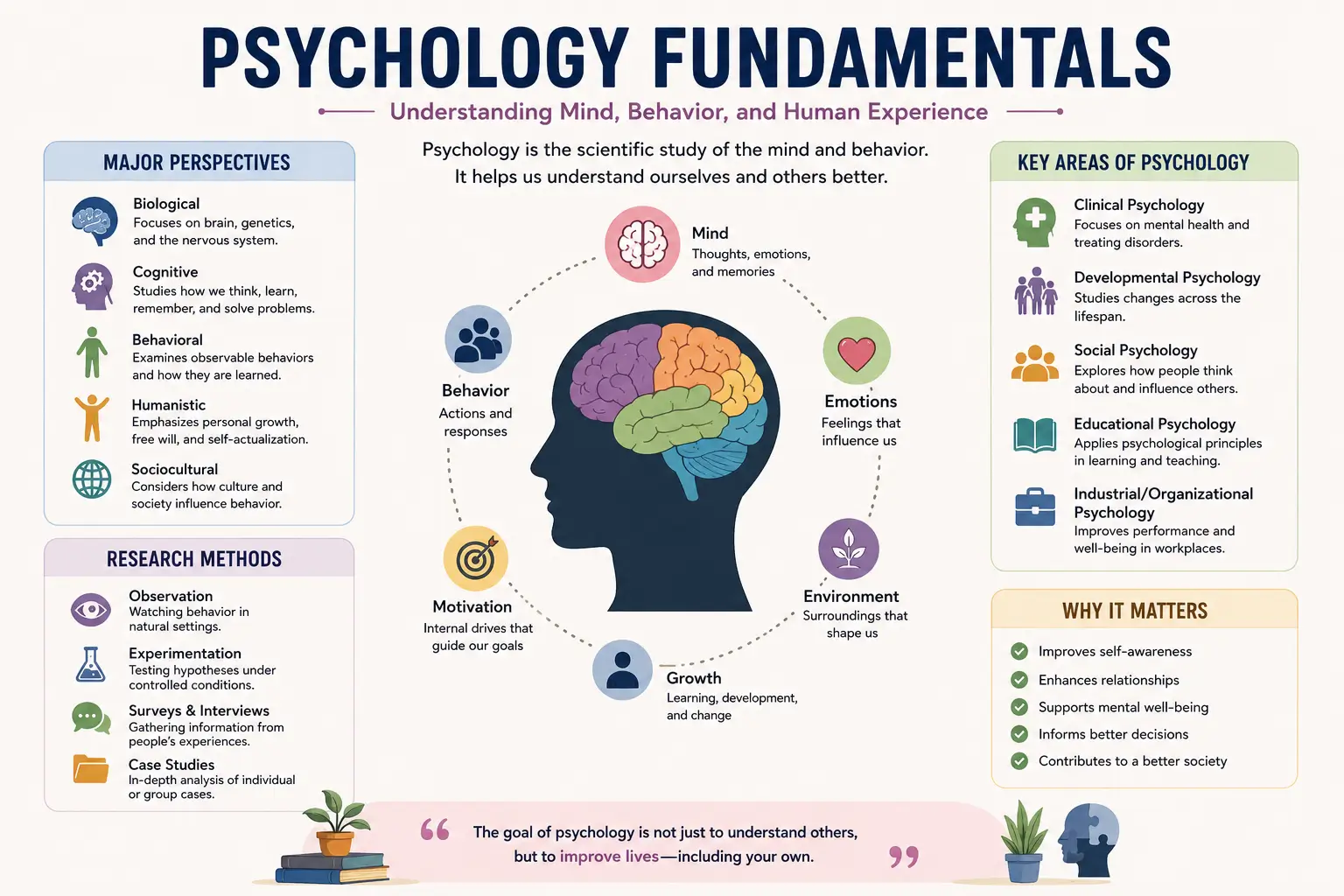
Introduction to Psychology Fundamentals
Psychology is the scientific study of human behavior, thoughts, emotions, and mental processes. The Psychology Fundamentals course provides learners with a comprehensive introduction to the core concepts and principles that help explain how people think, feel, learn, and behave.
Psychology influences many aspects of daily life, including communication, relationships, education, decision-making, workplace interactions, and personal development. By studying psychology, learners gain valuable insights into human behavior and develop a better understanding of themselves and others.
This course introduces foundational psychological theories, concepts, and areas of study while providing practical awareness of how psychology is applied in real-world situations.
Importance of Psychology Fundamentals
Understanding psychology helps individuals make sense of human behavior and mental processes.
Studying psychology helps learners:
- Improve self-awareness
- Understand human behavior
- Enhance communication skills
- Develop interpersonal understanding
- Increase emotional awareness
- Support effective decision-making
- Improve relationship management
- Gain knowledge of mental processes
These benefits make psychology valuable in both personal and professional settings.
Understanding Human Behavior
Human behavior is influenced by a variety of biological, psychological, and social factors.
Behavioral Awareness
Learners explore how behavior develops and changes over time.
Individual Differences
The course explains how people differ in personality, attitudes, and behaviors.
Environmental Influences
Participants gain awareness of how surroundings affect human actions.
Psychological Perspectives
Learners understand different approaches used to study behavior.
Understanding behavior is a key part of psychological learning.
Cognitive Processes and Thinking
Psychology examines how people process information and make decisions.
The course introduces:
Perception Awareness
Understanding how individuals interpret information from their environment.
Memory Concepts
Learning how information is stored, retained, and recalled.
Thinking Processes
Exploring problem-solving and decision-making concepts.
Learning Mechanisms
Understanding how individuals acquire knowledge and skills.
These cognitive processes influence everyday behavior and interactions.
Emotions and Motivation
Emotions and motivation play an important role in human behavior.
Learners explore:
Emotional Awareness
Understanding the role of emotions in daily life.
Motivation Concepts
Learning factors that influence human actions and goals.
Behavioral Drivers
Exploring internal and external influences on behavior.
Personal Development
Understanding how emotions and motivation contribute to growth and achievement.
These concepts help explain why people behave in certain ways.
Personality and Individual Differences
Every individual has unique characteristics that influence behavior.
The course covers:
Personality Awareness
Understanding basic personality concepts and traits.
Individual Characteristics
Learning how personal differences affect interactions.
Self-Understanding
Exploring factors that contribute to personal identity.
Human Diversity
Understanding variations in behavior and personality among individuals.
Personality studies help explain differences in human behavior.
Human Development and Growth
Psychology also studies how individuals develop throughout life.
Learners gain awareness of:
- Growth and development concepts
- Life stage changes
- Learning development
- Social development
- Emotional growth
- Behavioral changes over time
Understanding development helps learners appreciate human growth across different stages of life.
Social Psychology and Interactions
Human behavior is influenced by social environments and relationships.
The course discusses:
Social Behavior
Understanding how individuals interact within groups.
Communication Awareness
Learning how people share information and ideas.
Group Influence
Exploring how social settings affect behavior.
Relationship Dynamics
Understanding factors that influence interpersonal relationships.
These concepts help explain human interactions and social behavior.
Applications of Psychology
Psychological knowledge is applied in many fields and professions.
Learners explore applications in:
Education
Understanding learning and student development.
Workplace Environments
Exploring human behavior in professional settings.
Health and Well-Being
Understanding psychological factors that influence wellness.
Personal Growth
Applying psychological knowledge to self-improvement and development.
These applications demonstrate the practical value of psychology.
Skills You Will Gain
Upon completing this course, learners may develop:
- Human behavior awareness
- Psychological knowledge
- Communication understanding
- Emotional awareness
- Interpersonal skills
- Critical thinking abilities
- Self-awareness
- Learning and development understanding
- Social interaction awareness
- Personal development knowledge
These skills are useful across a wide range of personal, educational, and professional settings.
Benefits of Studying Psychology Fundamentals
This course offers several valuable benefits:
- Improved understanding of human behavior
- Enhanced communication awareness
- Better interpersonal understanding
- Increased emotional intelligence awareness
- Improved decision-making knowledge
- Greater self-awareness
- Understanding of learning processes
- Preparation for advanced psychology studies
The knowledge gained helps learners better understand themselves and the people around them.
Who Should Join
This course is suitable for:
- Students
- Teachers
- Human resource professionals
- Counselors in training
- Social science learners
- Workplace professionals
- Community workers
- Personal development enthusiasts
- Lifelong learners
- Beginners interested in psychology
No prior experience is required.
Career Opportunities
After completing this course, learners may explore opportunities such as:
- Psychology Assistant
- Human Resources Assistant
- Community Support Worker
- Training Coordinator Assistant
- Education Support Assistant
- Customer Service Executive
- Employee Relations Assistant
- Social Services Support Worker
- Learning and Development Assistant
- Behavioral Research Support Assistant
FAQ Section
1. What is Psychology Fundamentals?
It is a beginner-friendly course that introduces the basic concepts of psychology and human behavior.
2. Who can join this course?
Students, professionals, educators, and anyone interested in psychology can join.
3. Do I need prior knowledge of psychology?
No, the course is designed for beginners.
4. What will I learn?
You will learn about behavior, emotions, personality, learning, memory, and psychological concepts.
5. Why is psychology important?
Psychology helps us understand human thoughts, emotions, and behaviors in everyday life.
6. Does the course cover personality concepts?
Yes, learners gain awareness of personality traits and individual differences.
7. What skills will I gain?
You will gain communication awareness, behavioral understanding, emotional awareness, and interpersonal skills.
8. Is this course suitable for beginners?
Yes, it is specifically designed for learners with no prior experience.
9. Can this course support careers related to people and communication?
Yes, it provides foundational knowledge useful in education, human resources, customer service, and community support roles.
10. Is Psychology Fundamentals useful for personal development?
Yes, it helps improve self-awareness, communication, and understanding of human behavior.





Reviews
There are no reviews yet.