
Introduction
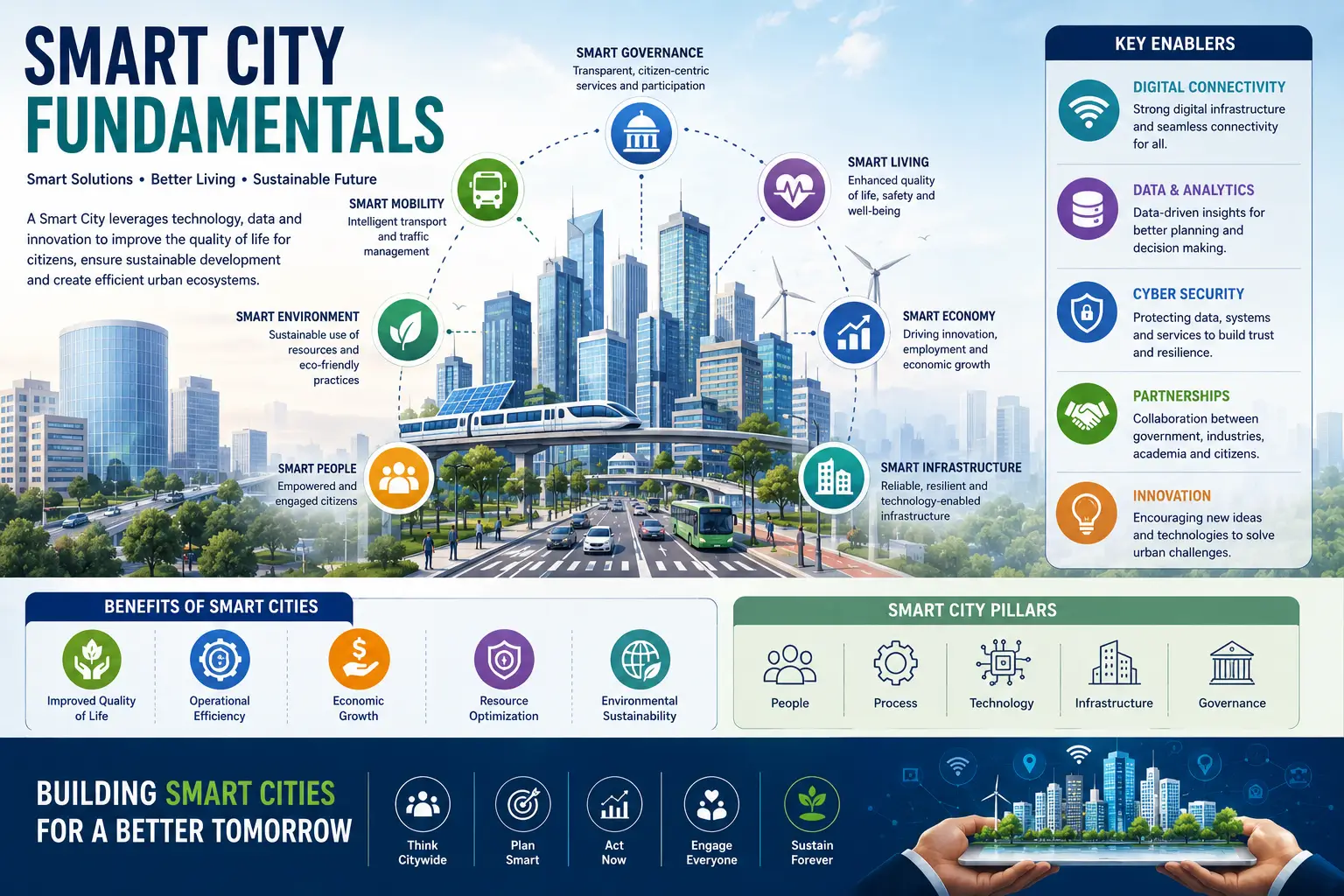
The Smart City Fundamentals Course is designed to introduce learners to the future of urban development. In today’s modern era, cities are evolving rapidly due to technological advancements and increasing population demands. Therefore, the concept of smart cities has become essential for sustainable growth and efficient urban management.
A smart city uses digital technology, IoT systems, and data-driven solutions to improve public services and infrastructure. As a result, cities become more livable, efficient, and environmentally friendly.
Course Overview
This course provides a clear and structured introduction to smart city concepts. First of all, learners will understand the meaning and purpose of smart cities. Next, they will explore how technology integrates with urban infrastructure.
Moreover, the course explains how data, sensors, and digital platforms support city operations. In addition, learners will study how smart governance improves transparency and decision-making.
Consequently, participants gain a strong foundation in urban innovation and digital transformation.
Key Components of Smart Cities
Smart cities are built on several interconnected systems. For instance, smart transportation systems help reduce traffic congestion and improve mobility. Similarly, smart energy systems optimize electricity usage and reduce waste.
Furthermore, smart waste management ensures efficient collection and recycling processes. In the same way, smart water systems help monitor and manage water distribution effectively.
As a result, these systems work together to create sustainable and efficient urban environments.
Role of Technology in Smart Cities
Technology plays a central role in smart city development. Specifically, IoT devices collect real-time data from urban environments. Additionally, artificial intelligence analyzes this data to improve decision-making.
Moreover, cloud computing enables storage and processing of large amounts of information. Therefore, city administrators can make faster and more accurate decisions.
What You Will Learn
In this course, learners will first understand the basics of smart city concepts. Then, they will explore how urban infrastructure is integrated with digital systems.
Additionally, learners will study key areas such as transportation, energy, governance, and public services. Finally, they will gain awareness of future trends in urban innovation and sustainability.
Skills You Will Gain
By completing this course, learners will develop important foundational skills such as:
- Understanding smart city concepts and systems
- Awareness of urban digital transformation
- Basic knowledge of IoT and infrastructure systems
- Analytical thinking about city planning
- Understanding sustainable development practices
- Knowledge of smart governance models
In addition, these skills help learners build a strong foundation for future technical and urban planning careers.
Benefits of the Course
This course offers multiple benefits for learners. Firstly, it provides clear knowledge of smart city technologies. Secondly, it improves awareness of sustainable urban development.
Moreover, it helps learners understand how technology improves public services and quality of life. As a result, learners become better prepared for future roles in urban innovation and infrastructure development.
Who Should Enroll?
This course is suitable for a wide audience. For example, students interested in technology and urban planning can benefit greatly.
Furthermore, professionals in IT, engineering, and public administration can enhance their knowledge. Importantly, no prior experience is required, making it ideal for beginners.
Career Opportunities
After completing this course, learners can explore career paths such as:
- Smart City Planner
- Urban Technology Analyst
- IoT Infrastructure Associate
- Sustainability Consultant
- Urban Development Assistant
- Digital Transformation Specialist
Ultimately, this course opens doors to emerging careers in future city development.
Certification
Upon completion, learners receive a certificate recognizing their understanding of smart city fundamentals and urban innovation concepts. This certification enhances career profiles and academic growth.
Why Choose This Course?
This course simplifies complex urban technology concepts into an easy-to-understand format. Moreover, it focuses on real-world applications and future trends.
Therefore, learners gain both theoretical knowledge and practical awareness. In conclusion, it is an ideal starting point for anyone interested in smart cities and sustainable urban development.
FAQ SECTION
1. What is the Smart City Fundamentals Course?
It is a beginner-level course that introduces smart city concepts, technologies, and urban innovation systems.
2. Is this course suitable for beginners?
Yes, it is designed for beginners with no technical background.
3. What topics are covered in this course?
It covers smart transportation, IoT, digital infrastructure, governance, and sustainability.
4. Do I need technical knowledge?
No, this is a foundation-level awareness course.
5. Will I receive a certificate?
Yes, a certificate is provided after completion.
6. Where are smart cities used?
Smart cities are implemented in modern urban areas worldwide for better infrastructure and services.
7. Can non-technical students join?
Yes, students from any background can enroll.
8. Is this course practical or theoretical?
It is a conceptual course with real-world examples.
9. What skills will I gain?
You will gain knowledge of smart systems, urban innovation, and digital infrastructure basics.
10. Why are smart cities important?
Because they improve efficiency, sustainability, and quality of life in urban areas.




Reviews
There are no reviews yet.