
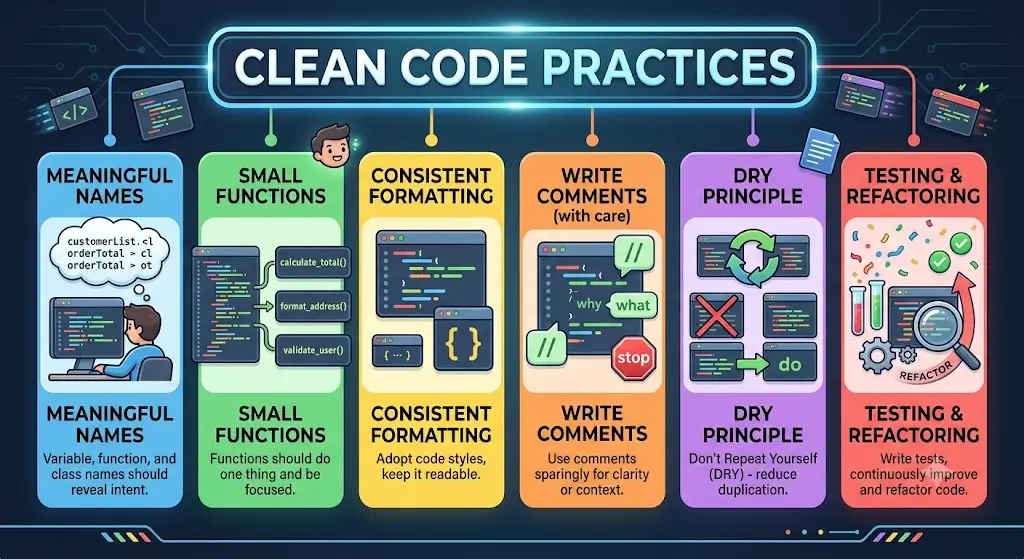
Clean Code Practices Course
The Clean Code Practices Course is designed to help learners develop professional programming habits by writing code that is clean, readable, maintainable, and easy to understand. High-quality code is the foundation of successful software development, enabling teams to build reliable applications, reduce technical debt, and simplify future maintenance.
This course introduces proven clean coding principles, coding standards, refactoring techniques, and software design practices used by professional developers worldwide. Learners will understand how to organize code effectively, choose meaningful names, create modular functions, handle errors gracefully, and apply object-oriented design principles.
Whether you are a beginner programmer, software developer, or experienced engineer looking to improve code quality, this course provides practical guidance for writing better software.
Course Overview
The course focuses on improving code quality through structured programming practices and software engineering principles. Learners will explore how clean code improves collaboration, debugging, testing, scalability, and long-term project maintenance.
You will also learn industry best practices for writing maintainable applications that are easier for teams to understand and extend.
What You Will Learn
By completing this course, you will be able to:
- Understand clean code principles.
- Write readable and maintainable code.
- Follow coding standards and naming conventions.
- Design small and reusable functions.
- Apply SOLID principles.
- Refactor existing code effectively.
- Improve software maintainability.
- Reduce technical debt.
- Write better object-oriented code.
- Handle errors using best practices.
- Participate in effective code reviews.
- Improve collaboration within development teams.
- Document code appropriately.
- Develop scalable software structures.
- Build professional coding habits.
Course Curriculum
The curriculum begins with clean coding fundamentals and progresses into naming conventions, modular programming, error handling, refactoring, SOLID principles, code reviews, software documentation, and clean architecture concepts.
Learners will work through practical coding examples to identify poor coding practices and transform them into clean, maintainable solutions.
Skills You Will Gain
After completing the course, you will develop skills in:
- Clean Coding
- Code Refactoring
- Coding Standards
- SOLID Principles
- Software Design
- Object-Oriented Programming
- Maintainable Code
- Readable Code
- Error Handling
- Code Reviews
- Technical Debt Reduction
- Software Quality
- Professional Programming Practices
- Documentation Best Practices
- Clean Architecture Fundamentals
Benefits of the Course
This course helps learners improve software quality by adopting coding practices that reduce bugs, simplify maintenance, and enhance collaboration. Writing clean code leads to faster development, easier debugging, and more reliable software.
Organizations benefit from maintainable codebases that are easier to scale and support. Clean coding skills are highly valued by employers because they contribute to efficient software development and long-term project success.
Who Should Enroll
This course is ideal for:
- Beginner Programmers
- Software Developers
- Full Stack Developers
- Backend Developers
- Frontend Developers
- Mobile App Developers
- Computer Science Students
- Software Engineers
- QA Automation Engineers
- DevOps Engineers
- Freelance Developers
- Technical Leads
- Programming Instructors
- IT Professionals
- Anyone interested in writing better code
Career Opportunities
After completing the Clean Code Practices Course, learners may pursue or strengthen careers in roles such as:
- Software Developer
- Software Engineer
- Full Stack Developer
- Backend Developer
- Frontend Developer
- Mobile App Developer
- QA Automation Engineer
- Technical Lead
- Software Architect
- DevOps Engineer
Clean coding skills are essential across startups, enterprise software companies, SaaS businesses, fintech, healthcare technology, gaming, and cloud-based application development.
Certification Details
Upon successful completion, learners receive a Certificate of Completion recognizing their expertise in clean coding principles, software quality, and professional programming practices. This certification demonstrates your commitment to writing maintainable, high-quality software and supports career growth in software development.
If you want to become a better programmer and build software that is easier to maintain, scale, and collaborate on, the Clean Code Practices Course provides the practical knowledge and techniques needed for modern software engineering.
9. FAQ SECTION
1. What is the Clean Code Practices Course?
It teaches how to write readable, maintainable, and high-quality software using professional coding standards.
2. Is this course suitable for beginners?
Yes. It is designed for beginners as well as experienced developers who want to improve coding practices.
3. What topics are covered?
Clean coding principles, SOLID principles, refactoring, coding standards, code reviews, and software design.
4. Do I need programming experience?
Basic programming knowledge is recommended to get the most from the course.
5. Is the course online?
Yes. It is fully online and self-paced.
6. Will I receive a certificate?
Yes. A certificate is awarded after completing the course.
7. Who should enroll?
Developers, software engineers, students, technical leads, and anyone interested in improving code quality.
8. What skills will I gain?
Clean coding, refactoring, software design, code reviews, maintainable programming, and professional development practices.
9. Can this course help my career?
Yes. Clean coding skills are highly valued in software engineering and are essential for professional development roles.
10. Why are clean code practices important?
They improve software quality, reduce maintenance costs, minimize bugs, and make collaboration easier across development teams.




Reviews
There are no reviews yet.