
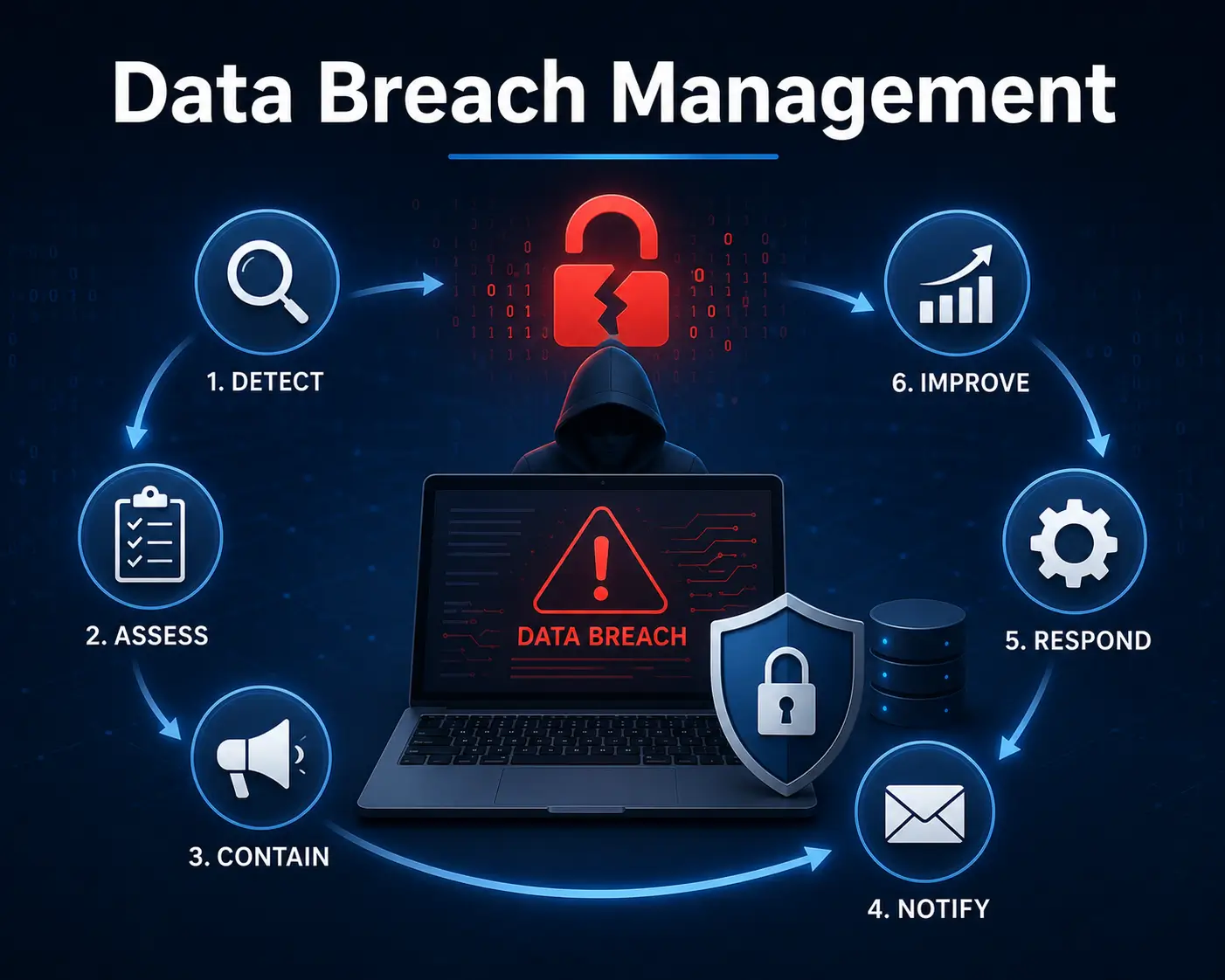
Data Breach Management Course
The Data Breach Management Course is designed to equip learners with the essential knowledge and practical skills required to detect, respond to, manage, and recover from cybersecurity incidents and data breaches. In today’s digital environment, organizations face increasing threats from cyberattacks such as ransomware, phishing, insider threats, malware infections, and unauthorized data access. Effective breach management is critical to minimizing damage, protecting sensitive data, and ensuring business continuity.
This course provides a structured and practical approach to handling cybersecurity incidents, from initial detection to full recovery. Learners will explore incident response frameworks, breach containment strategies, forensic fundamentals, communication protocols, and legal compliance requirements. The course emphasizes real-world scenarios to help learners understand how organizations respond to cyber crises effectively.
Whether you are a cybersecurity beginner, IT professional, SOC analyst, or business manager, this course prepares you to handle security incidents with confidence and precision.
Course Overview
The course introduces the complete lifecycle of data breach management, including preparation, identification, containment, eradication, recovery, and post-incident analysis. Learners will understand how organizations detect security incidents, assess their impact, and implement structured response plans.
Special focus is given to minimizing operational disruption while ensuring proper documentation and compliance with legal and regulatory requirements.
What You Will Learn
By completing this course, you will be able to:
- Understand data breach management principles.
- Identify different types of cyber incidents.
- Detect security breaches early.
- Apply incident response frameworks.
- Contain and mitigate cyberattacks.
- Handle ransomware and malware incidents.
- Preserve digital forensic evidence.
- Communicate during cybersecurity incidents.
- Manage breach notification processes.
- Restore systems after attacks.
- Conduct post-incident analysis.
- Document incident response activities.
- Improve organizational resilience.
- Reduce future cybersecurity risks.
- Follow industry best practices for incident handling.
Course Curriculum
The curriculum begins with cybersecurity incident fundamentals and progresses through detection techniques, containment strategies, forensic basics, communication protocols, recovery processes, and post-incident reviews.
Learners will study the full incident response lifecycle and understand how cybersecurity teams coordinate during real-world breaches. Case studies illustrate ransomware attacks, phishing breaches, and enterprise-level cyber incidents.
Skills You Will Gain
After completing this course, you will develop skills in:
- Data Breach Management
- Incident Response
- Cyber Crisis Management
- Malware Response
- Ransomware Handling
- Digital Forensics Basics
- Security Monitoring
- Risk Assessment
- Breach Containment
- System Recovery
- Incident Documentation
- Cybersecurity Communication
- SOC Operations Basics
- Threat Mitigation
- Security Operations
Benefits of the Course
This course helps organizations and professionals respond effectively to cyberattacks, reducing financial loss, operational downtime, and reputational damage. Learners gain the ability to act quickly during incidents, contain threats, and restore systems efficiently.
Professionals skilled in data breach management are highly valued because organizations must respond rapidly to cyber incidents to meet compliance and protect sensitive data.
Who Should Enroll
This course is ideal for:
- Cybersecurity Professionals
- SOC Analysts
- IT Support Engineers
- Network Administrators
- System Administrators
- Incident Response Teams
- Risk Management Professionals
- Compliance Officers
- Security Analysts
- Cloud Engineers
- Students in Cybersecurity
- Business Managers
- Technical Support Staff
- Digital Forensics Beginners
- Anyone interested in incident response
Career Opportunities
After completing the Data Breach Management Course, learners can pursue roles such as:
- Incident Response Analyst
- SOC Analyst
- Cybersecurity Analyst
- Security Operations Engineer
- Digital Forensics Assistant
- IT Security Specialist
- Risk Management Analyst
- Incident Response Consultant
- Cyber Crisis Manager
- Information Security Analyst
These roles are in high demand across IT companies, financial institutions, government agencies, healthcare organizations, and global enterprises.
Certification Details
Upon successful completion, learners receive a Certificate of Completion recognizing their expertise in data breach management, incident response, and cybersecurity recovery practices. This certification strengthens professional credibility and supports career advancement in cybersecurity operations and incident response domains.
If you want to develop strong incident response capabilities and learn how to manage cybersecurity crises effectively, the Data Breach Management Course provides practical, real-world skills essential for today’s threat-driven digital environment.
FAQ SECTION
1. What is the Data Breach Management Course?
It teaches how to detect, respond to, and recover from cybersecurity incidents and data breaches.
2. Is this course suitable for beginners?
Yes. It is designed for beginners and IT professionals interested in incident response.
3. What topics are covered?
Incident response lifecycle, breach detection, ransomware handling, forensics basics, recovery, and communication.
4. Do I need technical experience?
Basic IT knowledge is helpful but not required.
5. Is the course online?
Yes. It is a fully online self-paced course.
6. Will I receive a certificate?
Yes. A certificate is provided after completion.
7. Who should take this course?
SOC analysts, IT professionals, cybersecurity beginners, and incident response teams.
8. What skills will I gain?
You will learn incident response, breach containment, forensic basics, system recovery, and cyber crisis management.
9. Can this course help my career?
Yes. Incident response skills are highly in demand across cybersecurity roles.
10. Why is data breach management important?
It helps minimize damage, protect sensitive data, ensure compliance, and restore systems after cyberattacks.





Reviews
There are no reviews yet.