
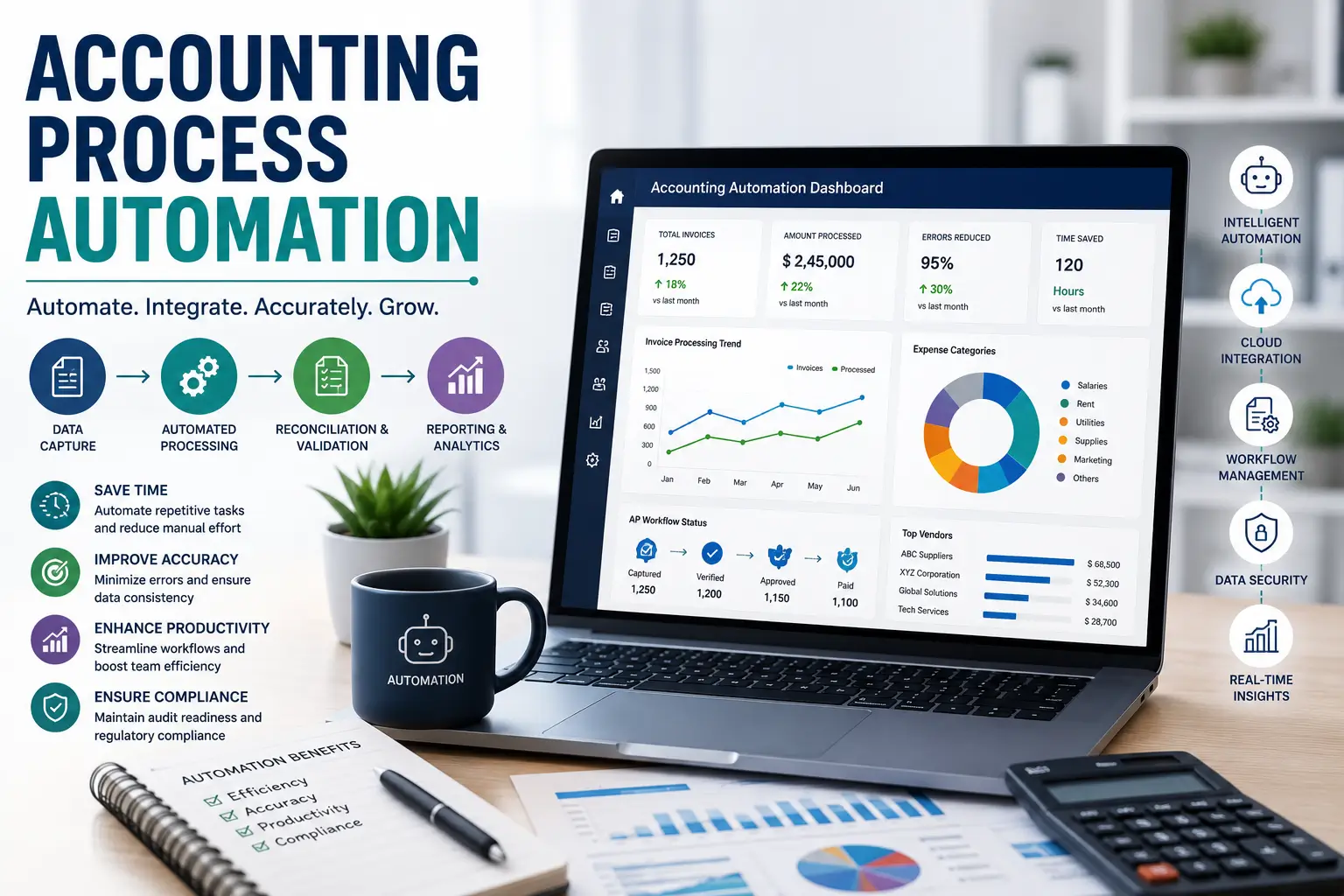
Introduction to Accounting Process Automation Course
The Accounting Process Automation Course is designed to help learners understand how businesses automate accounting functions to improve efficiency, accuracy, and financial control. As organizations embrace digital transformation, automation has become an essential part of modern accounting by reducing repetitive manual tasks and enabling finance teams to focus on strategic decision-making.
This course explains how accounting software, enterprise resource planning (ERP) systems, robotic process automation (RPA), artificial intelligence, and cloud-based financial platforms work together to streamline accounting operations. Learners gain practical knowledge of automation technologies that support faster financial processing, improved compliance, and reliable financial reporting.
Accounting Process Automation Course Overview
The Accounting Process Automation Course provides a structured understanding of accounting automation across the entire financial workflow.
Learners begin with accounting fundamentals before exploring automated invoice processing, accounts payable automation, accounts receivable automation, bank reconciliation, journal automation, financial reporting, approval workflows, document management, compliance monitoring, ERP integration, and cloud accounting systems.
The course also introduces workflow optimization, financial dashboards, digital record management, automated reporting, and internal controls that help organizations improve operational performance while reducing processing costs and human error.
Real-world examples demonstrate how finance departments implement automation solutions to support business growth and operational excellence.
What You Will Learn in Accounting Process Automation Course
Throughout this course, learners will understand:
- Accounting automation fundamentals
- Digital accounting workflows
- ERP accounting systems
- Cloud accounting platforms
- Invoice automation
- Accounts payable automation
- Accounts receivable automation
- Automated journal entries
- Bank reconciliation automation
- Financial reporting automation
- Workflow management
- Approval process automation
- Robotic Process Automation (RPA)
- AI applications in accounting
- Data integration
- Compliance monitoring
- Financial dashboards
- Internal accounting controls
- Document management
- Business process optimization
Skills You Will Develop
After completing this course, learners will develop:
- Accounting automation skills
- ERP system knowledge
- Workflow optimization techniques
- Digital finance capabilities
- Financial reporting skills
- Invoice management
- Data analysis abilities
- Problem-solving skills
- Analytical thinking
- Compliance awareness
- Cloud accounting knowledge
- Business process improvement
- Automation planning
- Documentation management
- Professional finance operations expertise
Benefits of Learning Accounting Process Automation
Automation enables organizations to improve productivity, reduce manual work, increase reporting accuracy, and strengthen financial governance. Professionals with automation knowledge help organizations streamline accounting operations while reducing operational risks and improving financial transparency.
Organizations across banking, manufacturing, healthcare, retail, logistics, consulting, technology, insurance, and financial services continue investing in digital accounting systems, creating significant career opportunities for finance professionals with automation expertise.
Learning accounting automation also prepares professionals for the future of finance, where intelligent technologies increasingly support accounting, auditing, compliance, and financial planning.
Who Should Enroll?
This course is ideal for:
- Accountants
- Finance professionals
- Commerce students
- Business graduates
- ERP users
- Financial analysts
- Banking professionals
- Auditors
- Business owners
- Entrepreneurs
- Digital transformation professionals
- Accounts executives
- Finance managers
- Operations professionals
- Anyone interested in accounting technology
No previous automation experience is required.
Career Opportunities After Accounting Process Automation Course
After completing this course, learners can pursue roles such as:
- Accounting Automation Specialist
- Finance Automation Analyst
- ERP Finance Consultant
- Digital Finance Executive
- Accounts Executive
- Financial Systems Analyst
- Business Process Analyst
- RPA Associate
- Financial Operations Executive
- ERP Functional Consultant
- Accounting Technology Specialist
- Finance Transformation Analyst
- Process Improvement Executive
- Accounting Systems Coordinator
- Digital Accounting Consultant
Career opportunities are available in banks, accounting firms, multinational companies, ERP consulting firms, fintech organizations, healthcare institutions, retail businesses, logistics companies, IT companies, and government organizations.
Why Choose Accounting Process Automation Course?
The Accounting Process Automation Course combines accounting knowledge with modern automation technologies to prepare learners for the future of finance.
The curriculum focuses on digital accounting systems, ERP platforms, workflow automation, financial reporting, compliance, and intelligent business processes. Learners gain practical knowledge aligned with current industry trends and digital transformation initiatives.
Whether you are beginning your accounting career or upgrading your finance skills, this course provides valuable expertise for today’s technology-driven financial environment.
Certification
Upon successful completion, learners will receive a Course Completion Certificate demonstrating their knowledge of accounting automation, ERP systems, digital finance operations, workflow optimization, and financial reporting.
This certification enhances your professional profile and supports career growth in accounting, finance, ERP consulting, digital transformation, and business operations.
Conclusion
Accounting automation is transforming the finance industry by improving efficiency, reducing manual errors, and enabling organizations to make better financial decisions. Businesses increasingly require professionals who understand both accounting principles and automation technologies.
The Accounting Process Automation Course provides practical knowledge and industry-relevant skills that prepare learners for successful careers in digital accounting, finance, ERP implementation, and business process automation.
FAQ Section
1. What is the Accounting Process Automation Course?
The Accounting Process Automation Course teaches how organizations automate accounting workflows using ERP systems, cloud accounting platforms, invoice automation, RPA, and digital finance technologies.
2. Is this course suitable for beginners?
Yes. The course is designed for beginners as well as accounting and finance professionals.
3. What topics are covered in this course?
The course covers ERP systems, accounting automation, invoice processing, accounts payable automation, accounts receivable automation, financial reporting, workflow automation, RPA, AI in accounting, and compliance.
4. Will I receive a certificate after completing the course?
Yes. Learners receive a Course Completion Certificate after successfully completing the program.
5. Do I need previous accounting or automation experience?
No. The course starts with the fundamentals and does not require prior experience.
6. Is the course completely online?
Yes. It is available through a flexible online learning platform.
7. What skills will I gain?
You will develop accounting automation, ERP, workflow management, digital finance, reporting, compliance, and business process optimization skills.
8. What career opportunities are available after completing this course?
Graduates can pursue careers as Accounting Automation Specialists, ERP Finance Consultants, Finance Automation Analysts, Digital Finance Executives, Financial Systems Analysts, and RPA Associates.
9. Why is accounting process automation important?
Automation improves financial accuracy, increases efficiency, reduces manual work, strengthens compliance, and supports faster business decision-making.
10. Who should enroll in this course?
Students, accountants, finance professionals, ERP users, auditors, entrepreneurs, business owners, and anyone interested in digital finance and accounting automation can benefit from this course.



Reviews
There are no reviews yet.