
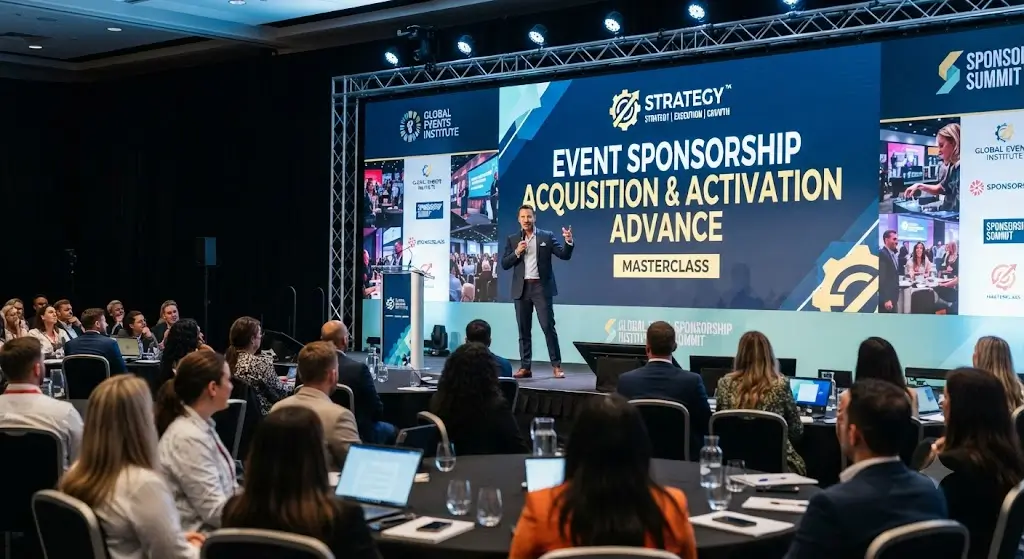
Event Sponsorship Acquisition & Activation Advanced
Master the Strategy Behind Successful Event Sponsorships
Successful event sponsorship requires much more than selling logo placement. Organizations need to identify suitable sponsors, understand their business objectives, create compelling partnership proposals, negotiate valuable rights, deliver activation opportunities, and demonstrate measurable results.
Advanced Event Sponsorship Acquisition & Activation provides an advanced, practical framework for managing this complete sponsorship lifecycle.
The course connects sponsorship acquisition with sponsorship activation, helping learners understand how a partnership can progress from prospect identification and negotiation to execution, measurement, reporting, and renewal.
Research and industry guidance emphasize that activation goes beyond simply securing sponsorship rights: the additional investment and strategic execution are what help convert rights into audience experiences and measurable outcomes.
What You Will Learn
1. Advanced Sponsorship Strategy
Learn how to build a sponsorship strategy aligned with the event’s broader objectives.
Topics include:
- Sponsorship objectives
- Event positioning
- Audience analysis
- Sponsor category strategy
- Partnership objectives
- Sponsorship inventory
- Competitive differentiation
- Revenue planning
- Long-term sponsorship strategy
2. Sponsor Prospecting & Opportunity Identification
Develop systematic approaches for identifying potential sponsors.
You can explore:
- Sponsor research
- Prospect qualification
- Industry and category mapping
- Brand-event fit
- Audience overlap
- Existing partnerships
- Competitive sponsorship analysis
- Sponsor priority scoring
- Prospect pipelines
3. Sponsor Fit & Qualification
Learn how to determine whether a potential sponsor is genuinely suitable for an event.
Evaluation criteria can include:
- Target audience alignment
- Brand values
- Marketing objectives
- Customer overlap
- Geographic relevance
- Budget potential
- Activation capability
- Partnership history
- Strategic value
4. Sponsorship Packaging
Learn how to transform event assets into compelling sponsorship packages.
Topics include:
- Sponsorship tiers
- Naming rights
- Category exclusivity
- Branding opportunities
- Digital inventory
- Content opportunities
- Hospitality
- Speaking opportunities
- Product integration
- Sampling
- Experiential spaces
- Data and lead opportunities
The objective is to create packages around business value, rather than simply listing event assets.
5. Sponsorship Value Proposition
Develop stronger sponsor propositions by connecting event assets with sponsor objectives.
A practical framework is:
Sponsor Objective → Audience → Event Asset → Activation Opportunity → Business Outcome → Measurement
Learners can practice translating event characteristics into sponsor-specific value propositions.
6. Sponsorship Proposals & Pitch Development
Explore how to develop persuasive sponsorship proposals.
Topics include:
- Sponsor research
- Proposal structure
- Audience statistics
- Event positioning
- Sponsorship benefits
- Activation concepts
- Deliverables
- Investment levels
- Measurement plans
- Sponsorship pitch decks
7. Advanced Sponsorship Sales
Develop a structured sponsorship acquisition process:
Prospecting → Qualification → Discovery → Proposal → Presentation → Objection Handling → Negotiation → Contract → Activation
Learners can explore how each stage contributes to conversion and relationship development.
8. Sponsorship Negotiation
Learn advanced approaches to negotiating sponsorship partnerships.
Topics include:
- Rights valuation
- Package customization
- Exclusivity
- Deliverables
- Media exposure
- Hospitality
- Activation rights
- Payment structures
- Performance expectations
- Renewal provisions
- Make-good considerations
The course focuses on creating mutually valuable agreements rather than competing solely on price.
9. Contract & Deliverable Management
Understand the importance of clearly documenting sponsorship commitments.
Topics include:
- Sponsorship rights
- Deliverables
- Timelines
- Brand guidelines
- Approval processes
- Exclusivity
- Cancellation considerations
- Activation responsibilities
- Reporting requirements
- Renewal provisions
Specific legal terms should always be reviewed by appropriate legal professionals.
10. Advanced Sponsorship Activation
Learn how to transform sponsorship rights into engaging audience experiences.
Activation opportunities may include:
- Product demonstrations
- Sampling
- Interactive experiences
- Contests
- Branded content
- VIP experiences
- Hospitality
- Workshops
- Social activations
- Digital experiences
- Community initiatives
- Lead-generation experiences
Effective activation should be connected to a defined sponsor objective rather than created simply for visibility.
11. Pre-Event Activation Planning
Develop a structured activation plan before event day.
You can practice planning:
- Activation objectives
- Audience journey
- Staffing
- Venue requirements
- Branding
- Technology
- Content
- Promotional activity
- Lead capture
- Social amplification
- Risk management
12. Attendee Engagement
Explore how to design experiences that encourage meaningful participation.
Topics include:
- Engagement mechanics
- Interaction design
- Gamification
- Product experiences
- Incentives
- QR and digital experiences
- Lead capture
- Surveys
- Social sharing
- Audience feedback
13. Sponsor Data & Lead Generation
Understand how sponsorship activations can support measurable audience and business outcomes.
Learners can explore:
- Lead capture
- Contact qualification
- Consent considerations
- Lead scoring
- CRM integration
- Lead follow-up
- Sales handoff
- Pipeline tracking
A lead list alone should not be treated as the final measure of sponsorship success; context, quality, engagement, and downstream business outcomes matter.
14. Sponsorship Measurement & KPIs
Develop a measurement framework connecting activation activity to sponsor objectives.
Metrics may include:
Exposure
- Reach
- Impressions
- Media exposure
- Brand visibility
Engagement
- Interactions
- Participation
- Product trials
- Activation completion
- Social engagement
Commercial
- Leads
- Qualified leads
- Pipeline
- Sales
- Customer acquisition
- Purchase intent
Relationship
- Sponsor satisfaction
- Attendee satisfaction
- Renewal intention
Industry measurement guidance recommends considering brand/business impact, performance efficiency, and social impact rather than relying only on exposure metrics.
15. Sponsorship ROI
Learn how to build a structured sponsorship ROI approach.
A simplified framework is:
ROI = (Attributed Value − Sponsorship Investment) ÷ Sponsorship Investment
However, the definitions of investment, attributable value, attribution model, and measurement period should be agreed upon before calculating ROI.
Learners can explore:
- Cost per engagement
- Cost per lead
- Cost per qualified lead
- Pipeline contribution
- Revenue contribution
- Customer acquisition
- Brand impact
- Sponsorship ROI
16. Post-Event Reporting
Learn how to turn event data into a professional sponsor report.
A strong report can include:
- Objectives
- Delivered benefits
- Audience reach
- Engagement
- Activation results
- Lead quality
- Social performance
- Brand feedback
- Commercial outcomes
- ROI analysis
- Recommendations
17. Sponsor Renewal Strategy
Develop approaches for converting successful sponsorships into longer-term relationships.
Topics include:
- Post-event communication
- Results presentation
- Sponsor feedback
- Performance review
- Renewal discussions
- Package improvement
- Multi-event partnerships
- Upselling
- Cross-event opportunities
18. Sponsorship Optimization
Use performance data to improve future sponsorship programs.
The optimization cycle is:
Measure → Analyze → Identify Gaps → Improve Activation → Test → Measure Again
This makes sponsorship a continuous marketing and partnership program rather than a one-time transaction.
Practical Exercises & Case Scenarios
Learners can apply the concepts through realistic sponsorship scenarios.
Case 1: Sponsor Prospecting
Build a qualified sponsor prospect list based on audience, industry, brand fit, and objectives.
Case 2: Sponsor Qualification
Score potential sponsors and determine which prospects should receive priority.
Case 3: Sponsorship Package
Create three sponsorship tiers with differentiated benefits and activation opportunities.
Case 4: Sponsorship Proposal
Develop a sponsor-specific value proposition and proposal structure.
Case 5: Negotiation
Work through a sponsorship negotiation involving rights, exclusivity, deliverables, and investment.
Case 6: Activation Plan
Create an activation concept connected to a sponsor’s business objective.
Case 7: KPI Framework
Develop pre-event, event-day, and post-event KPIs.
Case 8: ROI Analysis
Evaluate sponsorship performance using engagement, lead, pipeline, sales, and cost data.
Case 9: Renewal Decision
Determine whether a sponsor should be renewed, upgraded, redesigned, or replaced based on performance.
Advanced Sponsorship Workflow
Event Strategy → Audience Analysis → Sponsor Research → Prospect Qualification → Discovery → Sponsorship Packaging → Proposal → Pitch → Negotiation → Contract → Activation Planning → Event Execution → Measurement → Reporting → Renewal
This end-to-end workflow helps learners understand the relationship between acquisition and activation.
Who Should Take This Course?
This course is suitable for:
- Event managers
- Sponsorship managers
- Event marketers
- Partnership managers
- Business development professionals
- Sports marketing professionals
- Entertainment marketers
- Conference organizers
- Festival professionals
- Association professionals
- Nonprofit event teams
- Marketing agencies
- Brand partnership professionals
- Entrepreneurs
Skills You Can Develop
Learners can develop skills in:
- Event sponsorship acquisition
- Sponsor prospecting
- Sponsor qualification
- Sponsorship sales
- Sponsorship packaging
- Proposal development
- Sponsor pitching
- Negotiation
- Sponsorship activation
- Audience engagement
- Lead generation
- Sponsor relationship management
- KPI development
- Sponsorship measurement
- ROI analysis
- Post-event reporting
- Sponsor renewal strategy
Why Learn Event Sponsorship Acquisition & Activation?
Sponsorship acquisition and activation are closely connected. Securing rights creates an opportunity, but strategic activation is what helps turn those rights into meaningful audience engagement and measurable value.
Modern sponsorship programs increasingly need to demonstrate more than exposure. Strong measurement can connect event activity with engagement, brand outcomes, leads, pipeline, sales, and longer-term partnership value.
Course Outcome
After completing the course, learners can develop an advanced framework for identifying sponsors, evaluating opportunities, creating sponsorship packages, pitching and negotiating partnerships, designing activation programs, measuring outcomes, and supporting sponsor renewals.
Build advanced sponsorship acquisition and activation skills and learn how to connect event partnerships with measurable business and audience outcomes.
Q1. What is Event Sponsorship Acquisition & Activation?
It is the process of identifying and securing sponsors and then using the agreed sponsorship rights to create meaningful audience experiences and business value.
Q2. Who should take this advanced sponsorship course?
It is designed for event managers, sponsorship professionals, partnership managers, event marketers, business development professionals, sports and entertainment marketers, agencies, and entrepreneurs.
Q3. Is this an advanced-level course?
Yes. It assumes learners have some understanding of events, marketing, sponsorship, or business development and focuses on advanced strategy and practical application.
Q4. What will I learn about sponsor acquisition?
You can learn sponsor research, prospecting, qualification, packaging, proposals, pitching, objection handling, negotiation, and relationship development.
Q5. What is sponsorship activation?
Sponsorship activation involves using the rights and assets acquired through sponsorship to create experiences, engagement, marketing activity, and other outcomes for the sponsor.
Q6. Does the course cover sponsorship negotiation?
Yes. It covers rights valuation, exclusivity, deliverables, activation rights, package customization, payment considerations, and renewal-related terms.
Q7. How is sponsorship ROI measured?
ROI can be evaluated by connecting sponsorship investment with defined attributable value. Depending on the sponsorship, relevant measures can include leads, pipeline, sales, customer acquisition, engagement, and brand outcomes.
Q8. Does the course cover sponsor activation planning?
Yes. Learners can explore pre-event planning, attendee journeys, staffing, branding, digital experiences, product demonstrations, lead capture, and social amplification.
Q9. Will I learn how to create sponsorship proposals?
Yes. The course covers sponsor research, value propositions, sponsorship packages, benefits, activation concepts, investment levels, and measurement plans.
Q10. How can I improve sponsor renewal rates?
A structured approach includes delivering contracted benefits, measuring agreed KPIs, presenting credible results, gathering sponsor feedback, identifying improvement opportunities, and developing a stronger proposal for the next partnership cycle.



Reviews
There are no reviews yet.