
Introduction to Airline Operations Control
The Airline Operations Control Course is a comprehensive professional training program designed to prepare learners for managing the day-to-day coordination of airline operations. Modern airlines operate in dynamic environments where weather conditions, aircraft availability, airport congestion, crew scheduling, maintenance requirements, and passenger demands must be managed in real time. Airline Operations Control (AOC) plays a central role in ensuring flights operate safely, efficiently, and on schedule.
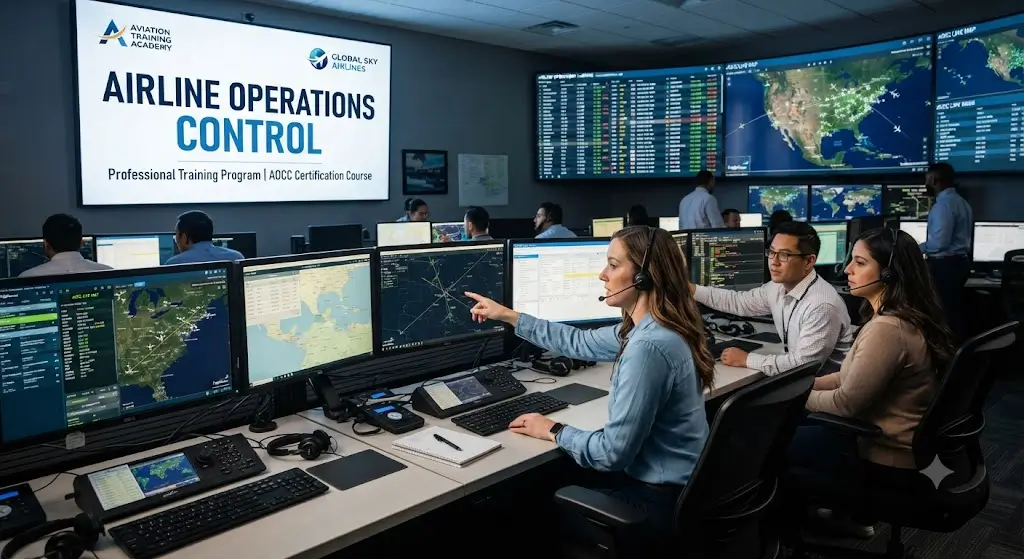
An Airline Operations Control Center (AOCC) serves as the operational hub where teams monitor flight progress, coordinate aircraft movements, manage disruptions, communicate with airports and flight crews, and support operational decision-making. Effective operations control reduces delays, improves aircraft utilization, enhances customer satisfaction, and ensures compliance with aviation regulations.
This course combines aviation operations, operational planning, risk management, communication, and technology to provide learners with practical knowledge applicable across airlines, airport operations, and aviation service providers.
Why Airline Operations Control Matters
Airline operations involve thousands of interconnected activities that require continuous monitoring and coordination. Delays, adverse weather, technical issues, air traffic restrictions, and crew availability can affect flight schedules and passenger experiences.
Professional airline operations control helps organizations respond quickly to operational challenges, optimize aircraft utilization, improve crew coordination, reduce disruptions, strengthen safety, and maintain regulatory compliance. Effective operational control also supports cost management and improves airline reliability.
The Airline Operations Control Course helps learners understand how proactive operational planning contributes to efficient airline performance and successful flight operations.
Course Overview
The Airline Operations Control Course introduces learners to the principles, systems, and technologies used to coordinate airline operations.
Participants begin by studying airline operations, aviation regulations, flight planning, and airline organizational structures. The course explores aircraft scheduling, flight dispatch support, crew coordination, airport communication, operational control centers, disruption management, maintenance coordination, aviation safety, quality management, and operational analytics.
Learners also study airline technology, digital monitoring systems, operational dashboards, customer relationship management (CRM), leadership, communication, teamwork, and continuous operational improvement.
Practical case studies demonstrate how airline operations control teams manage daily flight operations while balancing safety, efficiency, customer service, and regulatory compliance.
Topics Covered
Throughout the Airline Operations Control Course, learners will study:
Airline Operations Fundamentals
Understand airline business models, airline organizational structures, aviation terminology, flight operations, and airline operational processes.
Airline Operations Control Center (AOCC)
Learn the structure, responsibilities, workflows, communication systems, and operational decision-making processes within an Airline Operations Control Center.
Flight Planning and Monitoring
Study flight scheduling, aircraft routing, operational flight monitoring, weather analysis, fuel planning, flight progress tracking, and operational coordination.
Crew and Resource Coordination
Explore crew scheduling, crew availability, duty time regulations, workforce planning, aircraft allocation, and operational resource management.
Disruption Management
Understand delay management, flight cancellations, diversions, operational recovery planning, passenger communication, and contingency planning.
Aviation Safety and Regulatory Compliance
Learn aviation regulations, operational risk assessment, safety management principles, emergency response coordination, and compliance monitoring.
Airport and Ground Operations Coordination
Study communication with airports, ground handling teams, maintenance departments, air traffic services, baggage operations, and passenger service teams.
Airline Technology
Explore flight operations software, operational dashboards, aircraft tracking systems, AI-powered analytics, CRM systems, digital communication platforms, and performance monitoring tools.
Operational Performance Management
Learn key performance indicators (KPIs), operational reporting, airline efficiency measurement, quality assurance, and continuous improvement.
Leadership and Decision-Making
Develop leadership, teamwork, communication, analytical thinking, crisis management, problem-solving, strategic planning, and operational decision-making skills.
Skills You Will Gain
After completing the Airline Operations Control Course, learners will develop valuable professional skills including:
- Airline operations control
- Flight operations coordination
- Aircraft scheduling
- Flight monitoring
- Crew coordination
- Operational planning
- Disruption management
- Aviation safety awareness
- Airline technology
- Operational analytics
- Leadership
- Communication
- Team coordination
- Problem-solving
- Decision-making
These competencies are valuable across airlines, airport operations, aviation authorities, flight dispatch centers, ground handling companies, and aviation consulting firms.
Benefits of the Course
The Airline Operations Control Course provides practical knowledge for coordinating airline operations while maintaining high standards of safety, efficiency, and customer service.
Participants gain confidence in monitoring flight operations, managing disruptions, coordinating airline resources, using airline technologies, and improving operational performance. The course also strengthens leadership, communication, analytical thinking, and strategic planning skills that support career advancement.
As airlines continue to expand globally and operational complexity increases, professionals with expertise in airline operations control remain in strong demand throughout the aviation industry.
Who Should Enroll?
This course is suitable for:
- Aviation students
- Airline operations professionals
- Airport personnel
- Flight dispatch staff
- Ground handling employees
- Airline supervisors
- Aviation management professionals
- Operations coordinators
- Travel industry professionals
- Individuals interested in airline management careers
No previous airline operations experience is required.
Career Opportunities
After completing the Airline Operations Control Course, learners may pursue careers such as:
- Airline Operations Controller
- Flight Operations Coordinator
- Operations Control Center Executive
- Flight Dispatch Coordinator
- Airline Operations Manager
- Ground Operations Supervisor
- Airline Duty Manager
- Aviation Operations Analyst
- Crew Scheduling Coordinator
- Flight Planning Officer
- Airline Performance Analyst
- Aviation Operations Consultant
- Airport Operations Executive
- Airline Resource Planner
- Aviation Operations Specialist
Certification
Upon successful completion of the Airline Operations Control Course, learners receive a professional certificate recognizing their expertise in airline operations control, flight coordination, aircraft scheduling, crew management, operational planning, aviation safety, airline technology, and operational leadership. This certification supports career advancement across airlines, airport operations, flight dispatch centers, aviation authorities, ground handling companies, and aviation consulting organizations.
Frequently Asked Questions (FAQs)
1. What is the Airline Operations Control Course?
The course teaches how to monitor, coordinate, and optimize airline operations while ensuring safe, efficient, and reliable flight services.
2. Who should enroll in this course?
Aviation students, airline employees, airport professionals, flight dispatch staff, ground operations personnel, aviation managers, and individuals interested in airline operations can benefit from this course.
3. Do I need previous airline operations experience?
No. The course is suitable for beginners as well as professionals looking to strengthen their airline operations knowledge.
4. What topics are covered?
Topics include airline operations control, flight planning, aircraft scheduling, crew coordination, disruption management, aviation safety, airport coordination, airline technology, quality management, and leadership.
5. Will I receive a certificate after completing the course?
Yes. Participants receive a professional certificate upon successfully completing the course.
6. What skills will I develop?
You will develop skills in airline operations control, flight monitoring, aircraft scheduling, operational planning, disruption management, leadership, communication, aviation technology, and decision-making.
7. Is this course suitable for airline and airport professionals?
Yes. The course is highly relevant for airline operations teams, airport personnel, flight dispatch staff, ground handling professionals, and aviation managers.
8. Can this course improve my aviation career?
Yes. It prepares learners for careers in airline operations, flight dispatch, operations control centers, aviation consulting, airport operations, and aviation leadership.
9. Does the course include airline operations technology?
Yes. The course covers flight operations software, aircraft tracking systems, AI-powered analytics, operational dashboards, CRM software, digital communication platforms, and airline performance monitoring tools.
10. Why is airline operations control important?
Airline operations control ensures safe flight operations, efficient aircraft utilization, timely decision-making, effective disruption management, regulatory compliance, reduced delays, and improved passenger satisfaction.





Reviews
There are no reviews yet.