
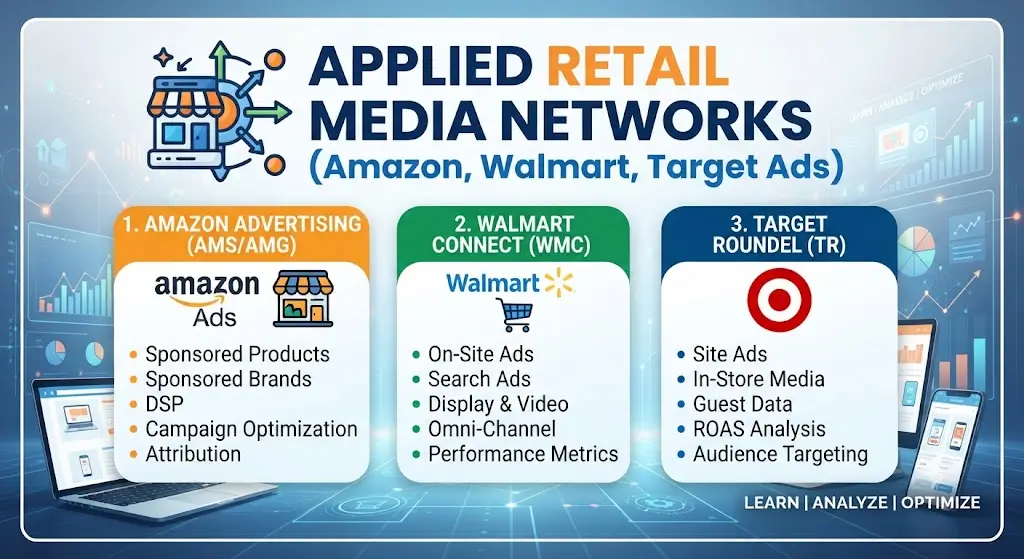
Applied Retail Media Networks (Amazon, Walmart, Target Ads)
Turn Retail Media Knowledge Into Practical Campaign Skills
Understanding Retail Media Networks is only the first step. Applying that knowledge to campaign planning, audience selection, budget decisions, performance analysis, and optimization is where practical advertising skills develop.
Applied Retail Media Networks is designed to help learners apply retail media concepts to realistic business and advertising scenarios across Amazon Ads, Walmart Connect, and Target Roundel.
The course focuses on practical decision-making rather than only explaining platform terminology.
What You Will Learn
1. Applied Retail Media Strategy
Learn how to translate a business objective into a retail media campaign strategy.
You can practice:
- Defining campaign objectives
- Identifying target customers
- Selecting appropriate retail media platforms
- Choosing advertising formats
- Planning campaign structures
- Setting performance goals
- Creating measurement frameworks
2. Amazon Ads Campaign Application
Apply Amazon advertising concepts to practical campaign scenarios.
Topics include:
- Sponsored Products
- Sponsored Brands
- Sponsored Display
- Keyword targeting
- Product targeting
- Search-term analysis
- Campaign segmentation
- Bid considerations
- Budget planning
- Performance evaluation
Amazon’s current advertising resources also highlight targeting, keywords, bidding, budgets, search-term reporting, and negative keywords as important campaign-management considerations.
3. Walmart Connect Campaign Application
Learn how to apply retail media strategy within the Walmart ecosystem.
Practical areas include:
- Sponsored Search
- Onsite Display
- Offsite Media
- Brand Shop and Shelf
- Store advertising
- Audience planning
- Campaign objectives
- Budget allocation
- Performance measurement
Walmart Connect describes its advertising solutions as covering online, offsite, and in-store environments, with first-party shopping data supporting targeting and omnichannel measurement.
4. Target Roundel Campaign Application
Apply retail media concepts to Target’s advertising ecosystem.
Learners can explore practical applications involving:
- Target Product Ads
- Search Ads
- Display
- Programmatic
- CTV
- Social
- Influencer campaigns
- In-store media
- Digital Out-of-Home
Roundel currently offers both on-platform and off-platform solutions and describes its measurement approach as connecting advertising with sales and ROAS.
5. Platform Selection
Practice deciding which retail media environment may be appropriate for different campaign objectives.
For example:
Business Objective → Product → Customer → Retailer → Ad Format → Campaign Strategy
Learners can compare Amazon, Walmart, and Target based on:
- Customer reach
- Product availability
- Shopping environment
- Advertising format
- Audience requirements
- Campaign objective
- Measurement needs
6. Audience & Targeting Application
Move beyond understanding targeting terminology and apply audience concepts to campaign scenarios.
Activities can include:
- Defining target audiences
- Selecting shopper segments
- Keyword targeting
- Product targeting
- Category targeting
- Audience exclusions
- Purchase-based audiences
- Retargeting concepts
- Audience testing
7. Campaign Structure
Develop practical campaign structures based on products, audiences, objectives, and performance goals.
Learners can practice:
- Campaign grouping
- Product segmentation
- Brand vs. generic campaigns
- Keyword organization
- Audience segmentation
- Budget separation
- Campaign naming conventions
8. Budget Allocation
Learn how to approach retail media budget decisions.
Practical exercises can cover:
- Campaign-level budgets
- Platform allocation
- Product-level budgets
- High- vs. low-performing campaigns
- Budget pacing
- Reallocation decisions
- Scaling opportunities
9. Performance Analysis
Learn how to interpret retail media performance data.
Important metrics include:
- Impressions
- Clicks
- CTR
- CPC
- Conversion rate
- Sales
- ROAS
- ACOS
- Cost
- Reach
- New-customer metrics where available
The objective is not simply to calculate metrics but to understand what they may indicate about campaign performance.
10. Campaign Optimization
Apply a structured optimization process:
Analyze → Identify Issue → Test Change → Measure → Optimize → Scale
Practical scenarios can involve:
- Poor CTR
- High CPC
- Low conversion rate
- High ACOS
- Declining ROAS
- Budget limitations
- Underperforming keywords
- Poor-performing products
- Inefficient audiences
11. Retail Media Creative Application
Explore how creative decisions can support campaign objectives.
Topics include:
- Product messaging
- Brand messaging
- Display creative
- Video creative
- Promotional messaging
- Creative testing
- Audience-specific messaging
- Product visibility
12. Full-Funnel Retail Media Planning
Apply retail media across the customer journey:
Awareness → Discovery → Consideration → Purchase → Retention
Learners can practice matching:
- Search
- Sponsored products
- Display
- Video
- Social
- Programmatic
- In-store media
with different campaign objectives.
13. Measurement & Attribution
Understand how to evaluate whether a campaign is achieving its intended outcome.
Topics include:
- Campaign attribution
- ROAS
- Sales measurement
- Conversion analysis
- New-customer metrics
- Online and offline measurement
- Omnichannel measurement
- Incrementality concepts
- Limitations of individual metrics
14. Practical Retail Media Workflow
Learners can apply the following end-to-end framework:
Business Goal → Product Selection → Audience → Platform → Ad Format → Targeting → Budget → Campaign Setup → Launch → Measurement → Optimization → Scaling
This provides a repeatable structure for approaching retail media campaigns.
Practical Exercises & Case Scenarios
The course emphasizes application through realistic scenarios such as:
Case 1: Platform Selection
Choose between Amazon, Walmart, and Target for a product based on business objectives and customer behavior.
Case 2: Campaign Planning
Create a campaign structure for a new product launch.
Case 3: Audience Targeting
Select appropriate audiences and targeting approaches for different products.
Case 4: Budget Allocation
Distribute a hypothetical advertising budget across campaigns and platforms.
Case 5: Performance Diagnosis
Analyze campaign data and identify why performance has declined.
Case 6: ROAS Optimization
Evaluate several campaigns and decide where budget should be increased, reduced, or maintained.
Case 7: Full-Funnel Strategy
Create an awareness-to-purchase retail media plan using multiple advertising formats.
Case 8: Optimization Roadmap
Develop a practical action plan for improving campaign performance.
Amazon vs Walmart vs Target: Applied Perspective
| Platform | Practical Application Areas |
|---|---|
| Amazon Ads | Sponsored advertising, keyword targeting, product targeting, search-term analysis, campaign optimization |
| Walmart Connect | Sponsored Search, onsite/offsite advertising, brand experiences, store advertising, omnichannel measurement |
| Target Roundel | Product Ads, search, display, programmatic, CTV, social, influencer and in-store campaigns |
The platforms offer different advertising environments and capabilities, so campaign decisions should be based on the specific business objective rather than assuming that one strategy works identically everywhere.
Who Should Take This Course?
This course is suitable for:
- E-commerce professionals
- Digital marketers
- Performance marketers
- Retail media professionals
- Marketplace sellers
- Brand managers
- Advertising specialists
- Marketing professionals
- Entrepreneurs
- E-commerce business owners
- Marketing students
- Learners with basic retail media knowledge
Skills You Can Develop
Learners can develop practical skills in:
- Retail media campaign planning
- Platform selection
- Audience targeting
- Keyword targeting
- Product targeting
- Campaign structuring
- Budget allocation
- Performance analysis
- ROAS evaluation
- ACOS analysis
- Campaign optimization
- Full-funnel planning
- Retail media measurement
- Cross-platform comparison
- Performance diagnosis
Why Learn Applied Retail Media Networks?
Retail media requires marketers to connect advertising activity with actual shopping behavior and business outcomes. Walmart Connect, for example, highlights first-party shopping data and omnichannel sales measurement, while Roundel describes closed-loop measurement connecting advertising with sales and ROAS.
An applied learning approach helps learners understand not just what retail media tools do, but also how to make campaign decisions using them.
Course Outcome
After completing the course, learners can develop a practical framework for planning, launching, evaluating, and optimizing retail media campaigns across Amazon, Walmart, and Target advertising environments.
The course provides a bridge between Advanced Retail Media Networks knowledge and the more implementation-focused skills required for practical campaign execution.
Apply your retail media knowledge, work through realistic campaign scenarios, and build practical skills across Amazon, Walmart, and Target Ads.
Q1. What is Applied Retail Media Networks?
Applied Retail Media Networks training focuses on using retail media concepts in realistic campaign planning, targeting, budgeting, optimization, and measurement situations.
Q2. Which platforms are covered?
The course focuses on Amazon Ads, Walmart Connect, and Target Roundel.
Q3. Who should take this course?
It is suitable for e-commerce professionals, digital marketers, performance marketers, brand managers, marketplace sellers, advertising professionals, and learners with retail media fundamentals.
Q4. Is this course different from a Retail Media Networks Basics course?
Yes. Basics focuses on understanding concepts, while Applied training focuses more on using those concepts to make campaign and optimization decisions.
Q5. Does the course include practical exercises?
Yes. Learners can work through scenarios involving platform selection, campaign planning, audience targeting, budgeting, performance analysis, and optimization.
Q6. Will I learn Amazon Ads?
Yes. The course applies concepts such as Sponsored Products, Sponsored Brands, Sponsored Display, keyword targeting, product targeting, campaign structure, and performance analysis.
Q7. Will I learn Walmart Connect?
Yes. The course covers practical applications involving Sponsored Search, onsite display, offsite media, Brand Shop and Shelf, store advertising, and measurement.
Q8. Will I learn Target Roundel?
Yes. The course explores practical applications across Target Product Ads, search, display, programmatic, CTV, social, influencer, and in-store advertising.
Q9. Will I learn how to optimize retail media campaigns?
Yes. Campaign diagnosis, targeting refinement, budget decisions, performance analysis, and optimization planning are major parts of the course.
Q10. What should I study after Applied Retail Media Networks?
A recommended progression is Retail Media Networks Implementation & Practice → Retail Media Networks Masterclass.



Reviews
There are no reviews yet.