
Introduction to Aviation Safety Management Systems
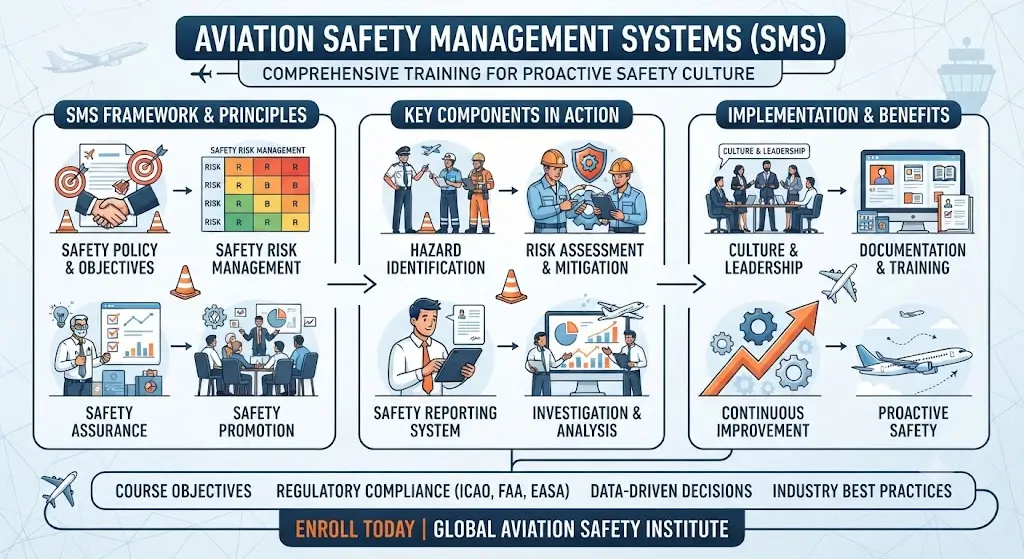
The Aviation Safety Management Systems Course is a comprehensive professional training program designed to prepare learners to implement and manage effective Safety Management Systems (SMS) within aviation organizations. Safety is the highest priority in aviation, and a structured SMS provides organizations with a proactive approach to identifying hazards, managing operational risks, and continuously improving safety performance.
Safety Management Systems are internationally recognized frameworks used by airlines, airports, maintenance organizations, air navigation service providers, and aviation authorities to prevent accidents, enhance operational reliability, and comply with regulatory requirements. Rather than responding only after incidents occur, SMS encourages organizations to identify potential hazards before they become serious safety issues.
This course combines aviation safety principles with internationally accepted SMS practices to help learners understand how safety policies, risk management processes, reporting systems, audits, and safety culture contribute to safer aviation operations. Whether working in airlines, airports, maintenance organizations, aviation authorities, or ground handling services, participants gain practical knowledge applicable across the aviation industry.
Why Aviation Safety Management Systems Matter
The aviation industry operates in a highly regulated environment where safety is essential for protecting passengers, crew members, aircraft, airport personnel, and the public. Even minor operational errors can have significant consequences, making systematic safety management critical for every aviation organization.
An effective Safety Management System helps organizations identify hazards, assess operational risks, improve communication, strengthen regulatory compliance, encourage safety reporting, and reduce accidents through continuous monitoring and improvement.
The Aviation Safety Management Systems Course helps learners understand how proactive safety management supports operational excellence, organizational resilience, and long-term aviation safety.
Course Overview
The Aviation Safety Management Systems Course introduces learners to the structure, implementation, and continuous improvement of Safety Management Systems within aviation organizations.
Participants begin by studying aviation safety principles, international safety standards, and the four key components of SMS: safety policy, safety risk management, safety assurance, and safety promotion. The course explores hazard identification, risk assessment, safety reporting, emergency preparedness, incident investigation, human factors, quality assurance, aviation regulations, and operational performance monitoring.
Learners also study aviation technology, safety data analysis, safety audits, leadership, organizational culture, communication strategies, and continuous improvement methods.
Practical case studies demonstrate how successful aviation organizations use Safety Management Systems to improve safety performance, comply with international standards, and strengthen operational reliability.
Topics Covered
Throughout the Aviation Safety Management Systems Course, learners will study:
Aviation Safety Fundamentals
Understand aviation safety principles, international safety standards, aviation regulations, and the role of Safety Management Systems within aviation organizations.
Safety Management System Framework
Learn the four components of SMS: safety policy, safety risk management, safety assurance, and safety promotion, along with implementation strategies.
Hazard Identification and Risk Assessment
Study hazard reporting, risk analysis, safety evaluation techniques, probability assessment, consequence analysis, and mitigation planning.
Safety Assurance
Explore performance monitoring, internal audits, inspections, safety performance indicators (SPIs), corrective actions, compliance monitoring, and continuous improvement.
Safety Promotion
Understand safety communication, employee training, safety awareness programs, organizational learning, leadership engagement, and reporting culture.
Human Factors in Aviation
Learn about human performance, fatigue management, decision-making, teamwork, communication, workload management, and error prevention.
Incident Investigation
Study accident reporting, incident investigation methods, root cause analysis, corrective action planning, documentation, and lessons learned.
Emergency Preparedness
Explore emergency response planning, crisis management, business continuity, airport emergency procedures, coordination, and recovery planning.
Aviation Technology and Safety Data
Understand safety databases, digital reporting systems, flight data monitoring, predictive analytics, artificial intelligence (AI), and aviation safety technologies.
Leadership and Safety Culture
Develop leadership, communication, ethical decision-making, organizational culture, change management, teamwork, and continuous safety improvement skills.
Skills You Will Gain
After completing the Aviation Safety Management Systems Course, learners will develop valuable professional skills including:
- Aviation safety management
- Safety Management Systems (SMS)
- Hazard identification
- Risk assessment
- Safety reporting
- Incident investigation
- Safety audits
- Regulatory compliance
- Human factors awareness
- Emergency preparedness
- Safety performance monitoring
- Leadership
- Communication
- Problem-solving
- Continuous improvement
These competencies are valuable across airlines, airports, aviation authorities, maintenance organizations, ground handling companies, and aviation safety consulting firms.
Benefits of the Course
The Aviation Safety Management Systems Course provides practical knowledge for implementing proactive safety management within aviation organizations.
Participants gain confidence in identifying operational hazards, assessing risks, supporting regulatory compliance, conducting safety investigations, promoting safety culture, and improving organizational performance. The course also strengthens leadership, communication, analytical thinking, and decision-making skills that support career advancement.
As aviation organizations continue to strengthen safety systems and regulatory compliance, professionals with expertise in Safety Management Systems remain highly valued across the global aviation sector.
Who Should Enroll?
This course is suitable for:
- Aviation professionals
- Airline employees
- Airport personnel
- Safety officers
- Quality assurance professionals
- Maintenance personnel
- Ground handling staff
- Aviation students
- Regulatory authority employees
- Individuals interested in aviation safety careers
No previous Safety Management System experience is required.
Career Opportunities
After completing the Aviation Safety Management Systems Course, learners may pursue careers such as:
- Aviation Safety Officer
- Safety Management System Coordinator
- Airline Safety Executive
- Airport Safety Manager
- Aviation Compliance Officer
- Safety Auditor
- Risk Management Specialist
- Quality Assurance Manager
- Aviation Operations Manager
- Ground Operations Supervisor
- Incident Investigation Officer
- Aviation Consultant
- Regulatory Compliance Specialist
- Safety Performance Analyst
- Aviation Safety Trainer
Certification
Upon successful completion of the Aviation Safety Management Systems Course, learners receive a professional certificate recognizing their expertise in aviation safety management, hazard identification, risk assessment, Safety Management Systems (SMS), safety assurance, regulatory compliance, incident investigation, safety leadership, and continuous improvement. This certification supports career advancement across airlines, airports, aviation authorities, maintenance organizations, ground handling companies, and aviation consulting organizations.
Frequently Asked Questions (FAQs)
1. What is the Aviation Safety Management Systems Course?
The course teaches how to implement, manage, and improve Safety Management Systems (SMS) to enhance aviation safety and regulatory compliance.
2. Who should enroll in this course?
Aviation professionals, airline employees, airport staff, safety officers, quality managers, aviation students, maintenance personnel, and regulatory professionals can benefit from this course.
3. Do I need previous SMS experience?
No. The course is suitable for beginners as well as experienced professionals seeking to strengthen their aviation safety management knowledge.
4. What topics are covered?
Topics include Safety Management Systems, hazard identification, risk assessment, safety assurance, safety promotion, aviation regulations, human factors, incident investigation, emergency preparedness, and safety leadership.
5. Will I receive a certificate after completing the course?
Yes. Participants receive a professional certificate upon successful completion of the course.
6. What skills will I develop?
You will develop skills in aviation safety management, hazard identification, risk assessment, incident investigation, safety audits, regulatory compliance, leadership, communication, and continuous improvement.
7. Is this course suitable for airline and airport professionals?
Yes. The course is highly relevant for professionals working in airlines, airports, aviation authorities, maintenance organizations, and ground handling operations.
8. Can this course improve my aviation career?
Yes. It prepares learners for careers in aviation safety, quality assurance, regulatory compliance, airport operations, airline management, consulting, and safety leadership.
9. Does the course include aviation safety technology?
Yes. The course covers digital safety reporting systems, flight data monitoring, safety databases, predictive analytics, AI-supported safety tools, and performance monitoring technologies.
10. Why are Safety Management Systems important in aviation?
Safety Management Systems help aviation organizations identify hazards, reduce operational risks, improve regulatory compliance, strengthen safety culture, enhance operational performance, and protect passengers, employees, and aviation assets.





Reviews
There are no reviews yet.