
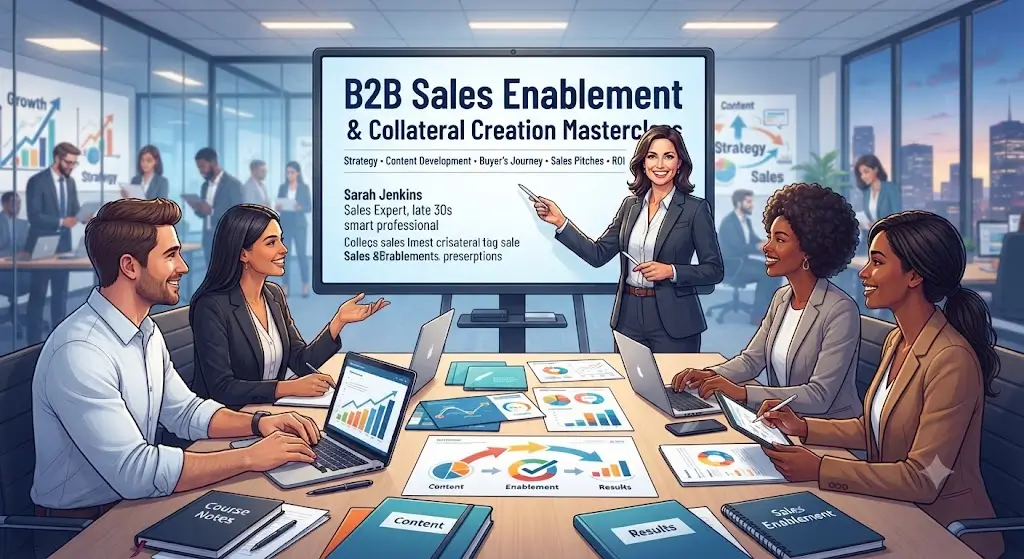
Introduction
The B2B Sales Enablement & Collateral Creation Masterclass is a comprehensive professional training program designed to help learners understand how effective sales enablement and high-quality sales collateral can improve B2B selling outcomes. Modern B2B buyers often conduct extensive research before speaking with a sales representative. Therefore, sales teams need relevant information that addresses customer problems, explains business value, supports decision-making, and strengthens trust.
Sales enablement brings together people, processes, content, technology, and training to help sales teams perform more effectively. At the same time, sales collateral provides practical resources that representatives can use during prospecting, discovery, presentations, negotiations, proposals, and follow-up activities.
When these two areas work together, sales professionals can deliver more consistent messages and create better buying experiences. Well-designed collateral can also reduce repetitive work and help sales teams communicate complex products or services in a clear and persuasive way.
This masterclass focuses on the practical relationship between B2B sales enablement and collateral creation. Learners will explore how to identify content requirements, understand buyer needs, develop useful sales resources, organize content libraries, support sales conversations, and measure content effectiveness.
The training is suitable for professionals working in sales, marketing, business development, customer success, sales operations, content creation, and commercial management. It is also valuable for entrepreneurs and business owners who want to build stronger B2B sales systems.
What is B2B Sales Enablement?
B2B sales enablement is a structured approach to helping sales teams access the knowledge, content, tools, and support they need to engage buyers effectively.
It connects sales activities with marketing resources and business objectives. Rather than creating content without a clear purpose, enablement focuses on producing resources that solve specific sales challenges.
For example, a sales team may need different materials for different stages of the buying journey. A prospecting email requires concise messaging. A discovery meeting may require an industry-specific presentation. A later-stage buyer may need a case study, proposal, ROI document, or product comparison.
Therefore, sales enablement ensures that representatives have the right resources at the right time.
Why Sales Collateral Matters in B2B Sales
Sales collateral supports communication between sellers and buyers. It helps sales representatives explain products, demonstrate value, address objections, and move conversations forward.
Effective collateral can include:
- Sales presentations
- Pitch decks
- Product brochures
- Product sheets
- Case studies
- Customer success stories
- White papers
- Proposal templates
- Comparison guides
- ROI documents
- Industry reports
- Sales playbooks
- Objection-handling guides
- Email templates
- Meeting follow-up resources
However, simply producing a large amount of content does not guarantee better sales results. The material must be relevant, accurate, easy to use, and aligned with customer needs.
This masterclass teaches learners how to approach collateral creation strategically rather than treating it as a purely creative task.
Course Overview
The B2B Sales Enablement & Collateral Creation Masterclass provides a structured understanding of sales enablement strategy, content development, buyer engagement, and B2B sales communication.
Learners will explore:
- B2B sales enablement fundamentals
- Sales content strategy
- Buyer journey analysis
- Buyer persona development
- Customer pain points
- Value proposition development
- Sales messaging
- Sales collateral planning
- Presentation development
- Pitch deck creation
- Case study development
- Proposal content
- Sales playbooks
- Objection-handling resources
- Content organization
- Sales and marketing alignment
- Sales technology
- Content performance measurement
- Continuous improvement
Understanding the B2B Buyer Journey
B2B purchasing decisions often involve multiple stakeholders, longer sales cycles, and detailed evaluation processes. As a result, sales teams need content that supports buyers throughout the journey.
The buyer journey can involve several stages, including:
- Awareness
- Problem identification
- Research
- Solution evaluation
- Vendor comparison
- Decision-making
- Implementation
- Post-purchase evaluation
Each stage may require different information.
For example, early-stage buyers may need educational content that explains a business problem. During evaluation, they may require product comparisons or case studies. Later, decision-makers may want pricing information, ROI evidence, implementation details, or risk assessments.
Understanding these differences helps organizations create more relevant sales collateral.
Creating Buyer-Centric Sales Content
Successful B2B collateral focuses on the buyer rather than simply describing the seller’s products.
A product-focused document might list features. A buyer-focused document explains how those features solve a specific business problem.
Learners will explore how to identify:
- Customer pain points
- Business objectives
- Buying motivations
- Decision criteria
- Common objections
- Industry challenges
- Stakeholder concerns
- Desired outcomes
This information can then guide content development.
For example, a finance decision-maker may care about cost reduction and ROI. Meanwhile, a technical stakeholder may focus on integration, security, and functionality. Strong sales collateral can address both perspectives without making the message confusing.
Developing Strong Value Propositions
A clear value proposition helps sales teams explain why a solution deserves consideration.
An effective value proposition should communicate:
- The customer problem
- The proposed solution
- The key benefit
- The business impact
- The reason to choose the solution
Learners will understand how to develop concise messaging that connects product capabilities with measurable customer outcomes.
This approach helps sales professionals move away from feature-heavy presentations and toward value-based conversations.
Sales Messaging and Positioning
Consistent messaging is essential for B2B organizations. If different representatives describe the same solution in completely different ways, buyers may receive confusing information.
Sales enablement can help establish clear messaging frameworks.
Learners will explore how to develop messaging around:
- Target audiences
- Business problems
- Product value
- Competitive differentiation
- Customer outcomes
- Proof points
- Industry-specific needs
Consistent messaging also makes onboarding easier because new sales representatives have a clear framework for communicating with prospects.
Creating Effective Sales Presentations
Sales presentations are among the most frequently used forms of sales collateral.
A strong presentation should be:
- Clear
- Relevant
- Visually organized
- Customer-focused
- Easy to understand
- Supported by evidence
- Appropriate for the audience
Learners will explore presentation structure, storytelling, message hierarchy, visual communication, customer pain points, value propositions, proof points, and calls to action.
Instead of filling slides with excessive information, sales professionals can use presentations to guide meaningful business conversations.
Developing Pitch Decks
A B2B pitch deck should quickly communicate the business problem, solution, value, differentiation, and evidence.
Depending on the context, a pitch deck may include:
- Customer challenge
- Market context
- Solution overview
- Key benefits
- Product capabilities
- Differentiators
- Customer evidence
- Implementation approach
- Business impact
- Next steps
The masterclass explains how to structure pitch materials around the needs of the intended audience.
Case Studies and Customer Stories
Case studies provide evidence that a product or service can deliver meaningful results.
An effective B2B case study can explain:
- The customer’s original challenge.
- The solution that was implemented.
- How the solution was used.
- The results achieved.
- The broader business impact.
Customer stories can make complex offerings easier to understand. They also provide sales teams with proof points that can support conversations with similar prospects.
Learners will understand how to organize case study content so that it communicates both credibility and business value.
Proposal and Sales Document Creation
B2B proposals often influence important purchasing decisions. Therefore, proposal content must be accurate, relevant, professional, and aligned with customer requirements.
Learners will explore how to structure sales documents around:
- Customer requirements
- Business challenges
- Recommended solution
- Deliverables
- Benefits
- Implementation
- Support
- Commercial considerations
- Expected outcomes
- Next steps
A strong proposal should demonstrate that the seller understands the customer’s situation rather than simply presenting a generic product description.
Building Sales Playbooks
Sales playbooks provide structured guidance for sales representatives.
A playbook may include:
- Target customer profiles
- Sales messaging
- Discovery questions
- Qualification criteria
- Objection responses
- Competitor information
- Product positioning
- Sales process guidance
- Recommended collateral
- Follow-up strategies
Sales playbooks can improve consistency and reduce the time representatives spend searching for information.
Learners will understand how enablement teams can organize playbook content around practical sales situations.
Sales and Marketing Alignment
Sales enablement works best when sales and marketing teams collaborate closely.
Marketing teams often create content, while sales teams understand the questions and objections they hear directly from customers. Sharing these insights can improve content relevance.
Strong alignment can help teams:
- Identify content gaps
- Improve messaging
- Reduce duplicated work
- Share customer insights
- Improve campaign effectiveness
- Support sales conversations
- Measure content performance
The masterclass explains how organizations can create stronger collaboration between sales and marketing teams.
Sales Content Management
Creating collateral is only one part of the process. Sales representatives must also be able to find and use it.
Poor content organization can lead to:
- Duplicate materials
- Outdated information
- Low content adoption
- Wasted time
- Inconsistent messaging
Learners will explore practical approaches to content organization, version control, content categorization, access management, and resource maintenance.
A well-organized content library helps representatives quickly identify the resources that match specific customer situations.
Sales Technology and Enablement Tools
Technology can make sales enablement more scalable.
Organizations may use CRM platforms, content management systems, sales engagement tools, analytics dashboards, collaboration platforms, and enablement technologies to support sales teams.
Learners will understand how technology can help organizations:
- Organize sales resources
- Track content usage
- Improve sales workflows
- Support collaboration
- Monitor performance
- Automate repetitive activities
- Deliver relevant information to sales representatives
Technology should support the sales process rather than create unnecessary complexity.
Measuring Sales Enablement Performance
Effective sales enablement requires measurement. Organizations need to understand whether their content and training resources are actually helping sales teams.
Important performance indicators may include:
- Content usage
- Content engagement
- Sales cycle duration
- Conversion rates
- Win rates
- Pipeline progression
- Representative productivity
- Revenue contribution
- Training completion
- Sales performance
These measurements can help identify which resources are valuable and which need improvement.
Continuous Improvement
Sales enablement is not a one-time project. Customer needs, products, markets, competitors, and sales processes continue to change.
Therefore, organizations should regularly review:
- Sales feedback
- Customer questions
- Content performance
- Competitive developments
- Product updates
- Sales results
- Content gaps
Continuous improvement ensures that sales collateral remains useful and relevant.
What You Will Learn
By the end of this masterclass, learners will be able to:
- Understand B2B sales enablement principles
- Develop sales enablement strategies
- Identify sales content requirements
- Analyze buyer needs
- Create buyer-focused messaging
- Develop value propositions
- Plan sales collateral
- Structure sales presentations
- Create effective pitch decks
- Develop customer case studies
- Improve proposal content
- Build sales playbooks
- Support sales and marketing alignment
- Organize sales resources
- Measure content effectiveness
- Improve sales productivity
Key Skills You Will Gain
After completing the B2B Sales Enablement & Collateral Creation Masterclass, learners will develop skills in:
- B2B sales enablement
- Sales content strategy
- Collateral development
- Buyer journey analysis
- Customer research
- Value proposition development
- Sales messaging
- Business writing
- Presentation development
- Storytelling
- Sales communication
- Content management
- Sales operations
- CRM utilization
- Performance measurement
- Strategic planning
- Cross-functional collaboration
- Customer engagement
Benefits of This Masterclass
Completing this masterclass can provide several professional advantages.
Improved Sales Communication
Learners can develop clearer messaging and create resources that help sales professionals communicate product value more effectively.
Better Sales Productivity
Well-organized collateral reduces the time sales representatives spend creating or searching for resources.
Stronger Buyer Engagement
Customer-focused content can help prospects understand solutions and evaluate their potential business value.
Better Sales and Marketing Collaboration
The course provides practical knowledge for improving cooperation between commercial and marketing teams.
Consistent Brand Messaging
Structured enablement resources help sales teams communicate with greater consistency across customer interactions.
Improved Sales Performance
Effective sales enablement can support better prospect engagement, stronger pipeline progression, and more productive sales conversations.
Enhanced Professional Skills
Learners develop valuable skills in content strategy, business communication, sales operations, customer engagement, and commercial planning.
Who Should Enroll?
The B2B Sales Enablement & Collateral Creation Masterclass is suitable for:
- Sales Professionals
- Sales Managers
- Sales Enablement Specialists
- B2B Marketing Professionals
- Business Development Executives
- Account Managers
- Sales Operations Professionals
- Content Strategists
- Business Writers
- Product Marketing Professionals
- Entrepreneurs
- Business Owners
- Sales Trainers
- Customer Success Professionals
- Commercial Managers
The masterclass is also suitable for professionals transitioning into sales enablement or B2B commercial roles.
No advanced technical background is required.
Career Opportunities
Knowledge of B2B sales enablement and collateral creation can support career development in several areas.
Potential roles include:
- Sales Enablement Specialist
- Sales Enablement Manager
- Sales Operations Specialist
- B2B Content Strategist
- Product Marketing Specialist
- Sales Content Manager
- Business Development Manager
- Sales Trainer
- Account Manager
- Commercial Manager
- Revenue Enablement Specialist
- Customer Success Manager
- Sales Strategy Consultant
- Business Communication Specialist
These skills can be applied across technology, SaaS, consulting, manufacturing, professional services, financial services, healthcare, telecommunications, logistics, and other B2B industries.
Practical Applications of Sales Enablement
The knowledge gained from this masterclass can be applied throughout the B2B sales process.
For example, sales teams can use enablement resources during prospecting to communicate a clear value proposition. During discovery, representatives can use industry-specific materials to understand customer challenges. During presentations, they can use pitch decks and product demonstrations to communicate benefits.
Later in the sales cycle, case studies, proposals, ROI documents, comparison guides, and objection-handling resources can help buyers evaluate their options.
After the sale, customer success teams can use structured resources to support onboarding, adoption, and long-term relationships.
This makes sales enablement valuable across the entire customer lifecycle.
Certification
Upon successful completion of the B2B Sales Enablement & Collateral Creation Masterclass, learners receive a professional course completion certificate recognizing their knowledge of B2B sales enablement, sales content strategy, collateral development, buyer journey analysis, sales messaging, value proposition development, presentation creation, case studies, proposal development, sales playbooks, content management, sales and marketing alignment, and sales performance measurement.
The certification can strengthen a professional profile and demonstrate practical knowledge relevant to sales enablement, B2B marketing, sales operations, business development, product marketing, customer success, and commercial strategy roles.
Conclusion
The B2B Sales Enablement & Collateral Creation Masterclass provides practical knowledge for professionals who want to improve B2B sales performance through effective enablement strategies and high-quality sales resources.
By learning how to understand buyer needs, develop value-based messaging, create effective sales collateral, structure presentations, build case studies, improve proposals, organize sales content, and measure enablement performance, learners can support more effective sales conversations and stronger customer engagement.
The masterclass also highlights the importance of collaboration between sales and marketing teams. When both functions work together, organizations can create relevant content, improve sales productivity, maintain consistent messaging, and respond more effectively to changing customer expectations.
Whether your goal is to advance in sales enablement, B2B marketing, sales operations, business development, product marketing, customer success, or commercial management, this masterclass provides a strong foundation for professional growth.
FAQ SECTION
1. What is the B2B Sales Enablement & Collateral Creation Masterclass?
It is a professional training program that teaches learners how to develop sales enablement strategies and create effective B2B sales collateral for different stages of the buyer journey.
2. Who should take this masterclass?
Sales professionals, sales managers, sales enablement specialists, B2B marketers, business development executives, account managers, content strategists, entrepreneurs, and commercial professionals can benefit from this masterclass.
3. Do I need previous sales enablement experience?
No. The masterclass is suitable for beginners as well as experienced professionals who want to strengthen their B2B sales enablement and content development skills.
4. What types of sales collateral will I learn about?
The masterclass covers sales presentations, pitch decks, case studies, product sheets, proposals, sales playbooks, comparison guides, ROI resources, email templates, and objection-handling materials.
5. Why is sales enablement important for B2B businesses?
Sales enablement gives sales teams access to useful content, knowledge, tools, and processes. This can improve sales productivity, customer engagement, communication consistency, and overall sales effectiveness.
6. Will I learn how to create buyer-focused sales content?
Yes. The masterclass explains how to identify buyer needs, customer pain points, decision criteria, business objectives, and stakeholder concerns before developing sales content.
7. Does the masterclass cover sales presentations and pitch decks?
Yes. Learners will explore how to structure clear, persuasive, and customer-focused presentations and pitch decks that communicate business value effectively.
8. Will I learn about sales playbooks?
Yes. The masterclass covers the purpose and structure of sales playbooks, including sales messaging, discovery questions, qualification guidance, objection handling, product positioning, and recommended collateral.
9. How can sales collateral improve sales performance?
Effective collateral helps sales representatives communicate value, answer customer questions, support buying decisions, address objections, and maintain consistent messaging throughout the sales process.
10. Will I receive a certificate after completing the masterclass?
Yes. A professional course completion certificate is awarded upon successful completion of the B2B Sales Enablement & Collateral Creation Masterclass.



Reviews
There are no reviews yet.