
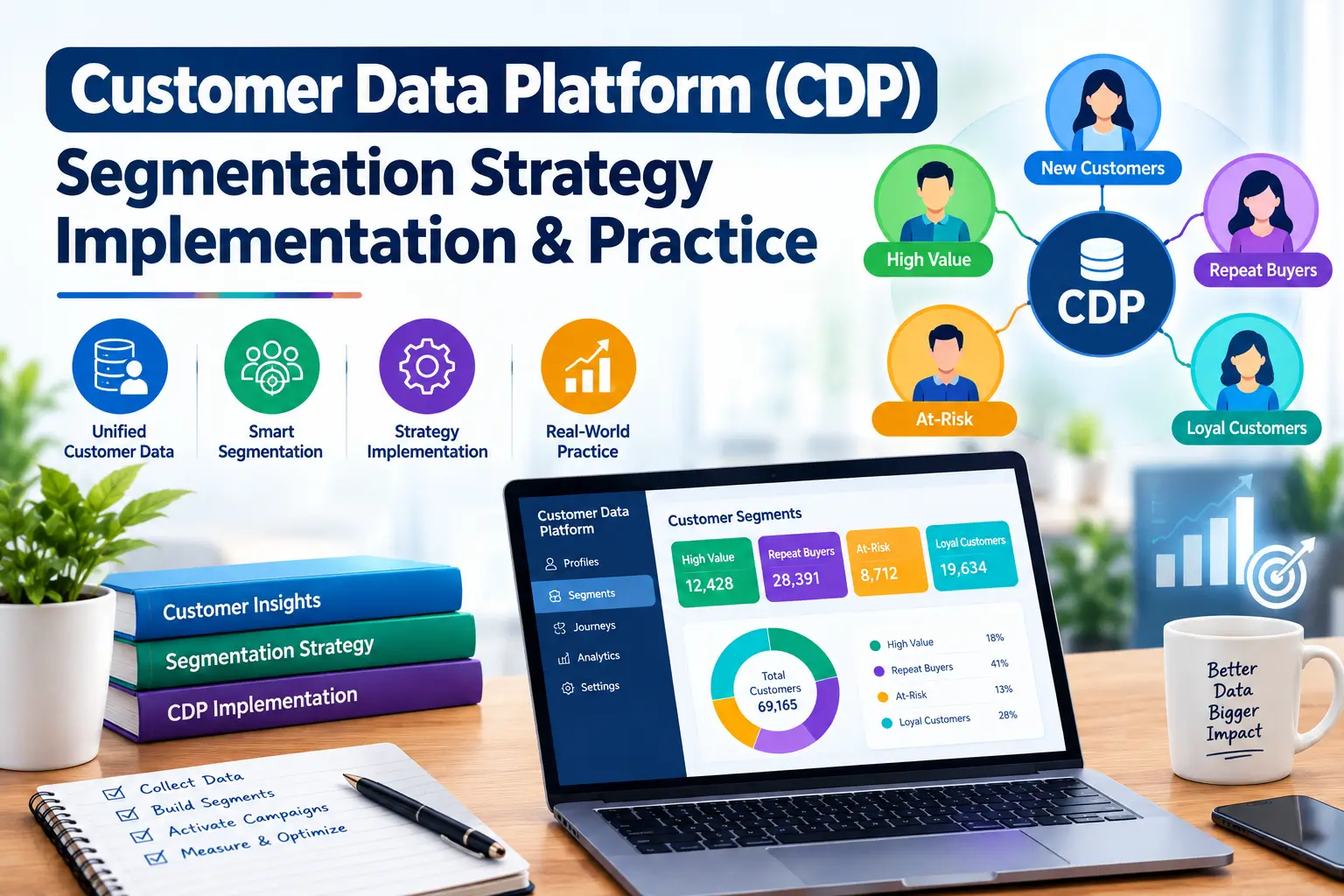
CDP Implementation: Segmentation Strategy & Practical Practice
Turn Customer Data Into Actionable Audiences
The CDP Implementation: Segmentation Strategy & Practical Practice course provides a hands-on framework for implementing Customer Data Platform segmentation strategies in practical marketing and customer-data scenarios.
A CDP can bring together customer information from multiple sources and support activities such as unified profiles, segmentation, analysis, and activation.
This course focuses on the practical side of segmentation: defining use cases, understanding available customer data, creating segmentation rules, validating audiences, activating segments, monitoring performance, and improving segment definitions.
What You Will Practice
1. CDP Use-Case Planning
Begin by connecting segmentation with a clear business objective.
Practice:
- Defining segmentation goals
- Identifying priority use cases
- Mapping business objectives to audiences
- Defining success metrics
- Identifying activation requirements
- Prioritizing segmentation projects
Examples may include acquisition, retention, reactivation, cross-sell, upsell, personalization, suppression, and lifecycle marketing.
2. Customer Data & Profile Analysis
Before creating segments, learners practice identifying the data required for segmentation.
Topics include:
- Customer profile attributes
- Behavioral events
- Transaction data
- Engagement data
- Lifecycle information
- Channel interactions
- Product usage
- Customer value indicators
- Data completeness
- Data quality considerations
3. Segmentation Criteria Development
Practice converting business requirements into specific segmentation rules.
Learners can work with:
- Demographic attributes
- Geographic attributes
- Behavioral activity
- Purchase behavior
- Engagement frequency
- Recency
- Customer lifecycle stage
- Product interests
- Customer value
- Channel preferences
CDP segmentation commonly uses attributes, behaviors, indicators, and logical conditions to classify customer profiles into actionable groups.
4. Building CDP Segments
Practice constructing segments using logical conditions such as:
- Include rules
- Exclude rules
- AND conditions
- OR conditions
- Date conditions
- Numeric conditions
- Text conditions
- Event-based criteria
- Nested conditions
Learners will also practice checking whether segment logic produces the intended audience.
5. Behavioral & Event-Based Segmentation
Build practical segments based on customer activity.
Examples include:
- Customers who visited a product page
- Customers who added products to cart
- Customers who purchased recently
- Customers who have not purchased recently
- Highly engaged customers
- Inactive customers
- Repeat purchasers
- Customers showing specific product interest
This helps learners understand how behavioral events can be translated into actionable audience definitions.
6. Lifecycle Segmentation
Practice creating customer groups based on lifecycle stages, such as:
- Prospects
- New customers
- Active customers
- Repeat customers
- High-value customers
- At-risk customers
- Inactive customers
- Reactivation audiences
The objective is to connect customer lifecycle information with appropriate marketing or engagement strategies.
7. Value-Based Segmentation
Practice developing segments based on customer value indicators.
Activities can include:
- High-value customer identification
- Purchase frequency
- Average order value
- Total spend
- Repeat purchase behavior
- Customer engagement
- Value-based audience prioritization
8. Segment Validation & Quality Checks
Creating a segment is only the first step.
Learners practice validating:
- Segment size
- Inclusion criteria
- Exclusion criteria
- Data completeness
- Rule logic
- Expected customer profiles
- Edge cases
- Segment overlap
- Unexpected audience growth or reduction
Testing segment logic before activation is important because incorrectly structured rules can produce unintended audiences.
9. Audience Building
Learn how validated segments can be transformed into actionable audiences.
Practice:
- Audience naming conventions
- Audience definitions
- Segment combinations
- Suppression audiences
- Target audiences
- Exclusion audiences
- Campaign-specific audiences
- Reusable audience definitions
10. CDP Audience Activation
Practice the transition from segmentation to activation.
The implementation workflow can include:
Segment Evaluation → Destination Configuration → Audience Mapping → Audience Activation → Monitoring
CDP audience activation patterns can involve publishing evaluated audiences to advertising platforms, CRM systems, cloud destinations, or other downstream systems, depending on the platform and use case.
11. Cross-Channel Audience Strategy
Explore how the same customer segment can support different business activities.
Examples include:
- Email audiences
- Paid media targeting
- Advertising suppression
- CRM audiences
- Website personalization
- Customer journey entry
- Analytics
- Retention campaigns
Exact activation capabilities depend on the CDP and connected destination systems.
12. Testing & Troubleshooting
Practice identifying common segmentation and activation issues.
Topics include:
- Unexpected segment size
- Missing customer attributes
- Incorrect logical conditions
- Duplicate profiles
- Identity-resolution issues
- Stale data
- Incorrect event definitions
- Activation mapping problems
- Consent or governance issues
13. Segment Performance Measurement
Learn how to evaluate whether a segment is useful.
Potential measures include:
- Audience size
- Engagement
- Conversion
- Revenue
- Retention
- Response rate
- Campaign performance
- Customer value
- Segment growth
- Activation delivery
14. Segmentation Optimization
Practice improving segment definitions based on observed results.
Activities include:
- Refining rules
- Adjusting audience thresholds
- Removing irrelevant criteria
- Improving audience quality
- Testing alternative definitions
- Comparing segment performance
- Creating reusable segmentation frameworks
Practical CDP Implementation Framework
Throughout the course, learners can follow this workflow:
Business Objective → Use Case → Data Requirements → Customer Profile → Segmentation Criteria → Segment Creation → Validation → Audience Building → Activation → Measurement → Optimization
This creates a practical connection between business goals and CDP implementation.
Hands-On Projects
Project 1: Segmentation Use Case
Define a business problem and convert it into a CDP segmentation requirement.
Project 2: Customer Data Mapping
Identify the customer attributes, events, and indicators required for the selected use case.
Project 3: Segment Builder
Create a detailed customer segment using inclusion, exclusion, AND/OR, behavioral, and date-based conditions.
Project 4: Lifecycle Segmentation
Build a customer lifecycle framework covering prospects, active customers, high-value customers, and at-risk customers.
Project 5: Behavioral Audience
Create an audience based on customer interactions and recent behavioral activity.
Project 6: Segment Validation
Analyze segment size and sample profiles to identify potential logic or data-quality problems.
Project 7: Audience Activation
Create an activation plan showing how a validated audience could be delivered to relevant downstream channels.
Project 8: KPI Framework
Develop KPIs for evaluating segment quality and campaign performance.
Project 9: Optimization Exercise
Review hypothetical performance results and modify the segmentation strategy accordingly.
Project 10: End-to-End CDP Segmentation Project
Complete a full workflow from business objective to segment creation, validation, activation, measurement, and optimization.
Who Should Take This Course?
This course is suitable for:
- Digital marketers
- CRM professionals
- Marketing managers
- Customer data professionals
- Marketing technologists
- Analytics professionals
- Customer experience teams
- Personalization specialists
- Marketing operations professionals
- Data-driven marketing teams
- Business analysts
- Students and professionals interested in CDP implementation
Skills You Can Develop
By completing the course, learners can develop practical skills in:
- CDP implementation planning
- Customer data analysis
- Customer segmentation
- Behavioral segmentation
- Lifecycle segmentation
- Value-based segmentation
- Segment rule creation
- Audience building
- Segment validation
- Audience activation
- KPI development
- Performance measurement
- Segmentation optimization
- CDP troubleshooting
- Cross-channel audience strategy
Why Choose an Implementation & Practice Course?
A segmentation strategy becomes more valuable when it can be translated into clearly defined, validated, and actionable audiences.
This course focuses on that practical transition.
Instead of only learning what CDP segmentation is, learners practice how to define, build, validate, activate, measure, and optimize segments using structured implementation workflows.
The course therefore provides a practical bridge between CDP Segmentation Strategy and real-world implementation activities.
Educational disclaimer: CDP functionality varies by platform. This course focuses on general implementation and segmentation principles rather than guaranteeing specific features across every CDP product.
1. What is CDP Implementation?
CDP implementation is the process of preparing customer data, creating unified customer profiles, developing segments and audiences, connecting activation destinations, testing workflows, and monitoring performance.
2. What will I learn in this CDP Implementation course?
You will learn how to plan CDP use cases, analyze customer data, create segmentation rules, build audiences, validate segments, plan activation, measure performance, and optimize segmentation strategies.
3. What is CDP segmentation?
CDP segmentation is the process of grouping customer profiles according to shared attributes, behaviors, events, or other criteria so that audiences can be used for marketing, personalization, analytics, or activation.
4. Does this course include practical CDP segmentation exercises?
Yes. The course includes practical exercises involving segment creation, behavioral segmentation, lifecycle segmentation, audience validation, activation planning, KPI development, and optimization.
5. Can I learn behavioral segmentation in a CDP?
Yes. The course covers creating audiences based on customer activities, interactions, purchases, engagement, recency, and other behavioral signals.
6. Does the course cover audience activation?
Yes. It introduces the practical workflow for moving validated CDP audiences toward relevant activation destinations and monitoring activation results.
7. How do I validate a CDP segment?
Segment validation can include checking the segment size, reviewing criteria, examining sample profiles, testing inclusion and exclusion rules, and comparing results against expected business conditions.
8. Who should take a CDP segmentation course?
The course is useful for marketers, CRM professionals, marketing operations teams, customer data professionals, analysts, personalization specialists, and marketing technologists.
9. Is CDP Implementation different from CDP Segmentation Strategy?
Yes. CDP Segmentation Strategy focuses more on designing the segmentation approach, while CDP Implementation & Practice emphasizes applying that strategy through segment creation, validation, activation, measurement, and optimization.
10. Is this course platform-specific?
The course focuses on general CDP implementation and segmentation principles. Specific interfaces, integrations, terminology, and capabilities vary between CDP platforms.



Reviews
There are no reviews yet.