
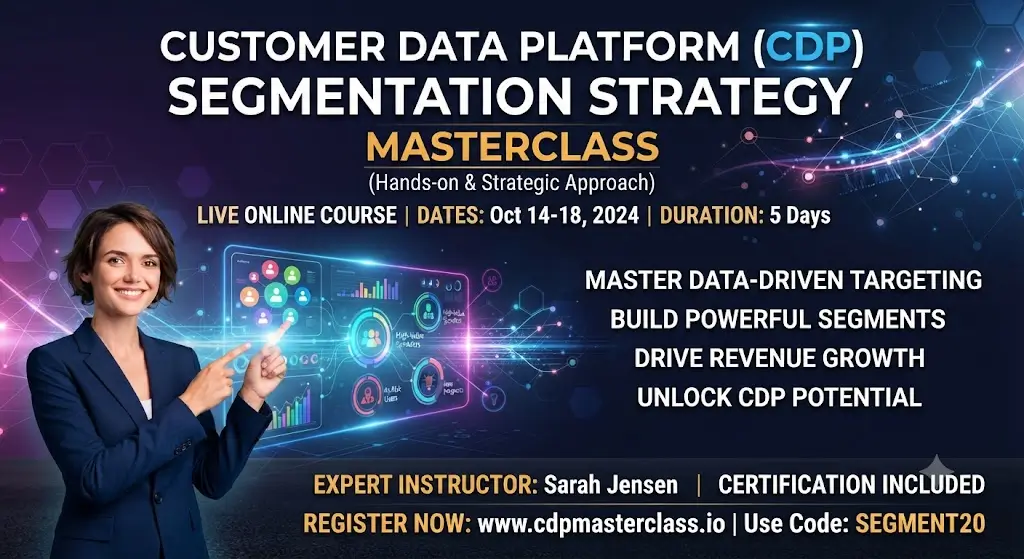
CDP Segmentation Strategy Masterclass
Master Customer Data Platform Segmentation
A strong CDP Segmentation Strategy helps organizations turn customer data into meaningful audiences that can support personalization, targeting, customer journeys, and marketing activation.
This masterclass provides a comprehensive learning experience for understanding how segmentation works within a Customer Data Platform and how businesses can develop structured, actionable customer segments.
Customer Data Platforms can unify information from different sources and provide capabilities for customer profiles, identity resolution, segmentation, audience building, and data activation.
What You Will Learn
Throughout this masterclass, learners will explore:
- Customer Data Platform fundamentals
- The role of segmentation within a CDP
- Customer profile and attribute-based segmentation
- Behavioral and activity-based segmentation
- Lifecycle segmentation
- Transactional and engagement-based segmentation
- Audience definition and audience building
- Segment rules and qualification criteria
- Inclusion and exclusion conditions
- Combining multiple segmentation criteria
- Segment evaluation and refinement
- Audience activation strategies
- Personalization and targeted customer experiences
- Suppression and exclusion audiences
- Cross-channel audience strategies
- Segment performance measurement
- Segmentation optimization
- Practical CDP segmentation workflows
Building a CDP Segmentation Framework
An effective segmentation strategy starts with a clear business objective.
Learners will explore a structured approach:
Business Goal → Customer Data → Profile Attributes → Behavioral Signals → Segment Criteria → Audience → Activation → Measurement → Optimization
This framework helps connect segmentation decisions with practical marketing objectives rather than creating customer groups without a clear purpose.
Customer Data and Profile Segmentation
The course explores how different customer data points can contribute to segmentation.
Examples include:
- Customer attributes
- Demographic information
- Purchase history
- Website behavior
- Product interactions
- Engagement activity
- Customer lifecycle stage
- Transactional information
- Campaign interactions
- Customer value indicators
CDP segmentation can use attributes and behaviors to distinguish subsets of customer profiles and create actionable audiences.
Behavioral and Lifecycle Segmentation
Go beyond static customer categories by exploring segmentation based on customer actions and lifecycle stages.
You will learn how to think about segments such as:
- New customers
- Engaged customers
- Repeat customers
- High-value customers
- Inactive customers
- Recently active visitors
- Product-interest audiences
- Cart or conversion-related audiences
- Re-engagement audiences
The goal is to create segments that reflect meaningful customer behaviors and marketing objectives.
Audience Building and Activation
Creating a segment is only one part of the process. The next step is determining how that audience can be used.
Learners will explore how CDP audiences can support:
- Email campaigns
- Advertising audiences
- Customer journeys
- Personalization
- Retargeting strategies
- Suppression strategies
- CRM engagement
- Analytics
- Cross-channel marketing
CDP platforms can evaluate audience segments and publish them to destinations such as advertising platforms, CRM systems, and other connected environments for targeting, suppression, personalization, or analytics use cases.
Segment Quality and Optimization
A segmentation strategy should be reviewed continuously.
This masterclass introduces ways to evaluate:
- Segment relevance
- Audience size
- Segment overlap
- Qualification rules
- Data quality
- Audience freshness
- Business usefulness
- Campaign performance
- Activation outcomes
Learners can use these considerations to refine segmentation rules and develop more useful customer audiences.
Practical CDP Segmentation Strategy
The masterclass emphasizes practical thinking rather than segmentation theory alone.
You will work through scenarios involving:
Customer Data → Segmentation Rules → Audience Creation → Activation → Measurement → Optimization
This helps learners understand how segmentation decisions can influence marketing execution and customer experience.
Who Should Take This Course?
This course is suitable for:
- Digital marketing professionals
- CRM professionals
- Marketing automation specialists
- Customer experience professionals
- Marketing analysts
- Data-driven marketers
- Customer data professionals
- Performance marketers
- Product marketers
- Marketing managers
- Business professionals working with customer data
It can also benefit learners who already understand basic digital marketing and want to develop more advanced customer segmentation skills.
Learning Outcomes
After completing the course, learners should be able to:
- Explain the role of segmentation within a Customer Data Platform
- Design a structured CDP segmentation strategy
- Identify useful customer attributes and behavioral signals
- Develop customer segment criteria
- Build audience concepts around business objectives
- Apply behavioral and lifecycle segmentation approaches
- Understand audience activation workflows
- Connect segmentation with personalization strategies
- Evaluate and refine customer segments
- Develop practical segmentation frameworks for marketing use cases
Why Learn CDP Segmentation Strategy?
Customer segmentation is a foundational capability for personalization, audience targeting, and customer engagement. CDP platforms can provide a unified environment where customer data and segmentation can support downstream marketing and customer experience activities.
Learning CDP Segmentation Strategy can therefore help professionals better understand how customer data can move from raw information to structured audiences and actionable marketing strategies.
Enroll in the CDP Segmentation Strategy Masterclass and build the knowledge required to design, evaluate, and apply customer segments in modern data-driven marketing environments.
Frequently Asked Questions
1. What is CDP segmentation strategy?
CDP segmentation strategy is the process of using Customer Data Platform information to classify customers into meaningful groups based on attributes, behaviors, activities, lifecycle stages, or other relevant criteria.
2. What will I learn in this CDP Segmentation Strategy Masterclass?
You will learn customer segmentation frameworks, behavioral segmentation, lifecycle segmentation, audience building, segment criteria, personalization, audience activation, measurement, and segmentation optimization.
3. Is this CDP segmentation course suitable for beginners?
Yes. The course can be useful for learners who understand basic marketing concepts and want to develop a structured understanding of Customer Data Platform segmentation.
4. How does a CDP help with customer segmentation?
A CDP can bring customer information from multiple sources into unified customer profiles and provide tools for creating segments based on attributes, behaviors, and activities.
5. What types of customer segments can be created using a CDP?
Depending on the platform and available data, segments can be based on customer attributes, behaviors, transactions, engagement, lifecycle stage, activities, and other profile signals.
6. What is the difference between customer segmentation and CDP segmentation?
Traditional customer segmentation may rely on data available within individual systems. CDP segmentation can use unified customer profiles and data from multiple sources to develop more connected audience definitions.
7. Can CDP segments be used for personalization?
Yes. CDP segments can support personalized experiences, targeted campaigns, customer journeys, and other engagement activities.
8. What is audience activation in a CDP?
Audience activation involves making a defined customer audience available to connected destinations or systems for activities such as targeting, suppression, personalization, or analytics.
9. Who should take this CDP Segmentation Strategy Masterclass?
The course is suitable for digital marketers, CRM professionals, marketing automation specialists, customer experience teams, marketing analysts, and professionals working with customer data.
10. What are the benefits of learning CDP segmentation?
Learning CDP segmentation can help professionals understand how to organize customer data into actionable audiences, develop targeted marketing strategies, support personalization, and improve audience planning.



Reviews
There are no reviews yet.