
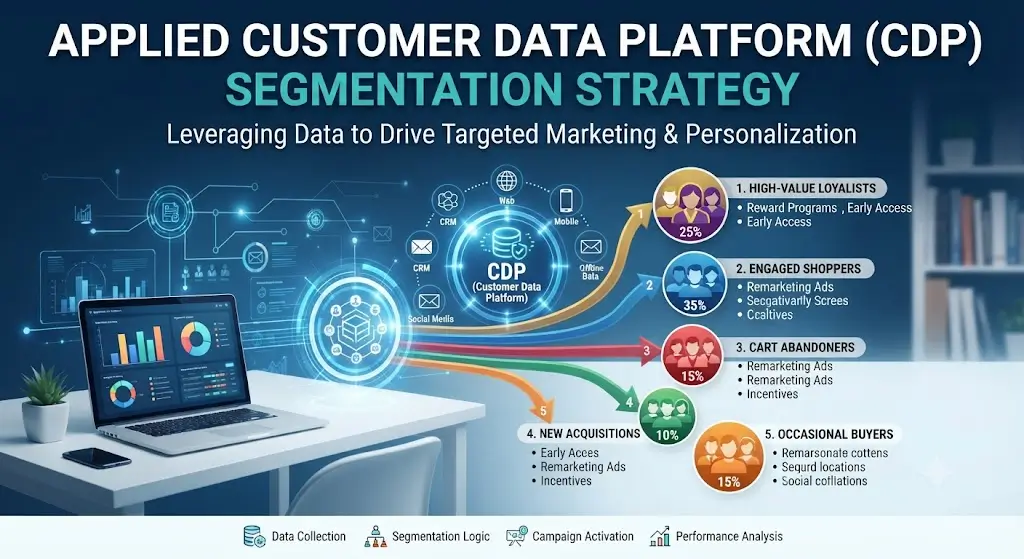
Applied Customer Data Platform (CDP) Segmentation Strategy
Customer Data Platforms can bring customer information together to support more connected marketing and customer experiences. However, collecting customer data is only the beginning. Marketers also need effective segmentation strategies to turn customer information into actionable audiences.
Applied Customer Data Platform (CDP) Segmentation Strategy focuses on the practical application of CDP segmentation for audience creation, targeting, personalization, and marketing activation.
The course helps learners understand how to move from customer data to meaningful segments and then connect those segments with practical marketing strategies.
What You Will Learn
CDP Segmentation Fundamentals
Build an understanding of how segmentation can be used within a Customer Data Platform to organize audiences based on meaningful customer characteristics and behaviors.
Learners explore:
- Customer profiles
- Customer attributes
- Behavioral data
- Engagement signals
- Purchase activity
- Lifecycle stages
- Audience criteria
- Segment definitions
Applied CDP Segmentation Strategy
Learn how to develop segmentation strategies based on specific marketing objectives.
A practical framework can include:
Business Goal → Customer Data → Segment Criteria → Audience → Activation → Measurement → Optimization
This approach helps learners connect segmentation decisions with actual marketing outcomes.
Customer Attribute Segmentation
Explore how customer characteristics can be used to create relevant audience groups.
Examples may include:
- Customer demographics
- Location
- Customer status
- Product interests
- Account characteristics
- Purchase attributes
- Other available first-party data
Behavioral Segmentation
Learn how customer behaviors can contribute to more actionable audience definitions.
Topics include:
- Website engagement
- Content interaction
- Product browsing
- Purchase behavior
- Email engagement
- App activity
- Repeat interactions
- Recent customer actions
Behavioral segments can help marketers create audiences based on what customers do rather than relying only on static attributes.
Customer Lifecycle Segmentation
Apply CDP segmentation to different stages of the customer journey.
Possible segments include:
- New customers
- Active customers
- Repeat customers
- High-engagement customers
- At-risk customers
- Lapsed customers
- Reactivation audiences
Learners can explore how lifecycle segments may support different messaging and marketing objectives.
Audience Building & Activation
Learn how defined customer segments can be translated into usable marketing audiences.
The course explores practical considerations around:
- Audience criteria
- Segment size
- Segment relevance
- Audience activation
- Campaign targeting
- Personalization
- Cross-channel marketing
Personalization Strategy
Understand how segmentation can support more relevant customer experiences.
Learners can explore how different audience segments may receive different:
- Messages
- Offers
- Content
- Product recommendations
- Campaign experiences
- Customer communications
Segment Evaluation
Creating a segment is not the end of the process. Learners can develop methods for reviewing whether a segment is useful and aligned with its intended purpose.
Evaluation areas may include:
- Segment size
- Segment quality
- Audience relevance
- Engagement
- Conversion behavior
- Campaign performance
- Changes over time
Practical CDP Segmentation Scenarios
The course emphasizes application through practical scenarios such as:
- Building a new-customer segment
- Creating a repeat-purchase audience
- Identifying highly engaged customers
- Developing a reactivation segment
- Creating behavior-based audiences
- Combining multiple segmentation criteria
- Evaluating segment performance
- Connecting segments with campaign objectives
Who Should Take This Course?
This course is suitable for:
- Digital marketing professionals
- CRM marketers
- Customer experience professionals
- Marketing analysts
- Data-driven marketers
- Performance marketers
- E-commerce marketers
- Marketing automation professionals
- Customer data professionals
- CDP practitioners
- Marketing managers
Learning Outcomes
After completing the course, learners can develop the ability to:
- Apply CDP segmentation strategies
- Define customer audience criteria
- Build meaningful customer segments
- Use behavioral and attribute-based segmentation
- Apply lifecycle segmentation concepts
- Connect customer segments with marketing objectives
- Develop audience activation strategies
- Support personalized marketing campaigns
- Evaluate segment quality and performance
- Optimize segmentation approaches based on campaign needs
Why Learn CDP Segmentation Strategy?
Customer data becomes more valuable when it can be transformed into useful audiences and actionable marketing strategies.
A practical understanding of CDP segmentation can help professionals move from simply collecting customer information toward using customer insights for targeting, personalization, engagement, and activation.
Applied Customer Data Platform (CDP) Segmentation Strategy provides a practical framework for developing and applying customer segmentation strategies in modern data-driven marketing environments.
Recommended Learning Path
CDP Basics → CDP Segmentation Strategy → Applied CDP Segmentation → CDP Activation & Personalization → CDP Masterclass
This course focuses on educational marketing and data-strategy concepts. Actual CDP capabilities, integrations, data availability, and privacy requirements can vary by platform and organization.
Frequently Asked Questions
1. What is a CDP segmentation strategy?
A CDP segmentation strategy is an approach to organizing customer data into meaningful audience groups based on attributes, behaviors, engagement, purchases, lifecycle stages, or other relevant criteria.
2. What will I learn in this CDP segmentation course?
You will learn practical approaches to customer segmentation, audience building, behavioral segmentation, lifecycle segmentation, personalization, activation, and segment evaluation.
3. Who should take this CDP segmentation course?
The course is suitable for digital marketers, CRM professionals, marketing analysts, e-commerce teams, customer experience professionals, and people working with customer data platforms.
4. What is Customer Data Platform segmentation?
Customer Data Platform segmentation involves using customer data and defined criteria to create audiences that can support targeted marketing, personalization, and customer engagement.
5. Does the course cover behavioral segmentation?
Yes. The course covers behavioral segmentation using customer actions such as website engagement, product interactions, purchases, content engagement, and other available behavioral signals.
6. Can CDP segmentation be used for personalization?
Yes. Customer segments can help marketers develop more relevant messages, content, offers, and campaign experiences for different audience groups.
7. Does the course cover customer lifecycle segmentation?
Yes. Learners explore lifecycle-based audiences such as new, active, repeat, at-risk, lapsed, and reactivation customer segments.
8. Is this course practical or theoretical?
The course is application-focused and uses practical frameworks and scenarios to help learners apply CDP segmentation concepts to marketing situations.
9. What skills can I develop from this course?
Learners can develop skills in audience definition, customer segmentation, behavioral analysis, lifecycle segmentation, personalization, activation, and segment evaluation.
10. Do I need prior CDP experience?
Basic knowledge of digital marketing, customer data, or CRM concepts can be helpful, but the course focuses on practical segmentation strategy and application.



Reviews
There are no reviews yet.