
INTRODUCTION
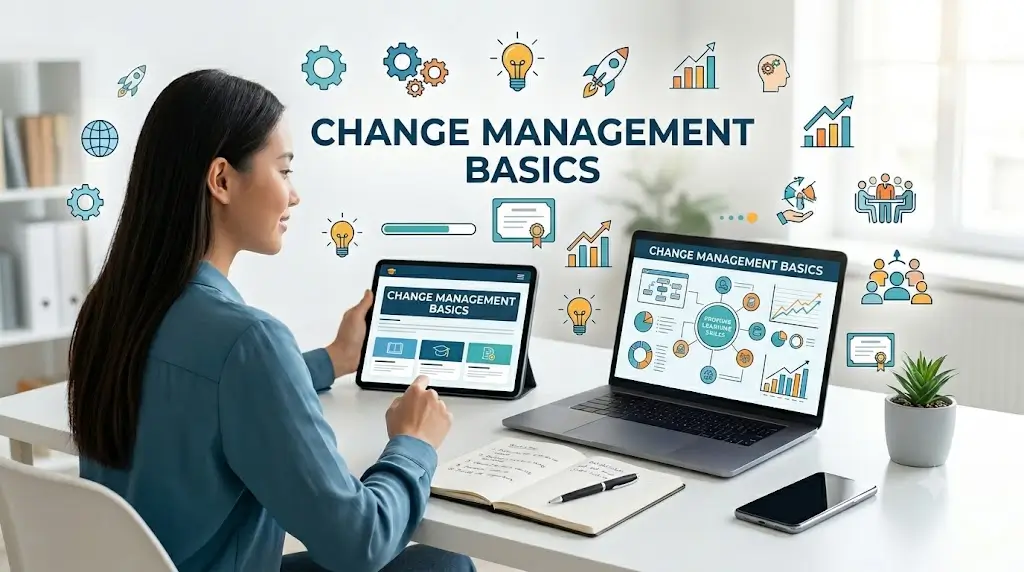
The Change Management Basics Course is a structured beginner-level program designed to help learners understand how organizations manage transitions, transformations, and changes in business processes, systems, and structures. Change management is a critical discipline that ensures smooth adaptation while minimizing disruption to productivity and employee performance.
In today’s dynamic business environment, organizations must continuously evolve to stay competitive. Therefore, effective change management is essential for successful implementation of new strategies, technologies, and processes.
This course introduces learners to the principles and practices used to manage change effectively in real-world organizations.
WHAT IS CHANGE MANAGEMENT?
Change management is the process of preparing, supporting, and helping individuals and organizations adapt to change.
Additionally, it focuses on minimizing resistance and ensuring smooth transitions during organizational changes.
A strong change management approach improves employee acceptance and organizational success.
COURSE OVERVIEW
This course provides a clear understanding of how organizations implement and manage change initiatives.
Learners will explore how companies plan change, communicate updates, and support employees during transitions.
Moreover, the course explains how leadership plays a key role in guiding successful change.
As a result, learners gain practical knowledge of managing organizational transformation effectively.
WHY CHANGE MANAGEMENT IS IMPORTANT
Change management is important because organizations constantly face internal and external changes.
Moreover, without proper management, change can lead to confusion, resistance, and reduced productivity.
Consequently, businesses with strong change management practices adapt faster and perform better.
This course helps learners understand why structured change processes are essential for success.
TYPES OF ORGANIZATIONAL CHANGE
Organizations experience different types of change:
Structural Change
Changes in hierarchy, roles, or organizational structure.
Technological Change
Implementation of new systems or digital tools.
Process Change
Improvements in workflows and operations.
Cultural Change
Shifts in workplace values, behavior, and mindset.
CHANGE PLANNING
Change planning involves defining objectives, timelines, and strategies for implementing change.
This section explains how organizations prepare structured plans to ensure smooth transitions.
Additionally, planning reduces risks and improves execution success.
RESISTANCE TO CHANGE
Employees often resist change due to fear, uncertainty, or lack of understanding.
This section explains why resistance occurs and how organizations address it effectively.
Moreover, communication and leadership play a key role in overcoming resistance.
LEADERSHIP IN CHANGE MANAGEMENT
Leadership is essential for guiding teams through change.
This section explains how leaders influence employee behavior and encourage acceptance.
Additionally, strong leadership ensures alignment with organizational goals.
COMMUNICATION STRATEGIES
Effective communication is critical during change initiatives.
This section explains how organizations communicate changes clearly and consistently.
Moreover, transparent communication reduces confusion and builds trust.
IMPLEMENTATION PROCESS
Change implementation involves executing planned strategies in a structured manner.
This section explains how organizations roll out changes step by step.
Additionally, monitoring and feedback help improve outcomes.
SKILLS YOU WILL GAIN
After completing this course, learners will develop:
Change management skills
Leadership understanding
Communication skills
Organizational planning ability
Problem-solving skills
Employee management awareness
Strategic thinking ability
Adaptability skills
Decision-making skills
Business transformation understanding
BENEFITS OF THE COURSE
The Change Management Basics Course helps learners understand how organizations handle transitions effectively. Additionally, it improves leadership and communication abilities.
Furthermore, change management skills are highly valuable in HR, management, consulting, and corporate transformation roles.
Benefits include:
Strong understanding of organizational change
Improved leadership capabilities
Better communication skills
Career opportunities in management roles
Enhanced adaptability
Business transformation knowledge
Industry-relevant skills
Future-ready leadership mindset
WHO SHOULD ENROLL
This course is suitable for:
Students
HR professionals
Managers
Team leaders
Business learners
Entrepreneurs
Corporate employees
Consultants
Management aspirants
Career changers
CAREER OPPORTUNITIES
After completing this course, learners may pursue roles such as:
Change Management Assistant
HR Change Coordinator
Business Transformation Assistant
Organizational Development Trainee
Management Support Executive
Project Change Assistant
Operations Change Analyst
Corporate Training Assistant
Business Process Consultant Trainee
Leadership Support Executive
CERTIFICATION DETAILS
Upon successful completion of the Change Management Basics Course, learners receive a certification recognizing their understanding of organizational change, leadership strategies, and transformation management.
CONCLUSION
The Change Management Basics Course provides a strong foundation in managing organizational transitions and business transformation. It helps learners understand how companies successfully adapt to change while maintaining performance.
Therefore, mastering change management skills opens valuable career opportunities in HR, management, consulting, and corporate leadership roles.
FAQ SECTION
1. What is Change Management Basics Course?
It is a beginner-level course that teaches organizational change and transformation.
2. Who should take this course?
This course is suitable for students, managers, and HR professionals.
3. Do I need experience?
No, it is beginner-friendly.
4. What will I learn in this course?
You will learn change planning, leadership, and communication strategies.
5. Why is change management important?
It helps organizations adapt smoothly to changes.
6. Is this useful for HR careers?
Yes, it is highly valuable in HR and management roles.
7. Will I learn leadership skills?
Yes, leadership in change is included.
8. Does it include communication strategies?
Yes, communication is a key part.
9. Will I get a certificate?
Yes, a completion certificate is provided.
10. Is this useful for career growth?
Yes, it supports management and corporate careers.


Reviews
There are no reviews yet.